Content Readability: Writing for Scanning, Not Scoring
Readability scores aren't a Google ranking factor, but the behaviour they measure — short sentences, clear structure — drives the dwell time and engagement that do influence rankings.
Readability isn’t a Google ranking factor by itself, but the behaviours it produces are: content people can scan, find their answer in, and stay on has better dwell time and lower pogo-sticking back to the results page, and those engagement patterns feed the quality signals Google does weigh. The goal isn’t a Flesch score. The goal is a page a reader can extract value from in the first ten seconds, whether they’re reading top to bottom or scanning for one specific answer.
The confusion comes from readability tools reporting a single number and content teams treating that number as the target instead of the proxy it actually is. A 70+ Flesch score with no real structure underneath it doesn’t help. A page organized around scannable headings, short paragraphs, and answer-first sections helps regardless of what the score says.
Is readability actually a ranking factor?
Google has never listed a readability score among its ranking signals, and multiple independent tests confirm that manipulating Flesch Reading Ease alone, without changing anything else about a page, produces no ranking movement. What the research does show is a correlation: pages scoring in the 60-70 range on Flesch Reading Ease generate meaningfully more engagement and leads than dense, jargon-heavy pages, and top-ranking pages across competitive niches average a Flesch score around 51-53 — solidly in the “fairly difficult” range, not the simplest tier.
That average matters. It means the goal isn’t maximum simplicity. It’s matching the complexity of the writing to what the audience actually needs, while removing the unnecessary friction — long unbroken paragraphs, buried answers, unnecessarily complex sentence construction — that has nothing to do with the topic’s real difficulty.
How do you write for scanning instead of scoring?
Scanning behavior is well documented: readers entering a page from a search result skim headings and the first line of each paragraph before deciding whether to read linearly. Writing for that behavior means structuring content so the skim alone delivers value, not just the full read.
| Writing for a score | Writing for scanning |
|---|---|
| Shortens sentences uniformly regardless of content | Varies sentence length; short for key claims, longer for nuance |
| Targets a Flesch number as the deliverable | Targets “can a skimmer find the answer in 10 seconds” |
| Adds bullet points to break up any paragraph | Uses bullets only for genuinely listable information |
| Simplifies vocabulary regardless of audience | Matches vocabulary to what the specific audience already knows |
| Puts the answer wherever it fits narratively | Puts the direct answer in the first 1-2 sentences of a section |
What five structural habits actually improve scanability?
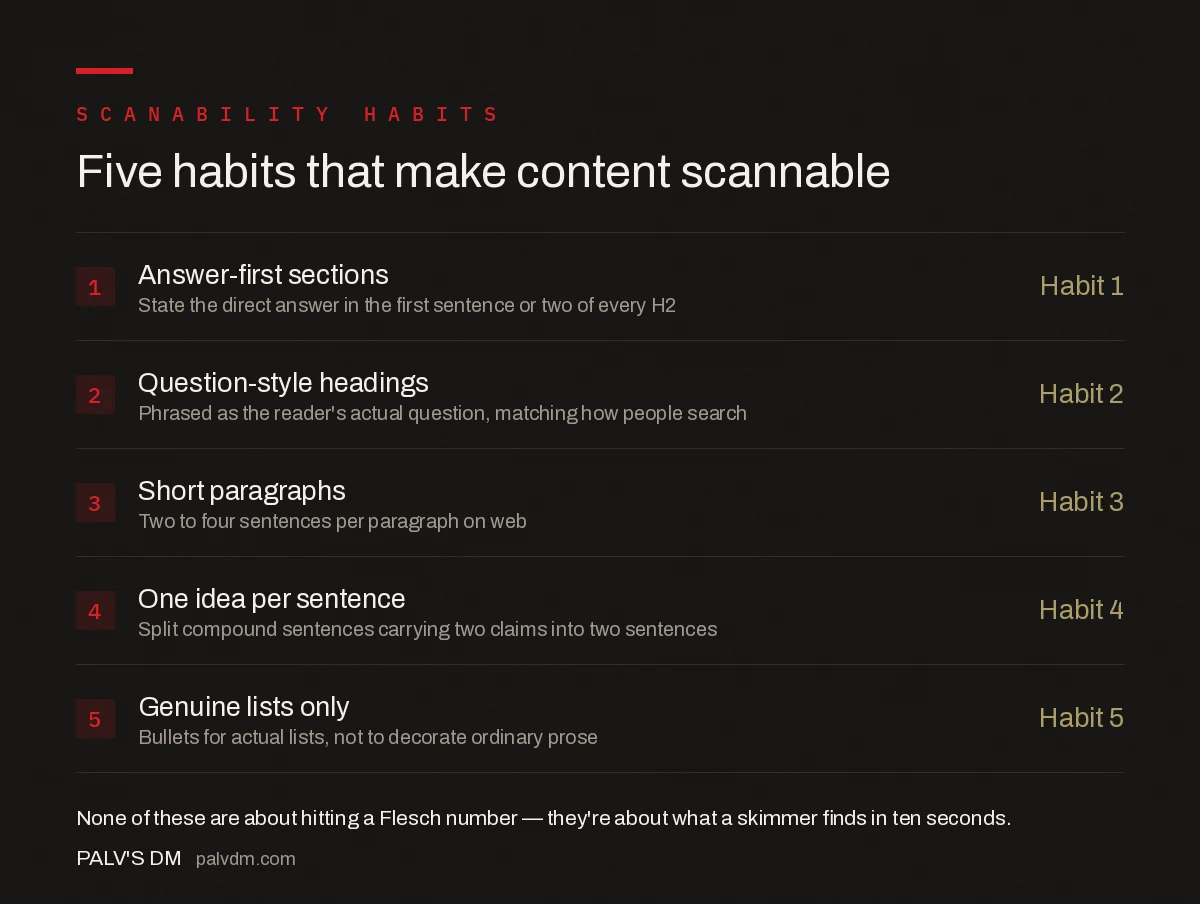
Five habits that make content scannable
- Answer-first sections — State the direct answer in the first sentence or two of every H2, before the supporting detail.
- Question-style headings — Headings phrased as the reader’s actual question are easier to scan against and match how people search.
- Short paragraphs — Two to four sentences per paragraph on web; a wall of text gets skipped, not read closely.
- One idea per sentence — Split compound sentences carrying two claims into two sentences, even if it costs some flow.
- Genuine lists, not decorative ones — Use bullets for information that’s actually a list (steps, options, criteria), not to break up prose that isn’t list-shaped.
How do you balance simplicity with genuine expertise?
The mistake teams make chasing readability scores is conflating “simple sentences” with “simple thinking.” A technical claim doesn’t get less accurate by being stated in a shorter sentence — it usually gets more precise, because the writer has to decide what the sentence is actually claiming instead of hedging across three clauses. Expertise shows up in specificity: a named tool, an exact threshold, a concrete example, not in sentence length. Readable writing and substantive writing aren’t in tension; verbose writing and substantive writing often are, because unnecessary words are exactly where vague thinking hides.
How does readability affect how AI systems cite content?
Content structured for scanning — a direct answer near the top of a section, a clearly labeled list, a genuine comparison table — is also easier for AI systems generating search summaries to extract and quote accurately. A paragraph that buries its actual claim in the middle of a long sentence, three clauses deep, is harder for an extraction system to pull cleanly, and more likely to be paraphrased incorrectly or skipped in favor of a competitor’s more clearly stated version of the same fact.
How do you measure readability without over-relying on the score?
A readability tool is useful as a smoke detector, not a thermostat. Run a draft through one, and treat any score wildly outside your normal range as a prompt to look closer, not as an instruction to mechanically rewrite until the number moves. If a technical explainer scores in the “very difficult” range because it’s dense with necessary terminology, that’s expected — the fix isn’t simplifying the terminology out, it’s making sure each term is introduced clearly the first time it appears.
A more useful test than any automated score is the ten-second scan: open the page, look at it for ten seconds the way a search visitor would, and ask what you actually absorbed. If the answer is “nothing specific,” the structure needs work regardless of what the Flesch number says. If the answer is a clear, correct summary of the section’s point, the structure is doing its job even if the score isn’t impressive.
How does paragraph and sentence rhythm affect reading experience?
Uniform sentence length is its own readability problem, even when every individual sentence is short. A page where every sentence runs eight to twelve words reads in a flat, monotone rhythm that’s tiring in a different way than long sentences are. Varying length deliberately — a short sentence to land a point, followed by a longer one that adds context or a caveat — mirrors how people actually speak and think, and keeps a reader’s attention through a section longer than uniform short sentences do.
The same logic applies to paragraph length. Three short paragraphs in a row, each making one small point, can feel choppy and disconnected if there’s no throughline between them. Grouping genuinely related points into one paragraph, and only breaking to a new one when the idea actually shifts, keeps structure legible without fragmenting the argument into disconnected fragments.
What readability mistakes hurt more than they help?
- Over-simplifying technical audiences. Explaining a term a practitioner-level reader already knows adds length without adding value, and reads as padding.
- Fragmenting sentences until they lose connection. Cutting every sentence to under ten words regardless of content produces choppy, disconnected prose that’s harder to follow than moderate-length sentences with clear logic.
- Bullet-pointing everything. Converting narrative explanation into bullets removes the connective reasoning between ideas, which sometimes is the point being made.
- Ignoring structure while chasing a score. A low Flesch score with no headings, no short paragraphs, and no visual hierarchy still reads as dense, regardless of vocabulary simplicity.
Frequently asked questions
Is readability score a Google ranking factor?
No, not directly. Google has never confirmed Flesch Reading Ease or any similar score as a ranking input. What readability affects is user behaviour — dwell time, bounce rate, scroll depth — and those behavioural signals are things Google’s systems do account for when judging content quality.
What Flesch Reading Ease score should a blog post target?
Analysis of top-ranking pages puts the average around 51-53, which corresponds to a 10th-to-12th-grade reading level — more accessible than academic writing but not aimed at children’s content. Match the score to your actual audience rather than chasing a universal target.
Does writing simpler sentences hurt content depth?
No. Sentence length and information density are separate variables. A short sentence can carry a precise, technical claim; the skill is putting one idea per sentence and cutting the connective filler between them, not removing substance.
Do bullet points and short paragraphs actually help rankings?
Indirectly. Google’s own content guidelines call for organizing content with clear structure and headings to help users navigate. That structure improves scanability and time-on-page, and pages built for scanning are also easier for AI systems to extract and cite accurately.
Sources
- Creating Helpful, Reliable, People-First Content — Google Search Central
- On-Page SEO: The Complete Checklist
- Heading Hierarchy: Structuring a Page for Readers and Machines
- Where to Place Your Keyword on a Page (And Where Not To)
Want this done on your site?
Every PalV’s DM engagement starts with a free audit of your actual website — a 12-point
crawl covering what is blocking indexation, on-page gaps against your primary keywords, speed
findings, and the three to five fixes worth making first. Delivered in two working days. No
payment details, and the findings are yours whether you hire us or not.