Service Support — One-Time Services
What a Content Strategy Deliverable Contains
A content strategy service deliverable includes an audit, topic map, gap analysis, prioritised calendar, and content briefs — here's exactly what to expect.

A content strategy service deliverable is a written plan, not a stack of blog posts. At minimum, expect five things: a content audit of what you already have, a keyword-to-topic map organised into pillars and clusters, a gap analysis showing what competitors cover that you don’t, a prioritised editorial calendar mapped to funnel stage, and a set of content briefs the writing team will actually work from. If a content strategy service quote doesn’t include at least the audit, the topic map, and the prioritised calendar, you’re buying a keyword list with a fancier name on the invoice.
Key takeaway
- A content strategy deliverable is a plan and a priority list, not the content itself — writing is almost always a separate line item.
- The core components are an audit, a topic/keyword map, a gap analysis, a prioritised calendar, and briefs — a spreadsheet of keywords alone is not a content strategy.
- Scope varies a lot by agency, so get the exact deliverable list, format, and timeline confirmed in writing before you pay anything.
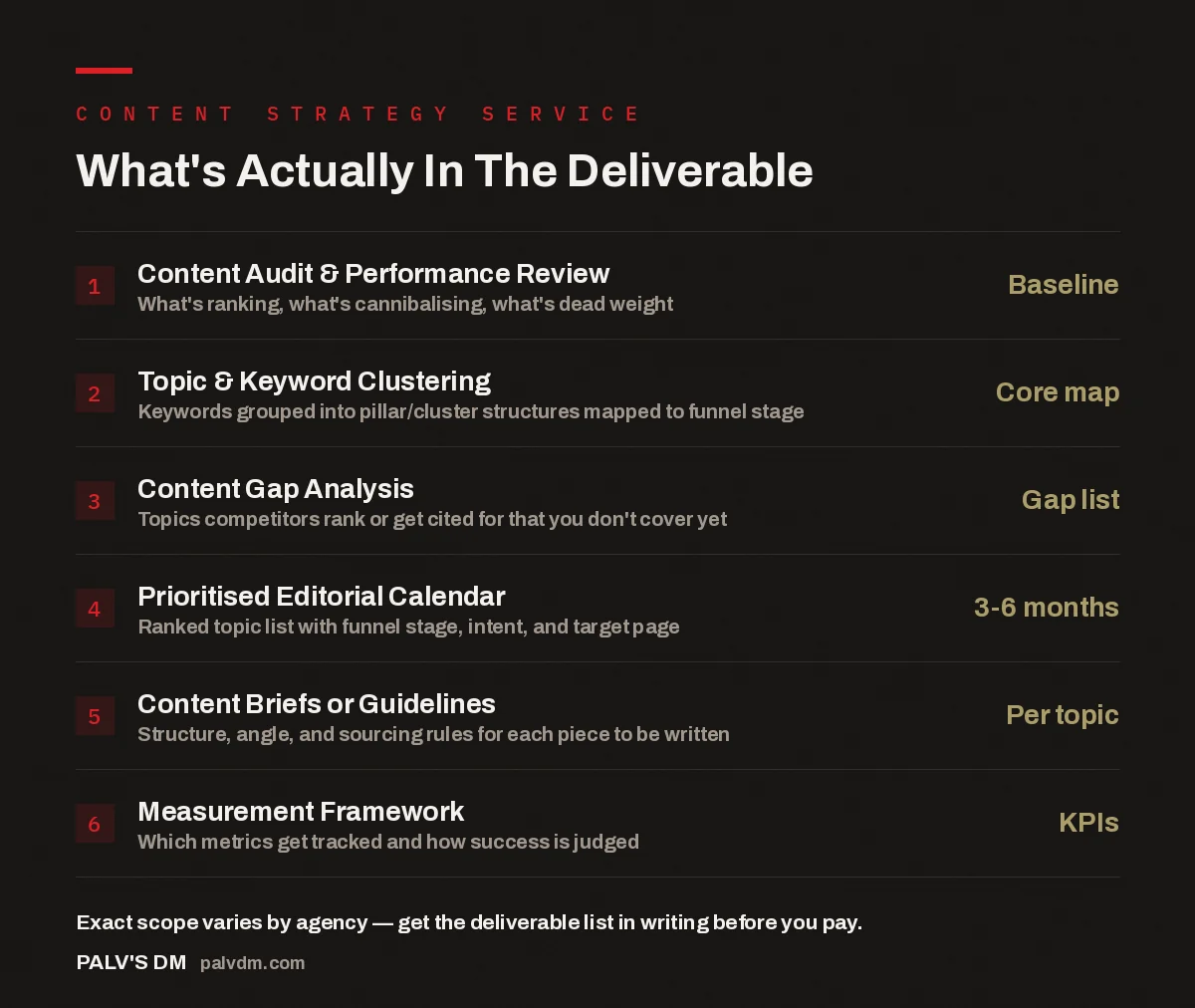
What’s Actually In The Deliverable
- Content Audit & Performance Review — Baseline. What’s ranking, what’s cannibalising, what’s dead weight.
- Topic & Keyword Clustering — Core map. Keywords grouped into pillar/cluster structures mapped to funnel stage.
- Content Gap Analysis — Gap list. Topics competitors rank or get cited for that you don’t cover yet.
- Prioritised Editorial Calendar — 3-6 months. Ranked topic list with funnel stage, intent, and target page.
- Content Briefs or Guidelines — Per topic. Structure, angle, and sourcing rules for each piece to be written.
- Measurement Framework — KPIs. Which metrics get tracked and how success is judged.
What Does “Content Strategy” Actually Mean as a Paid Service?
Content strategy, sold as a standalone deliverable, is the layer of thinking that sits between “we should probably write more” and an actual publishing schedule. It’s not content marketing (which is the ongoing execution) and it’s not copywriting (which is the sentence-level craft). It’s the decision-making step: which topics matter, in what order, aimed at which stage of the buyer’s journey, and why. Agencies that sell it as a one-time service are packaging that decision-making into a document you can hand to any writer — internal or freelance — and get consistent output from.
That distinction matters when you’re comparing quotes. Some vendors label a simple keyword list “content strategy” because it’s easier to sell than an audit. A real deliverable ties every recommended topic back to a reason: a keyword with commercial intent your site doesn’t rank for, a question competitors answer and you don’t, or a gap that’s actively costing you visibility in AI-generated answers as much as in classic search results.
What Happens During the Content Audit Stage?
The audit comes first because you can’t prioritise new content sensibly without knowing what already exists. In practice, this stage pulls every indexed page on the site, checks which ones get traffic and which ones don’t, and flags three kinds of problems: pages that compete with each other for the same keyword (cannibalisation), pages that were relevant two or three years ago but are now outdated, and topics with multiple thin pages that would perform better consolidated into one strong one.
The output isn’t a narrative report — it’s a working list with a decision against each URL: keep as-is, refresh, merge, or retire. This list matters more than most buyers expect, because a large share of the “new content” a strategy recommends often turns out to be existing content that needs rework rather than a blank page.
How Is the Topic and Keyword Map Built?
Once the audit is done, keywords get grouped into clusters — a pillar topic (broad, high-intent) surrounded by supporting subtopics that each target a narrower question or keyword variant. Each cluster is then tagged by funnel stage (awareness, consideration, decision) and by intent (informational, commercial, transactional), so the calendar that comes out of it isn’t just “what to write” but “what to write, and what job that piece is doing for the business.”
If you’ve already bought a standalone keyword research project, this stage builds directly on that raw data rather than starting over — see What You Receive From a Paid Keyword Research Project for what typically feeds into this step. Content strategy without an underlying keyword dataset tends to be opinion dressed up as planning; with one, the clustering has something concrete to organise.
What Does the Final Deliverable Document Look Like?
Format varies by agency, but the substance is usually a shared spreadsheet or document containing the prioritised topic list, plus a set of content briefs for the highest-priority items. A brief is not the article — it’s the instructions for writing it: target keyword, search intent, recommended structure, competing pages to review, internal links to include, and any specific angle the strategy calls for. Briefs are what separates a strategy from a topic list; without them, whoever writes the content is guessing at structure and depth on every single piece.
Some deliverables also include a short rationale document explaining the prioritisation logic — why topic four comes before topic twelve — so the reasoning survives even if the person who built the strategy isn’t around six months later to explain it verbally.
The biggest tell that a content strategy deliverable is padding is when the priority order isn’t explained. If nobody can tell you why topic twelve comes before topic three, there wasn’t much strategy involved — it’s a keyword list with a cover page.
Palash, Founder, PalV’s DM
What’s Usually Not Included in the Scope?
Three things routinely get assumed and then billed separately: the writing itself, design or graphic work for the pieces, and ongoing publishing or CMS upload. A content strategy service tells you what to write and why — it doesn’t hand you finished articles unless the quote explicitly says so. Ongoing rank tracking and ranking monitoring after publication is also typically out of scope for a one-time deliverable; that’s retainer territory.
This is also why content strategy rarely stands alone in the order you buy services. It usually follows an audit and sits before the writing gets commissioned — see The Order to Buy One-Time Services In for how it fits against technical checks and keyword research if you’re assembling a stack of one-off purchases rather than a retainer. And once the strategy document exists, executing against it is its own separate step — Turning an Audit Into a Prioritised Action Plan covers how a static document like this gets converted into weekly or monthly work.
How Long Does a Content Strategy Engagement Usually Take?
Timelines depend heavily on site size and how much existing content needs auditing, but the pattern that shows up repeatedly is somewhere in the range of two to four weeks from kickoff to a finished, reviewable document — longer for sites with hundreds of existing pages that need auditing individually, shorter for newer sites with a handful of pages and no cannibalisation to untangle. Ask upfront how many revision rounds are included; a strategy document you can’t push back on before it’s finalised is worth less than one you can iterate on with the person who built it.
Should You Buy Content Strategy as a One-Time Service or Roll It Into a Retainer?
A one-time content strategy purchase makes the most sense when you have a writing capability already — in-house, freelance, or another agency — but no clear direction for it. You’re buying the thinking, not the execution. It makes less sense if you don’t have anyone lined up to act on the briefs; a strategy document that sits unused for six months loses most of its value, because the competitive landscape it was built against will have shifted by the time anyone gets to topic three.
If you’re still deciding between a standalone purchase and folding this into a broader retainer, When a One-Time SEO Service Beats a Retainer walks through the trade-off in more detail — content strategy is one of the clearer cases where the answer depends entirely on whether execution capacity already exists on your side.
Get the scope in writing
If you want a content strategy deliverable that names every topic, prioritises it, and hands you briefs you can act on immediately, we scope it as a fixed, standalone project.
Frequently Asked Questions
What’s the difference between a content strategy and a content calendar?
A content calendar is just the schedule — dates and titles. A content strategy is the reasoning behind that schedule: the audit, the keyword clustering, the gap analysis, and the priority order that decided which titles made the calendar and in what sequence. You can hand someone a calendar without a strategy; it just won’t hold up when priorities need defending.
Does a content strategy service include the actual writing?
Usually not, unless the quote says so explicitly. The standard deliverable is the audit, topic map, gap analysis, prioritised calendar, and briefs — the instructions for writing, not the writing itself. Some agencies bundle writing as an add-on or a follow-on retainer; confirm which one you’re getting before you sign anything.
How many topics does a typical content strategy deliverable cover?
This varies with the size of the gap analysis and how many months of publishing the calendar is meant to cover, so there’s no fixed number worth quoting. What matters more than the count is whether every topic on the list is tied to a specific keyword, gap, or business reason — a long list of untethered ideas is weaker than a short list you can defend.
Can I use a content strategy deliverable with my own in-house writing team?
Yes — that’s one of the most common reasons to buy it as a standalone service rather than a retainer. The briefs are written to be handed to any competent writer, in-house or freelance, without the strategist needing to be involved in execution. Just confirm the briefs include enough structural detail that a writer unfamiliar with your niche could still follow them.
How is content strategy different from an SEO audit?
An SEO audit typically covers technical health, on-page issues, and site structure across the whole site. Content strategy is narrower and forward-looking — it focuses specifically on what to publish or fix next, using a content audit as one input among several. Many agencies run a content audit as the first phase of a content strategy engagement rather than treating it as a separate technical audit.
Short version: a content strategy service deliverable is an audit, a topic and keyword map, a gap analysis, a prioritised calendar, and content briefs — not finished articles. If a quote skips straight to a list of titles with no audit or gap analysis behind it, ask what the priority order is based on before you pay for it.