Entity SEO: How to Become an Entity AI Engines Recognise
AI engines match questions to entities, not keywords. Entity SEO makes your brand a defined thing engines recognise and recommend. How to build entity recognition, step by step.
Entity SEO is the practice of getting search and AI engines to recognise your brand, people and products as distinct, well-defined “entities” — real things with known attributes and relationships — rather than as strings of text. It matters because AI engines match questions to entities, not keywords. When someone asks an engine to recommend a company in your category, it draws on what it understands about the entities in that space. If your brand isn’t a clear entity, you’re not in the running. This guide explains what entities are and how to become one the engines recognise.
Key takeaway
- An entity is a distinct, defined thing — a brand, person, product or concept — that engines understand with attributes and relationships, not just as a keyword string.
- Engines increasingly reason about entities, so being a recognised entity is what gets your brand into “recommend a X” style AI answers.
- You build entity recognition through consistent naming, structured data, authoritative third-party mentions, and clear associations with your topic.
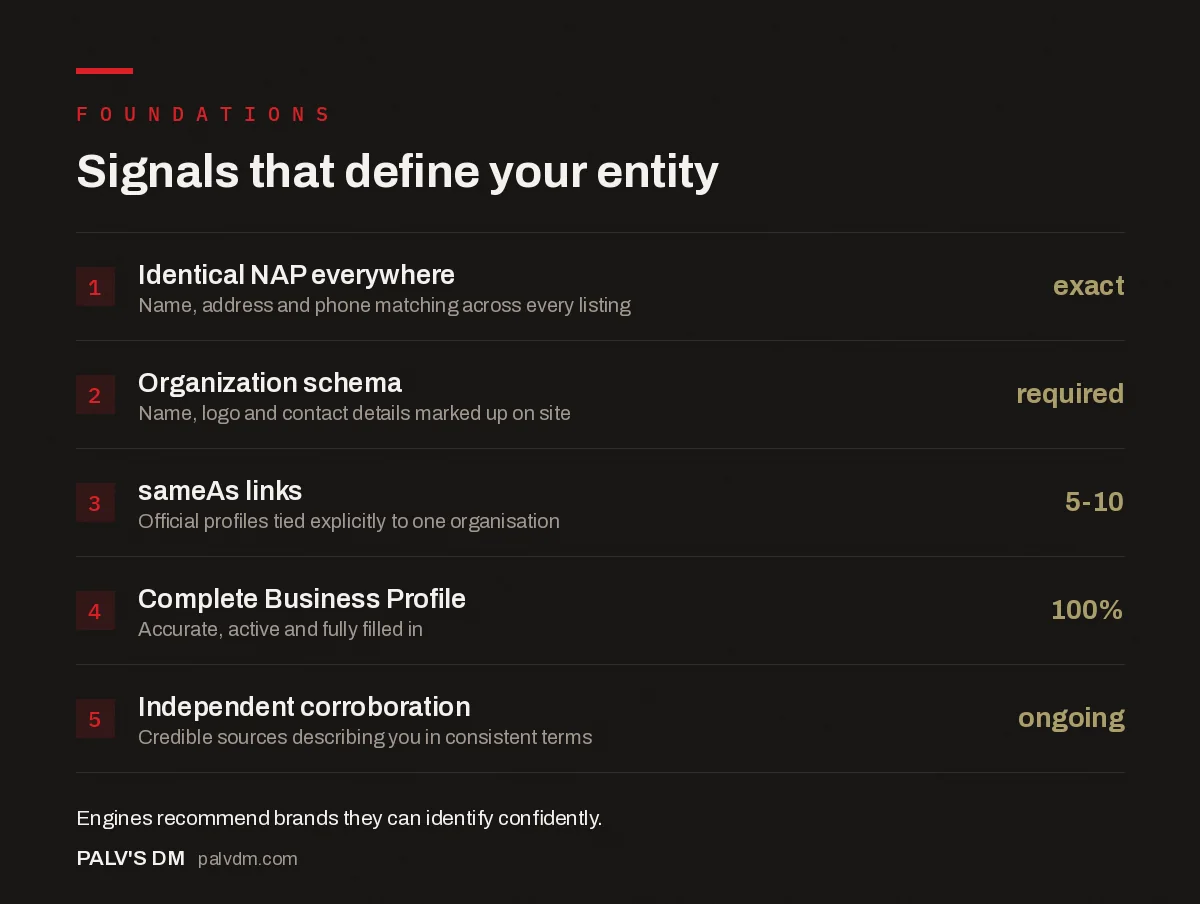
Signals that define your entity
- Identical NAP everywhere — exact. Name, address and phone matching across every listing.
- Organization schema — required. Name, logo and contact details marked up on site.
- sameAs links — 5-10. Official profiles tied explicitly to one organisation.
- Complete Business Profile — 100%. Accurate, active and fully filled in.
- Independent corroboration — ongoing. Credible sources describing you in consistent terms.
What is an entity in SEO?
An entity is a uniquely identifiable thing — a specific company, person, place, product or concept — that a search or AI engine understands as a distinct object with its own attributes and relationships, independent of the exact words used to describe it. Google formalised this idea with its Knowledge Graph, which stores entities and the facts connecting them. “PalV’s DM,” “digital marketing,” and “GEO” are entities; the engine knows what each is and how they relate.
The contrast is with keyword-based matching, where the engine only sees strings of characters. Entity-based understanding lets an engine know that a brand is a company, that it operates in a particular field, that it’s associated with certain topics and people, and that it’s distinct from a similarly-named business elsewhere. That understanding is what modern retrieval and generation increasingly run on.
Why entities matter more in the AI era
AI answer engines reason about the world in terms of entities and their relationships. When someone asks “which SEO agencies specialise in AI visibility in India,” the engine isn’t matching that string against pages — it’s drawing on its understanding of which entities are agencies, which operate in India, and which are associated with AI visibility, then assembling an answer from the entities that fit.
If your brand is a well-defined entity with clear associations to your category, you’re a candidate for that answer. If your brand is just a fuzzy string the engine has seen a few times with no clear attributes, it can’t confidently place you in the set, and it leaves you out. Entity clarity is increasingly the difference between being recommendable and being invisible in generative answers.
Entities > strings
Google’s foundational framing since the Knowledge Graph launched: search moved from matching “strings” of text to understanding “things” — entities with attributes and relationships. AI answer engines inherit and extend that entity-centric model when deciding which brands to name.
Source — Google Knowledge Graph, “things not strings”
How engines learn what your brand is
Engines assemble their understanding of an entity from many signals across the web, not from your website alone. They read how you describe yourself, but they weigh just as heavily how third parties describe you — the consistency of your name and details across directories, the topics you’re mentioned alongside, the people and organisations you’re linked to, and any structured data you provide that spells out the facts explicitly.
The more consistent and corroborated these signals are, the more confidently the engine forms a clear entity. Contradictory names, missing details, and thin third-party presence leave the entity blurry, and a blurry entity doesn’t get confidently recommended.
How to build entity recognition
- Be relentlessly consistent with your name and details. Use the exact same brand name, spelling, address and description everywhere — your site, social profiles, directories, review platforms. Inconsistency splits your entity into fragments the engine can’t confidently merge.
- Implement Organization and Person schema. Structured data tells engines the facts explicitly: what your organisation is, who its people are, what it does, how to reach it, which profiles belong to it. Use the sameAs property to link your official profiles, so the engine can connect the dots between your presence across the web.
- Build authoritative third-party corroboration. Mentions on trusted sites — trade publications, review platforms, Wikipedia if you genuinely qualify, industry directories — confirm your entity’s existence and attributes from outside your own domain. Engines trust corroborated facts far more than self-description.
- Associate your entity clearly with your topic. Publish depth in your specialism so the engine repeatedly sees your brand alongside your core topics. Consistent topical association is how you become the entity linked to “AI visibility” rather than a generic agency string.
- Claim and complete your knowledge-panel presence. Where a Google Knowledge Panel exists for your brand, claim it and keep its facts accurate. It’s the most visible expression of how the engine models your entity.
Entities for your people, not just your brand
Author and founder entities matter as much as the company entity. AI engines weigh authorship when deciding whether to trust content, and a credentialed, recognisable author who is a clear entity — with a consistent name, a real bio, external corroboration, and links between profiles — lends citation trust to everything they publish. For a founder-led agency, building the founder as a recognised entity in the category is among the highest-leverage entity work you can do.
Frequently asked questions
What is the difference between an entity and a keyword?
A keyword is a string of text the engine matches literally. An entity is a distinct real-world thing — a brand, person or product — that the engine understands with its own attributes and relationships, independent of exact wording. Keyword matching asks “does this text appear?”; entity understanding asks “what is this thing and how does it relate to others?” AI engines increasingly reason with entities.
How do I make my brand a recognised entity?
Be perfectly consistent with your name and details everywhere, implement Organization and Person schema with sameAs links to your profiles, earn authoritative third-party mentions that corroborate your facts, and publish depth that repeatedly associates your brand with your core topic. Consistency plus corroboration plus clear topical association is what turns a fuzzy string into a confident entity.
Does entity SEO require a Wikipedia page?
No, but Wikipedia is a strong corroborating signal if your organisation genuinely meets its notability standards. Don’t force one. You can build a clear entity through consistent details, structured data, review-platform and directory presence, trade-press mentions, and topical depth. Wikipedia helps when it’s warranted; it isn’t a prerequisite for being recognised as an entity.
Why does entity clarity affect AI recommendations?
Because AI engines assemble “recommend a X” answers from their understanding of which entities fit the criteria. A well-defined entity with clear category associations is a confident candidate; a fuzzy string with no clear attributes can’t be placed in the set and gets left out. Entity clarity is what makes your brand eligible to be named in generative recommendations.
The bottom line
Entity SEO is how you go from being text an engine has seen to being a thing an engine understands. Name yourself consistently, spell out your facts with structured data, earn corroboration from trusted third parties, and associate your brand and your people clearly with your topic. Do that and you become an entity the engines can confidently recommend — which is the entry ticket to being named in AI answers at all.
We build brand and founder entities that AI engines recognise and recommend, as part of our AI Visibility service.