Sitelinks: What Influences Them and What Doesn’t
Sitelinks are algorithmic, not something you can request or buy. Here's what actually influences whether Google shows them, myth by myth.

Sitelinks — the extra links Google sometimes shows under a top result, pointing to a site’s key pages — are generated entirely by algorithm, and there is no way to request, buy, or directly submit them. What actually influences whether Google shows them is a mix of clear site architecture, consistent internal linking, and strong brand or navigational search intent. Most of what circulates as sitelinks “tactics” is either outdated or was never true.
Sitelinks tend to show up on branded searches for well-established sites, which makes them look like a reward for being big. They’re really a reward for being unambiguous — Google shows sitelinks when it’s confident it knows exactly what a searcher wants next, and that confidence comes from structure and consistency, not size alone.
What are sitelinks and why does Google show them?
Sitelinks are the additional links — sometimes with a short description — that appear beneath a top search result, usually for a homepage or a strongly branded query. Google’s own documentation describes them as automatically generated shortcuts to other relevant parts of a site, shown “only if Google thinks the sitelinks for your site are useful for the user.” The purpose is efficiency: instead of making a user click through to the homepage and then hunt for the page they actually want, Google surfaces the likely next click directly in the results.
Because sitelinks are query-specific and recalculated continuously, the same domain can show four sitelinks for one search and none for a slightly different phrasing of the same brand name.
Myth: you can request or pay for sitelinks
Claim: Some agencies pitch “sitelinks optimisation” as a deliverable, implying there’s a lever to pull to turn them on.
Reality: There is no request mechanism in Search Console, no paid product, and no setting anywhere that turns sitelinks on. Google removed the old manual sitelink-demotion tool years ago and never replaced it with anything that lets a site owner add links, only remove ones Google already chose to show.
Why the confusion exists: Sitelinks reliably show up after structural SEO work — clean navigation, consistent internal linking, clear page titles — so the work looks causal. It is, but indirectly: the fixes improve the signals Google’s algorithm reads, not a submission Google reviews.
Myth: sitelinks are only about domain authority
Claim: Only large, high-authority brands get sitelinks, so smaller sites shouldn’t bother trying to influence them.
Reality: Domain strength helps, but plenty of small, well-structured sites with strong branded search volume for their own name show sitelinks, while some large sites with messy architecture or ambiguous navigation don’t. Structure and query-intent clarity matter independently of raw authority.
Why the confusion exists: Authority correlates with the things that actually drive sitelinks — more branded searches, more consistent internal links accumulated over time — so it looks like the direct cause instead of a correlated one.
Myth: schema markup turns sitelinks on
Structured data has one specific, narrow connection to sitelinks: the Sitelinks Search Box schema (SearchAction) can enable a search box to appear inside your sitelinks result, letting users search your site directly from Google. It doesn’t create the standard multi-link sitelinks block, and adding it doesn’t guarantee even the search box variant will show. Site structure and internal linking, not markup, drive the core sitelinks decision.
What genuinely influences whether sitelinks appear?
| Factor | What it does | How to influence it |
|---|---|---|
| Clear, consistent site structure | Gives Google a small set of obvious top-level pages to surface | Keep primary navigation stable and limited to genuinely important pages |
| Internal link consistency | Reinforces which pages the site itself treats as important | Use consistent, descriptive anchor text sitewide, not one-off phrasing |
| Strong branded/navigational search volume | Signals users are searching for your site specifically, not comparing options | Build brand recognition; this compounds over time rather than through a quick fix |
| Descriptive, unique page titles | Gives Google clean text to use for each sitelink label | Avoid generic or duplicate <title> tags across key pages |
| Overall trust and ranking strength | Google is more willing to expand real estate for results it’s confident about | Sustained technical and content SEO, not a single fix |
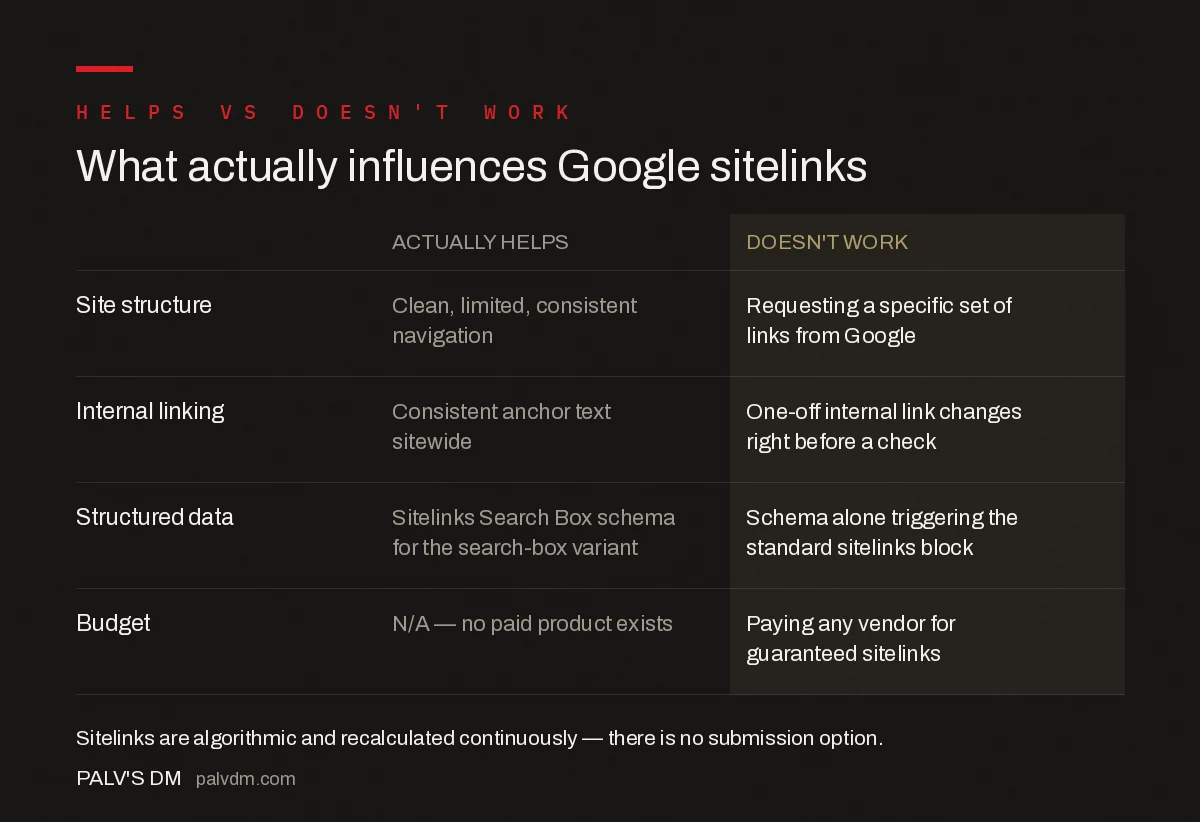
Helps vs doesn’t help: sitelinks factors
| Actually helps | Doesn’t work | |
|---|---|---|
| Site structure | Clean, limited, consistent navigation | Requesting a specific set of links from Google |
| Internal linking | Consistent anchor text sitewide | One-off internal link changes right before a check |
| Structured data | Sitelinks Search Box schema for the search-box variant | Schema alone triggering the standard sitelinks block |
| Budget | N/A — no paid product exists | Paying any vendor for guaranteed sitelinks |
Can you remove or demote a sitelink you don’t want shown?
Not directly anymore. Google previously offered a sitelinks demotion tool in the old Search Console, letting site owners suppress a specific unwanted sitelink. That tool has been retired. The current approach is indirect: fix the underlying reason Google chose that page — often a navigation link, an old high-traffic URL, or a page that used to be prominent — and the algorithm typically adjusts its selection over subsequent recalculations.
Frequently asked questions
Can you request sitelinks from Google?
No. There is no submission form, setting, or paid option to request sitelinks. Google’s algorithm decides automatically, per query, whether a site’s structure and relevance justify showing them, and that decision can change from one search to the next.
Does schema markup guarantee sitelinks?
No. Sitelinks Search Box structured data can enable the search-box variant of sitelinks under your result, but it doesn’t guarantee Google will show it, and it has no effect on the standard multi-link sitelinks block, which is driven by site structure and query relevance instead.
Why do sitelinks disappear for a site that used to have them?
Usually a drop in the query’s brand-search volume, a site restructuring that removed the internal link patterns Google had learned, or a ranking or trust dip severe enough that Google no longer sees the query as clearly navigational. Sitelinks are recalculated continuously, not locked in once earned.
Do sitelinks only appear for branded searches?
They appear overwhelmingly for branded and navigational searches, where Google is confident the user wants your specific site rather than comparing options. They’re rare on competitive non-branded keywords because that intent doesn’t map to a single expected destination.
Sources
- Learn About What Sitelinks Are — Google Search Central
- On-Page SEO Checklist: The Complete Working List
- Getting Into the Top Stories Carousel
- People Also Ask: Mining It and Ranking In It
- How to Win Featured Snippets, Format by Format
Want this done on your site?
Every PalV’s DM engagement starts with a free audit of your actual website — a 12-point
crawl covering what is blocking indexation, on-page gaps against your primary keywords, speed
findings, and the three to five fixes worth making first. Delivered in two working days. No
payment details, and the findings are yours whether you hire us or not.