How to Run a Competitor SEO Analysis in Under Two Hours
A time-boxed competitor SEO analysis: find your real search rivals, pull the keyword gap, tear down their pages, and leave with three scheduled tasks.

A useful competitor SEO analysis takes about two hours and answers four questions: who actually competes with you in search results, which queries they rank for that you do not, what those pages do that yours do not, and which two or three of those gaps you can close this quarter. Everything beyond those four questions is research theatre. The common failure is not lack of data — it is spending a week producing a fifty-slide competitor deck that nobody converts into a task list.
The other common failure is analysing the wrong companies. Your business competitors and your search competitors overlap far less than founders expect. The site taking the traffic you want may be a review aggregator, a marketplace listing, or a publisher with no commercial interest in your category at all.
Who are your actual search competitors?
Search competitors are the domains that appear repeatedly in the results for the queries you want. That is a different list from the companies you meet in sales calls, and it is the only list worth analysing.
Build it in fifteen minutes. Take ten to fifteen queries that a buyer would type immediately before purchasing — not your brand name, not broad category terms. Search each one, logged out, and record which domains appear in the top ten. Any domain appearing in four or more of those searches is a search competitor. Identifying the competitors that share your keyword set is the whole exercise, and it usually returns two or three names you did not expect.
Sort the resulting list into three types, because each demands a different response. Direct competitors sell what you sell. Aggregators and marketplaces rank on category terms and are usually unbeatable head-on, so competing against aggregator-heavy results means going after the queries they cover badly. Publishers rank on informational queries and are often a link opportunity rather than a threat.
What do you need before you start?
Two hours is only realistic if the setup is done first. The minimum viable stack is your own Search Console, one keyword tool with a competitor-keyword report, and a crawler.
- Google Search Console for your own baseline — which queries you already earn impressions on, and at what average position. Nothing external substitutes for it.
- A keyword tool with an organic-keywords-by-domain report. Paid tools are faster; free keyword research tools will get you through a single analysis more slowly.
- A crawler for on-page structure. Choosing between Screaming Frog and Sitebulb matters less than actually running one, and crawling a competitor site politely has rules worth knowing before you point a tool at someone else’s server.
- A spreadsheet with four tabs: competitor list, keyword gap, page teardown, actions. Set it up before the clock starts.
What does the two-hour process look like?
Time-boxing is the mechanism that keeps competitor research from expanding to fill a week. Each block below produces one artefact, and the block ends when the artefact exists.
| Block | Time | Output |
|---|---|---|
| 1. Identify search competitors | 15 min | Three to five domains, typed by category |
| 2. Pull the keyword gap | 30 min | A filtered list of queries they rank for and you do not |
| 3. Tear down their top three pages | 30 min | Structural notes on format, depth and evidence |
| 4. Compare link profiles | 20 min | Repeat referring domains they have and you do not |
| 5. Check technical basics | 10 min | Index counts, site speed, mobile rendering |
| 6. Write the action list | 15 min | Three tasks with owners and dates |
How do you find the keyword gap?
A keyword gap is the set of queries a competitor earns organic traffic on that your site does not rank for at all, or ranks for beyond position twenty. Every serious keyword tool has a report for this; the skill is in filtering it, not in running it.
Apply four filters in order, and the list drops from thousands of rows to a workable few dozen:
- Remove brand terms. Their brand queries are unwinnable and irrelevant to you.
- Keep commercial and transactional intent. A query someone types while comparing or buying is worth more than a definition lookup, though both have a place. Separating commercial from informational queries is the filter that most changes the output.
- Cut what you cannot serve. If you do not sell it, ranking for it produces traffic that never converts.
- Sort by difficulty against your own authority, not in absolute terms. Keyword difficulty scores are estimates, and a score that is achievable for a ten-year-old domain may be impossible for yours.
Cross-reference the survivors with your own Search Console. Queries where you already hold positions 11 to 20 are the fastest wins in the whole exercise — striking-distance keywords usually move with on-page work alone rather than needing new pages. The full keyword gap analysis process covers the edge cases this compressed version skips.
What should you look for on their pages?
Open the competitor page that ranks for your most valuable gap keyword and read it as a searcher, not as a marketer. You are looking for what the page contains that yours does not — not word count.
Five things are worth recording. What format the page takes, because the format that ranks tells you what searchers accepted: a comparison table, a step-by-step guide, a calculator. What evidence it carries — original data, named sources, screenshots, quotations. What questions it answers that your page ignores. How it is structured, since headings function as retrieval labels for both search engines and AI answers. And what it does badly, which is where your opportunity actually lives.
That last point is the one people skip. Ranking pages are frequently outdated, thin in the middle, or written by someone who has never done the thing. A structured competitor page teardown forces you to write down the weakness rather than just admiring the strength, and the on-page checklist gives you the comparison points.
How should you compare backlink profiles?
Backlink comparison is the part most likely to waste your afternoon, because the data is incomplete by design — no tool sees the whole web, and different tools report materially different link counts for the same domain.
Restrict yourself to one question: which referring domains link to two or more of your competitors but not to you? Those domains have already demonstrated willingness to link to companies like yours, which makes them the highest-probability targets in any outreach list. Running a link gap analysis is a twenty-minute job when framed that way, and deeper backlink analysis can wait for a separate session.
Ignore aggregate authority metrics as a scorecard. A domain authority number is a third-party estimate, not a Google signal, and comparing two of them tells you nothing you can act on this quarter.
What do you do with the findings?
The output of a competitor SEO analysis is three tasks, not a report. Anything longer will not survive contact with a real week.
- One page to improve. Usually an existing page in striking distance where the competitor teardown showed a specific missing element.
- One page to create. The highest-intent gap keyword you can genuinely serve.
- One structural fix. Internal linking, site architecture, or a technical issue the crawl surfaced.
Score them before committing. Prioritising SEO tasks with ICE scoring takes ten minutes and stops the loudest finding from beating the most valuable one. Then put the three tasks into the plan you already run — a twelve-month SEO roadmap is where competitor findings become scheduled work rather than notes.
What competitor analysis cannot tell you
Competitor analysis reveals what is currently ranking. It does not reveal why, and treating correlation as instruction is how sites end up copying a competitor’s mistakes.
You cannot see their conversion rate, so a page sending them huge traffic may sell nothing. You cannot see how long a position has been held, so a page that looks dominant may be sliding. You cannot see whether their rankings survive the next core update. And copying a ranking page produces a page with no reason to exist — Google’s own guidance asks whether content provides substantial value compared with other pages already in results, which a close paraphrase by definition does not. Use competitors to find the gap, then fill it with something they have not got.
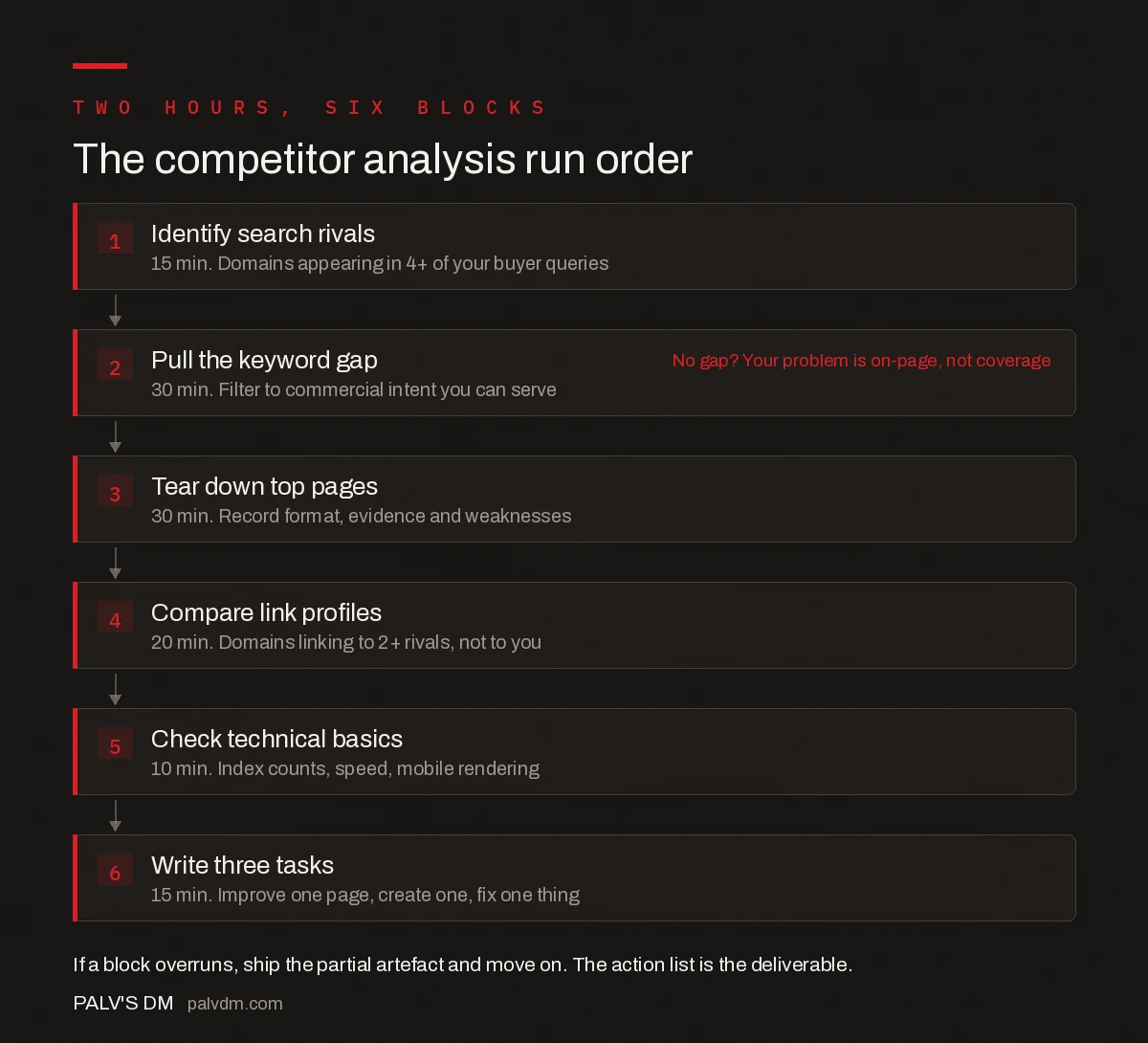
The competitor analysis run order
- Identify search rivals. 15 min. Domains appearing in 4+ of your buyer queries.
- Pull the keyword gap. 30 min. Filter to commercial intent you can serve. No gap? Your problem is on-page, not coverage
- Tear down top pages. 30 min. Record format, evidence and weaknesses.
- Compare link profiles. 20 min. Domains linking to 2+ rivals, not to you.
- Check technical basics. 10 min. Index counts, speed, mobile rendering.
- Write three tasks. 15 min. Improve one page, create one, fix one thing.
Frequently asked questions
How do I find my real SEO competitors?
Take ten to fifteen queries a buyer would type just before purchasing, search each one logged out, and record the domains in the top ten. Any domain appearing in four or more of those searches is a search competitor. This list usually differs from your sales competitor list, because aggregators, marketplaces and publishers frequently occupy the results you want.
What is a keyword gap analysis?
A keyword gap analysis lists the queries a competitor earns organic traffic on that your site does not rank for, or ranks for beyond position twenty. The value is in the filtering: remove their brand terms, keep commercial and transactional intent, cut anything you cannot actually serve, and rank what remains by difficulty relative to your own site’s authority.
How often should I run a competitor SEO analysis?
Quarterly is enough for most businesses, plus once after any confirmed Google core update, because update aftermath is when competitor positions genuinely change. Running it monthly produces noise rather than insight, since organic positions rarely shift enough in four weeks to justify changing a plan.
Can I do competitor SEO analysis with free tools?
Yes, more slowly. Your own Search Console is free and irreplaceable for baselining. Manual searching identifies competitors. Free keyword tools give smaller and less current keyword sets, and free crawler tiers limit URL counts. Budget roughly double the time. The analysis quality depends far more on filtering discipline than on tool spend.
Should I copy what my competitors are doing?
No. Competitor analysis shows what currently ranks, not why, and you cannot see their conversion rates or how long a position has held. Google’s guidance asks whether a page provides substantial value compared with other results, which a close paraphrase cannot. Use competitors to locate the gap, then fill it with evidence, data or first-hand experience they do not have.
What should a competitor SEO analysis produce?
Three scheduled tasks: one existing page to improve, usually one already ranking between positions eleven and twenty; one new page targeting the highest-intent gap keyword you can genuinely serve; and one structural or technical fix. Anything longer than three items rarely survives a real working week, and an unactioned report has no value.
Sources
- SEO Starter Guide — Google Search Central
- Performance report (Search results) — Search Console Help
- Creating helpful, reliable, people-first content — Google Search Central
Want this done on your site?
Every PalV’s DM engagement starts with a free audit of your actual website — a 12-point
crawl covering what is blocking indexation, on-page gaps against your primary keywords, speed
findings, and the three to five fixes worth making first. Delivered in two working days. No
payment details, and the findings are yours whether you hire us or not.