Where to Place Your Keyword on a Page (And Where Not To)
Keyword placement still matters in five specific spots on a page. Where your primary keyword earns its place, where exact-match placement is wasted, and how to avoid stuffing.

Your primary keyword earns real placement in five spots: the title tag, the H1, the URL, the first paragraph, and naturally within a couple of subheadings — everywhere else, exact-match placement matters less than covering the topic thoroughly with natural language and related terms. The old model of hitting a target keyword density across the whole page is not how Google’s current systems evaluate relevance, and chasing it produces worse content than writing for the five spots that still count and letting the rest follow the topic.
The confusion mostly comes from advice written for an older, simpler ranking system. Modern search understands synonyms, related concepts, and topical context well enough that repeating an exact phrase everywhere doesn’t move a page up — and can actively flag it as spam. The placements below are the ones with a clear, defensible reason to matter; everything else is better spent on being useful to the reader.
Where does keyword placement actually still matter?
| Location | Priority | Why it matters |
|---|---|---|
| Title tag | High | Used in the search snippet over 80% of the time; the strongest single relevance and click signal on the page |
| H1 | High | First on-page confirmation of topic for both readers and crawlers |
| URL slug | Medium | A minor, stable relevance signal; more useful for readability than ranking |
| First paragraph | Medium-high | Confirms the page delivers on the title’s promise immediately |
| One or two H2s | Medium | Reinforces topic structure without forcing every heading |
| Meta description | Low-medium | Doesn’t affect rankings directly, but a matching term can bold in the snippet and lift click-through |
| Image alt text | Low | Only where it accurately describes the image; relevant for Google Images, not page ranking |
Everything else — body paragraphs, image file names, footer text — should use the keyword and its natural variations only where they fit the sentence. There’s no separate ranking credit for forcing it in beyond that.
How should the primary keyword appear in the title tag?
Near the beginning where possible, and only once. Google’s own guidance on title links recommends descriptive, concise text and explicitly warns against keyword stuffing — repeating the same word or phrase multiple times doesn’t help users and can make a result look spammy. A title like “Keyword Placement SEO Guide: Best Keyword Placement Tips for SEO Keywords” repeats the term three times and reads exactly as bad as it sounds; “Where to Place Your Keyword on a Page (And Where Not To)” states the topic once, clearly, and lets the content do the rest.
Google also rewrites titles it judges to be poorly matched to a query or the page content, something covered in more depth in why Google rewrites your title tags. A title stuffed with keyword repetitions is one of the more common triggers for a rewrite, which defeats the purpose of writing the title in the first place.
Does the keyword need to be in the first sentence?
Not literally, and Google has been explicit that there’s no strict word-position rule tied to the first 100 or 200 words. What actually matters is that the opening paragraph confirms, quickly, that the page answers what the title promised. That confirmation reads naturally when it includes the primary keyword or a close variation, but engineering the literal first sentence around it at the cost of a clear opening statement is optimizing for the wrong thing.
A useful test: read the first two sentences of the page as if you were the person who typed the query. If they immediately confirm you’re in the right place, the keyword placement is doing its job whether or not the exact phrase appears verbatim.
How should headings use the keyword without becoming repetitive?
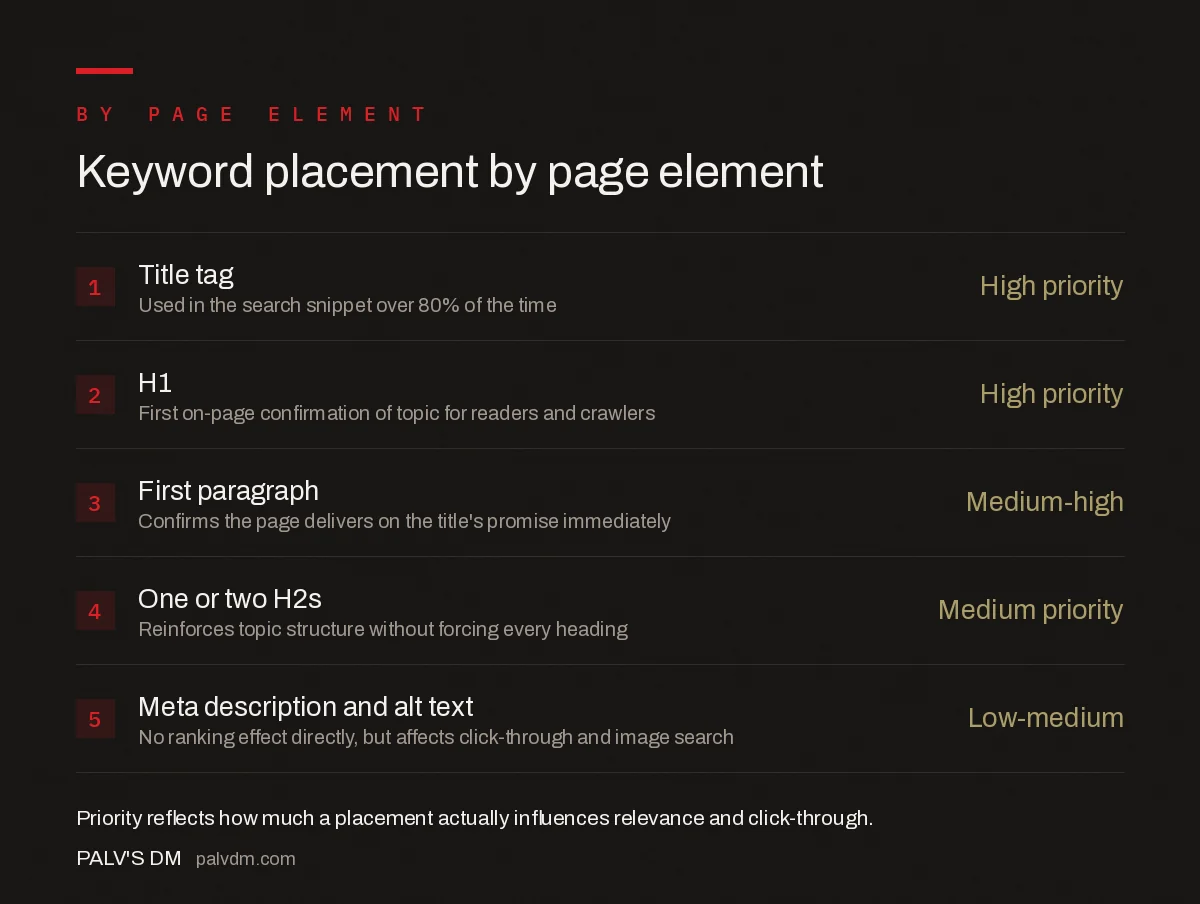
Keyword placement by page element
- Title tag — Once, near the start — The strongest single on-page relevance and click signal.
- H1 — Once — Confirms topic immediately for readers and crawlers.
- First paragraph — Naturally, in context — Confirms the page matches what the title promised.
- One or two H2s — Where it fits the section’s actual content — Not forced into every subheading.
- Meta description — Once, framed as a benefit — Doesn’t affect ranking but can lift click-through.
Good heading structure follows the content, not a keyword list. If a section genuinely covers the primary keyword topic, using it in that H2 is natural. If a section covers a related but distinct subtopic, forcing the exact primary keyword phrase into that heading makes it inaccurate and worse for readers — a sign the page’s heading hierarchy is being organized around a keyword list instead of the actual structure of the topic.
What counts as keyword stuffing today, and what’s the actual risk?
Google’s spam policies explicitly call out loading pages with keywords or numbers in an attempt to manipulate rankings, including filler lists of terms, blocks of repeated phrases, and text that reads unnaturally dense with the target keyword. This isn’t a density threshold you can technically stay under — it’s evaluated as a pattern, and pages that clearly read as written for algorithms rather than people are the ones flagged.
The practical risk isn’t usually a manual penalty; it’s more often that stuffed content simply reads worse, converts worse, and gives Google’s systems less reason to treat the page as a genuinely helpful answer to the query. The fix a lot of older sites need isn’t removing every instance of a keyword — it’s rewriting the sections that were clearly padded to hit a count, which is exactly the finding covered in keyword density is a myth.
What about the URL slug — exact match or short and readable?
Short and readable wins over exact-match stuffing. Google’s guidance on site structure favours URLs that are simple and describe the page’s content in a few words over long strings built to cram in a keyword phrase. A slug like /blog/keyword-placement-on-page/ communicates the topic clearly; a slug like /blog/best-keyword-placement-seo-tips-guide-2026/ is longer, harder to read in a shared link, and doesn’t carry meaningfully more ranking value for the extra words.
Where the URL slug does earn its placement is consistency with the title and H1 — a page titled around “keyword placement” with a slug about something else entirely is a small but avoidable mismatch. Once a URL is published and indexed, though, changing it purely to insert a keyword usually isn’t worth the redirect risk; a clean, readable slug set once at publish time is enough, and it’s not worth revisiting for marginal keyword gains later.
How does this change for pages targeting multiple related keywords?
Most useful pages rank for dozens or hundreds of related queries, not just the one primary term used to plan the page. Trying to place every one of those variants in specific locations is neither possible nor necessary — write the page to comprehensively cover the topic, and the related terms appear naturally as you explain sub-questions, comparisons, and edge cases a thorough answer requires. The five placements above apply to the single primary keyword the page is built around; everything else in the topic cluster earns its place through genuine coverage, not placement engineering.
A practical way to check this without a keyword-density spreadsheet: after drafting a page, list the three or four questions a reader with that search intent would still have after the title and first paragraph. If the page’s headings and body already answer them in plain language, the related keyword variants are almost certainly already present, because those questions are usually phrased using the same vocabulary a searcher would use. Pages that struggle for related-keyword coverage are usually pages that stopped short of actually answering the full question, not pages that placed a term in the wrong spot.
Frequently asked questions
Does my keyword need to appear in the exact first sentence?
No. Google has stated its systems interpret topical relevance from context across a page, not from a strict word-position rule. Getting the primary keyword or a close variation into the first paragraph is good practice for both readers and search engines, but the exact first sentence isn’t a requirement.
How many times should a keyword appear in the body content?
There’s no target count or density ratio. Google’s own spam policies flag repeating the same word or phrase excessively as keyword stuffing, which can hurt rather than help. Use the keyword and its natural variations wherever they read naturally, and stop counting.
Should the keyword be in every H2 on the page?
No. Forcing the exact keyword into every subheading produces repetitive, robotic-sounding headings. Use the primary keyword in one or two headings where it fits the actual content of that section, and let related terms and natural language cover the rest.
Does keyword placement in alt text still matter?
Yes, but for a narrower reason than page ranking: alt text describes the image for accessibility and for Google Images. Include the keyword only if it accurately describes what the image shows — writing keyword-stuffed alt text for images unrelated to the term provides no benefit and hurts accessibility.
Sources
- Spam Policies for Google Web Search: Keyword Stuffing — Google Search Central
- Influencing Title Links in Google Search — Google Search Central
- On-Page SEO Checklist: The Complete Reference
- Why Google Rewrites Your Title Tags (And How to Stop It)
- Keyword Density Is a Myth. Here’s What Replaced It
- Heading Hierarchy: Structuring a Page for Readers and Machines
Want this done on your site?
Every PalV’s DM engagement starts with a free audit of your actual website — a 12-point
crawl covering what is blocking indexation, on-page gaps against your primary keywords, speed
findings, and the three to five fixes worth making first. Delivered in two working days. No
payment details, and the findings are yours whether you hire us or not.