Keyword Density Is a Myth. Here’s What Replaced It
Keyword density has never been a Google ranking factor. Here's why the myth persists and the three things that actually replaced it: topical coverage, entity usage, and natural placement.

Keyword density — the percentage of times a target keyword appears on a page — has never been a Google ranking factor, and Google has said so consistently since at least 2011. There is no ideal percentage, no “1-2% is safe” threshold, and no tool that can tell you the correct number, because the number Google’s ranking systems look for doesn’t exist. What replaced it is topical coverage: whether the page actually answers the question as completely as the pages already ranking for it.
This matters because keyword density checkers are still bundled into popular SEO plugins and content briefs, producing a green/yellow/red score that writers optimise toward without knowing the score maps to nothing in Google’s actual systems. Chasing it wastes editing time and, at the extreme, produces exactly the unnatural repetition Google’s spam policies penalise.
Myth: there’s an ideal keyword density percentage
The claim. A page ranks better if its target keyword appears within a specific percentage range of the total word count — commonly cited as 1-2%, sometimes narrower.
The reality. Former Google engineer Matt Cutts was telling site owners to stop worrying about keyword density as far back as 2011, and Google’s John Mueller has repeated the same position multiple times since: there is no magic number. Google’s automated ranking systems evaluate content based on what a reader sees and whether it satisfies the query — not a word-frequency calculation run against the body text.
Why the confusion persists. Keyword density was a real, exploitable signal in very early search engines that ranked pages largely on term frequency. SEO practices from that era calcified into checklists and tools that never got updated once the underlying algorithm moved on. A density score is easy to compute and easy to put in a dashboard, which is exactly why it survived long after it stopped mattering.
Myth: repeating a keyword more times always helps it rank
The claim. If one mention of the keyword helps, ten mentions must help more.
The reality. Past a natural point, repetition stops adding relevance signal and starts reading as keyword stuffing — a specific, named violation in Google’s spam policies, defined as filling a page with keywords or phrases in a way that’s unnatural or out of context. Google’s guidance is explicit that automated systems analyse content the way a visitor experiences it, not by tallying keyword occurrences, and that stuffing can get a page ranked lower or removed from results entirely.
Why the confusion persists. Early correlation studies genuinely found that top-ranking pages mentioned their target keyword a certain number of times — but that’s because comprehensive answers naturally use their core term repeatedly while covering the topic, not because the repetition caused the ranking. Mistaking correlation for the mechanism is the root of most keyword density advice still in circulation.
Myth: exact-match keyword phrasing beats natural variation
The claim. Using the precise keyword phrase, word for word, outperforms using synonyms, related terms, or natural rephrasing.
The reality. Modern natural language processing lets Google’s systems understand that “how to fix a leaky faucet,” “stop a dripping tap,” and “faucet won’t stop dripping” describe the same intent. Google’s own SEO Starter Guide directs writers toward creating content for people first, using language your audience would use, rather than engineering exact phrase matches. Forcing an exact match where a natural variant reads better is a style downgrade with no compensating ranking benefit.
Why the confusion persists. Exact-match domains and exact-match anchor text were genuinely powerful signals in the 2000s, and some of that thinking transferred to on-page phrasing even though the two are unrelated mechanisms and the domain-level version was devalued years ago.
What actually replaced keyword density as a signal?
| Old approach | What replaced it | What it actually measures |
|---|---|---|
| Keyword density percentage | Topical completeness | Whether the page covers the sub-questions and related concepts a full answer requires |
| Exact-match phrase repetition | Entity and synonym coverage | Whether the page uses the vocabulary a knowledgeable writer on the subject would naturally use |
| Keyword in every heading | Structural relevance | Whether headings map to the actual sub-topics a searcher expects, keyword or not |
| Keyword count target | Comparative quality against top-ranking pages | Whether the page is as good or better than what’s already satisfying the query |
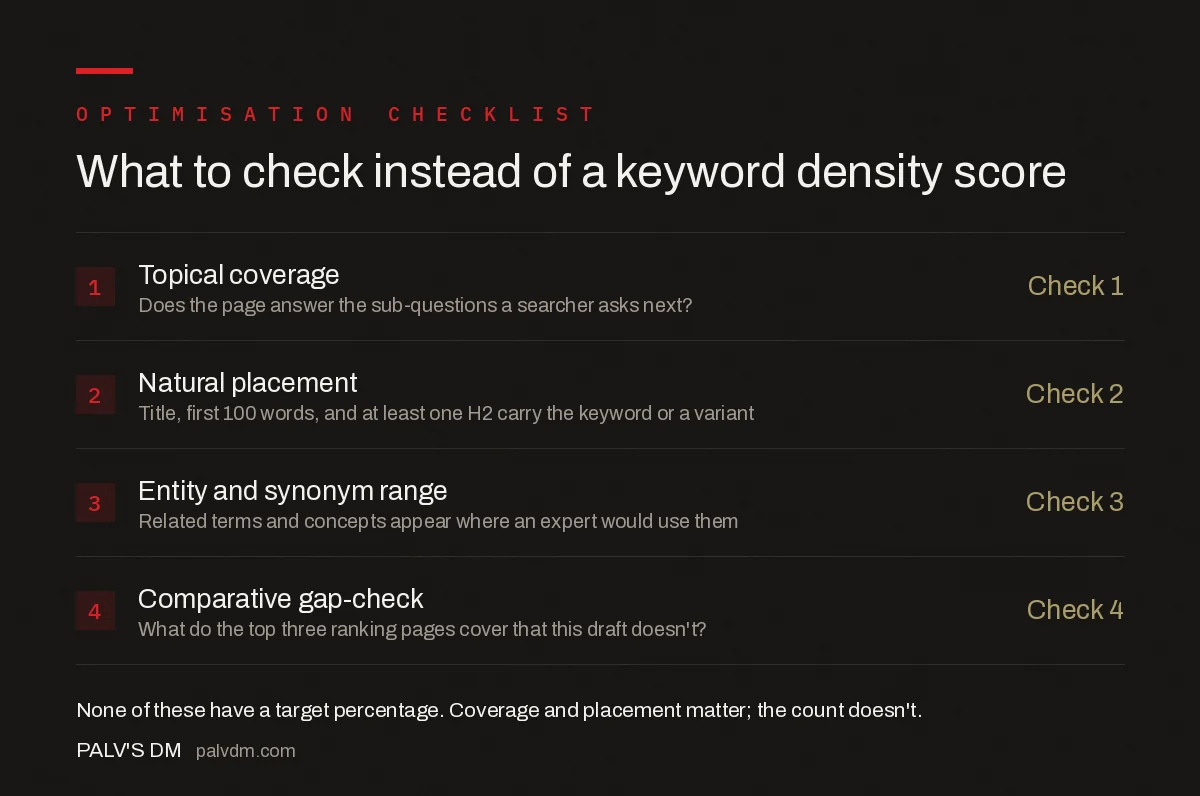
What to check instead of a density score
- Topical coverage — Does the page answer the sub-questions a searcher would ask next, not just the headline question?
- Natural placement — Title, first 100 words, and at least one H2 use the keyword or a close variant where it fits.
- Entity and synonym range — Related terms, product names, and concepts appear where a subject-matter expert would use them.
- Comparative gap-check — Read the top three ranking pages; note what they cover that this draft doesn’t.
How do you optimise a page without chasing a density score?
Start from the question, not the word count. Write the paragraph that actually answers what the searcher wants, then check whether the target keyword or a natural variant of it appears in the title, the first paragraph, and at least one subheading — not because a formula requires it, but because those are the places both readers and Google’s systems look first to confirm the page matches the query. After that, stop counting. If the keyword shows up eight times in a 1,800-word article because the topic genuinely needs it repeated, that’s fine. If it shows up eight times in a 400-word article because a tool said to hit 2%, that reads as stuffing to a human editor and, per Google’s spam policies, potentially to Google’s systems too.
Run a gap-check instead of a density check: pull the top three to five ranking pages for the target keyword and list what questions, sub-topics, or entities they cover that the draft doesn’t. Filling those gaps moves the needle. Adjusting a percentage in a plugin sidebar does not.
Frequently asked questions
Is there an ideal keyword density percentage?
No. Google has repeatedly said there is no target percentage or magic number for keyword usage. Any tool or checklist that recommends a specific density, such as 1-2%, is applying a rule Google’s own engineers have said doesn’t exist in the ranking algorithm.
Why do keyword density checker tools still exist?
Legacy SEO tooling and content briefs built in the 2000s and early 2010s baked density targets into their scoring, and many tools never removed the feature because users expect a numeric score. The number is a leftover UI element, not a signal Google reads.
What replaced keyword density as a ranking signal?
Topical and entity coverage. Google’s language models assess whether a page comprehensively covers the concepts, related questions, and entities a topic requires, judged by comparison against other high-quality pages on the same subject, not by counting word repetitions.
Can using a keyword too many times hurt rankings?
Yes, but the mechanism is different from density. Google’s spam policies treat unnatural, repetitive keyword use as keyword stuffing, a specific spam violation, not a density threshold. The penalty comes from the pattern reading as manipulative, not from exceeding a percentage.
How many times should I use my target keyword in an article?
As many times as it appears naturally while covering the topic completely — usually the title, one H2, the opening paragraph, and a handful of times across the body where it reads normally. Write the sentence first; check whether the keyword fits, not the reverse.
Sources
- Spam Policies for Google Web Search — Google Search Central
- On-Page SEO Checklist: The Complete Guide
- Where to Place Your Keyword on a Page (And Where Not To)
- How to Write Title Tags That Google Won’t Rewrite
- Why Google Rewrites Your Title Tags (And How to Stop It)
Want this done on your site?
Every PalV’s DM engagement starts with a free audit of your actual website — a 12-point
crawl covering what is blocking indexation, on-page gaps against your primary keywords, speed
findings, and the three to five fixes worth making first. Delivered in two working days. No
payment details, and the findings are yours whether you hire us or not.