Share of Voice: A Better Metric Than Average Position
Average position hides competitive shifts share of voice catches. Here is the formula, the keyword set to use, and how to read it.

Published August 2026. Written by the SEO team at PalV’s DM.
Share of voice measures the percentage of total available search visibility a site captures across a defined set of keywords, weighted by search volume and estimated click-through rate at each ranking position. Average position only tells you where you rank; share of voice tells you how much of the actual market you’re capturing relative to competitors, which is the number that answers the question a stakeholder is really asking: are we winning or losing ground.
Why is average position an incomplete metric?
Average position treats every keyword equally and every position gap equally, regardless of search volume or how steep the click-through-rate drop-off is between positions. A site averaging position 4 across ten keywords could be dominating the two highest-volume terms and barely visible on the other eight, or spread evenly across all ten. Average position alone can’t tell the difference, and the two scenarios represent very different competitive realities.
It also says nothing about competitors. A site holding steady at position 4 for a keyword looks stable in an average-position report, even while a competitor climbs from position 8 to position 2 on the exact same term, quietly capturing most of the click volume that used to be split more evenly. Average position simply doesn’t have a mechanism to show that shift.
How is share of voice calculated?
Share of voice applies an estimated click-through-rate curve to each site’s ranking position for a defined keyword set, sums the estimated clicks across all keywords, and divides by the total estimated clicks available across all ranking sites for that same keyword set. The output is a percentage: the share of total available search demand a site is capturing, relative to everyone else ranking for those terms.
This calculation requires three inputs: the keyword set being measured (usually a business’s priority commercial terms), search volume for each keyword, and current ranking position for every competing site on those terms. Most all-in-one SEO platforms with rank tracking, including tools that track competitor positions alongside your own, calculate share of voice automatically once a keyword set and competitor list are configured.
What does the comparison actually look like?
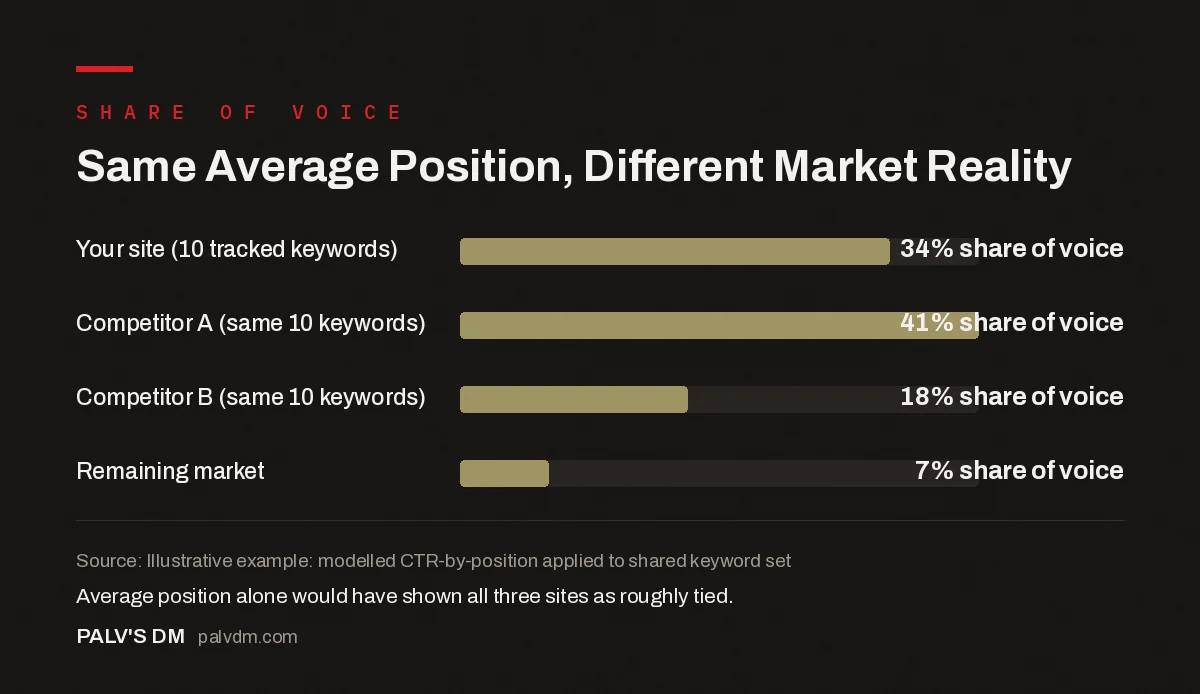
Same average position, different market reality (illustrative example)
| Metric | Value |
|---|---|
| Your site (10 tracked keywords) | 34% share of voice |
| Competitor A (same 10 keywords) | 41% share of voice |
| Competitor B (same 10 keywords) | 18% share of voice |
| Remaining market | 7% share of voice |
This is an illustrative example, not a real client result, built to show the structure of the calculation. In a scenario like this, average position across the same ten keywords might show all three sites within a point or two of each other, looking roughly tied. Share of voice reveals that Competitor A is actually capturing meaningfully more of the available click volume, likely by holding the top 1-2 positions on the highest-volume terms in the set while your site and Competitor B split the remaining, lower-volume rankings more evenly.
What keyword set should share of voice be calculated on?
Use a defined, stable set of commercially relevant keywords, not every keyword the site happens to rank for. A workable approach:
- Select 15-30 keywords that best represent the core commercial intent for the business, avoiding branded terms that inflate the number without reflecting competitive SEO performance
- Keep the set stable over time so period-over-period share of voice comparisons stay meaningful, adding new keywords only during a scheduled quarterly review
- Identify 2-4 real competitors ranking consistently on the same keyword set, rather than an arbitrary list of well-known brands that may not actually compete for the same search terms
A share of voice number calculated against the wrong competitor set, or against a keyword list that changes every month, isn’t comparable over time and loses most of its value as a trend metric.
How often should share of voice be reported?
Monthly is a reasonable cadence for most businesses, since the metric is meant to show a competitive trend rather than catch daily fluctuation. A single month’s dip or rise is less informative than the trend across a full quarter, particularly because a competitor’s short-term content push or a temporary SERP feature change can move the number without reflecting a lasting shift in competitive position.
How does AI search change what share of voice means?
Traditional share of voice models assume clicks flow from a ranked position on a classic organic results page. AI Overviews, chat-based answers, and other generative search features complicate that assumption, because a query can now be fully answered inside the SERP or inside a chat interface without a click ever reaching any ranked page, regardless of who ranks where. A share of voice calculation built purely on organic CTR-by-position curves increasingly overstates the click volume actually available, particularly on informational queries where AI-generated answers are common.
The practical adjustment most teams are making is tracking two related but distinct numbers: classic share of voice for click-driving queries where organic results still dominate the SERP, and a separate AI citation tracking effort for queries where AI Overviews or chat answers have become the primary surface. Treating both as the same metric risks either overstating available click volume or missing a real visibility loss to AI-generated answers that a classic share of voice number wouldn’t capture.
What does a share of voice calculation look like with real numbers?
Here’s a simplified version showing the inputs, using a keyword set of three terms for a services business:
- Keyword A: 1,200 monthly searches, your site ranks position 2 (est. CTR 15%), estimated clicks: 180
- Keyword B: 800 monthly searches, your site ranks position 6 (est. CTR 4%), estimated clicks: 32
- Keyword C: 500 monthly searches, your site ranks position 1 (est. CTR 28%), estimated clicks: 140
- Your total estimated clicks across the set: 352
- Total estimated clicks available across all ranking positions for the same three keywords (summed across all competing sites, based on the CTR curve applied to total search volume): 2,500
- Your share of voice: 352 / 2,500 × 100 = 14.1%
Run the same calculation for each tracked competitor using their ranking positions on the identical keyword set, and the resulting percentages show relative competitive standing rather than just your own isolated position data. A competitor holding position 1 on Keyword A and Keyword B, even while ranking lower than you on Keyword C, would likely show a higher combined share of voice, because Keyword A’s higher search volume carries more weight in the total than Keyword C’s smaller volume does.
What mistakes make a share of voice number unreliable?
A few setup issues distort share of voice more often than the underlying formula does:
- Using a stale or overly broad keyword set. Including keywords the business no longer targets, or terms with search intent that’s drifted since the list was built, dilutes the number with irrelevant noise. Review the keyword set at the same cadence as the brand list, at minimum quarterly.
- Applying a generic CTR curve instead of a category-calibrated one. Click-through rates by position vary by query type. A CTR curve built from broad informational search behaves differently than one for high-intent local service queries. Where the data is available, calibrate the CTR curve against your own site’s actual position-versus-click data from GSC rather than using an industry-generic curve unadjusted.
- Tracking too many competitors, including ones that aren’t real search competitors. A well-known market competitor that doesn’t actually rank for the tracked keyword set adds no useful signal and can make the “remaining market” figure misleadingly large. Limit the competitor set to sites consistently appearing in the top 10 for the tracked terms.
- Not separating branded from non-branded keywords in the set. Including branded terms in a share of voice calculation inflates a site’s own share artificially, since a business typically ranks first for its own name regardless of competitive SEO strength elsewhere. Keep the tracked set non-branded only, consistent with how the rest of SEO reporting should segment brand traffic.
Fixing these is mostly a matter of keeping the inputs current and specific to the actual market being measured, not changing the underlying formula.
Frequently asked questions
Can share of voice be higher than 100%?
No, by definition it’s a percentage of total available demand across the tracked keyword set, so all competitors’ shares plus any unclaimed remainder should sum to 100%. If a calculation is producing figures that don’t sum correctly, the CTR curve or keyword set being used likely needs review.
Does share of voice replace rank tracking entirely?
No, the two serve different purposes and work best together. Rank tracking shows exactly where a specific keyword sits today, which is useful for diagnosing individual page issues. Share of voice aggregates that position data with volume and competitor context to answer the higher-level question of whether overall competitive visibility is growing or shrinking. Most teams need both.
How do I find out which competitors to include in a share of voice calculation?
Check who’s actually ranking in the top 5-10 positions for your priority keyword set over several months, rather than assuming it’s the same competitors a business considers rivals in the market generally. Search competitors and business competitors overlap less often than expected, and a share of voice calculation built around the wrong competitor set won’t reflect the real competitive picture in search.
Why did my share of voice drop even though my rankings stayed the same?
The most common cause is a competitor’s ranking improving on the same keyword set, which reduces your share of the total available demand even without any change on your own site. A second common cause is a shift in the CTR curve itself, such as an AI Overview or expanded SERP feature appearing on a high-volume keyword in the set, reducing the total organic click pool that share of voice is calculated against for everyone, not just your site.
The bottom line
Average position tells you where you rank. Share of voice tells you how much of the actual market you’re winning, relative to the competitors fighting for the same demand. Building a stable keyword set, a real competitor list, and reviewing the trend monthly turns share of voice into the metric that actually answers whether SEO progress is translating into competitive ground gained, not just position numbers moving in isolation.
PalV’s DM’s SEO Growth service includes share of voice tracking against your real search competitors as part of standard reporting, not just your own site’s position history in isolation.
For the tracking foundation this metric builds on, see our rank tracking setup guide. To keep the branded-versus-non-branded split clean in this analysis, read segmenting branded and non-branded traffic. For turning visibility gains into a revenue story, see calculating SEO ROI. Our Google Search Console guide covers the query and position data this calculation starts from.