Calculating SEO ROI With Numbers a CFO Accepts
SEO ROI needs more than revenue minus cost. Here is the formula, the attribution model to name, and a worked example a CFO will actually accept.

Published August 2026. Written by the SEO team at PalV’s DM.
SEO ROI is calculated as (organic revenue attributable to SEO minus fully loaded SEO cost) divided by SEO cost, expressed as a percentage. A CFO will not accept that number unless you can also show the attribution model you used, the time window, and whether you subtracted branded traffic that would have converted anyway. Get those four things wrong and the number gets thrown out in the first finance review, regardless of how good the underlying SEO work was.
What is the actual SEO ROI formula?
The formula itself is not the hard part: ROI = (Revenue − Cost) / Cost × 100. If a business spent ₹4,00,000 on SEO over six months and that work drove ₹16,00,000 in organic revenue over the same window, the raw calculation reads (16,00,000 − 4,00,000) / 4,00,000 × 100 = 300%. Every ₹1 spent returned ₹3 in profit-eligible revenue.
The hard part is defending each input. “Organic revenue” is not the same as “total sessions from Google.” It has to be revenue that a defensible attribution model actually credits to organic search, in a window long enough for SEO to have caused it rather than merely coincided with it. Most rejected ROI numbers fail on one of those two points, not on the arithmetic.
Which revenue counts as SEO revenue?
Start with GA4’s organic search channel, then subtract two categories a CFO will ask about immediately:
- Branded organic traffic. Someone searching your company name was already going to find you, by SEO or not. Counting that revenue as an SEO win inflates the number and won’t survive scrutiny.
- Traffic that would exist regardless of ranking position. A page ranking position 4 instead of position 9 for a term nobody searches is not driving incremental revenue. Isolate non-branded, commercially relevant queries only.
What’s left is closer to true incremental organic revenue: non-branded search traffic, landing on pages your SEO work targeted, converting inside your GA4 conversion window. This is a smaller number than total organic revenue, and that’s the point. A CFO trusts a conservative number more than an impressive one.
How do you calculate the fully loaded cost side?
SEO cost is not just the agency retainer. A defensible cost figure includes:
| Cost category | What to include | Common omission |
|---|---|---|
| Agency or team fees | Monthly retainer or in-house salary allocation | Founder or marketer time not on payroll for SEO |
| Content production | Writers, editors, subject-matter review | Internal stakeholder review hours |
| Tools | Rank tracker, crawler, analytics add-ons | Shared tools split across multiple channels |
| Technical/dev work | Site speed fixes, schema, migrations tied to SEO | Dev hours billed to a “general maintenance” bucket |
| Link building or digital PR | Outreach fees, content assets built for links | One-off placements paid outside the SEO budget line |
Leaving out dev time or internal review hours is the single most common way an SEO ROI figure looks better than it actually is. A CFO who finds the omission once will discount every number you present afterward.
What attribution model should you use?
State the model by name in the report, not just the number. Multi-touch attribution assigns proportional credit to each touchpoint that influenced a conversion, so a buyer who found a blog post via organic search, later clicked a retargeting ad, and converted a week after an email gets that revenue split across three channels rather than handed entirely to the last click. Last-click attribution, by contrast, gives 100% of the credit to whichever channel closed the sale, which routinely undervalues organic search because SEO tends to do upper-funnel work.
Google Analytics 4 defaults to data-driven attribution (DDA), which distributes credit across the observed conversion path using your account’s own conversion data rather than a fixed rule. Comparing the DDA report against a last-click view for the same period is usually the fastest way to show a CFO how much organic search was actually undercounted under the old model.
Pick one model, name it in every report, and don’t switch models between quarters without flagging the change. A CFO comparing quarter-over-quarter ROI needs the comparison to be apples to apples.
How long a measurement window makes the number credible?
Six months is the practical minimum. SEO work published today rarely converts into ranking movement inside 30 days, and ranking movement rarely converts into stable revenue inside 60. Reporting ROI on a 60-day window after a new content push almost always understates the return, because most of the revenue hasn’t landed yet.
For sites with longer B2B sales cycles, extend the window to match the buying cycle length, not an arbitrary quarter boundary. A ninety-day enterprise sales cycle needs at least a nine-to-twelve month measurement window before the ROI figure has stabilised enough to report with confidence.
A worked example a CFO can follow
Here’s a version with the inputs shown, not just the output:
- Non-branded organic sessions, 6 months: 42,000
- Conversion rate on those sessions (GA4, DDA model): 1.4%
- Conversions: 588
- Average order value: ₹6,200
- Attributed revenue: ₹36,45,600
- Fully loaded SEO cost, 6 months (retainer + content + tools + dev): ₹9,00,000
- ROI: (36,45,600 − 9,00,000) / 9,00,000 × 100 = 305%
Every line item here is independently checkable against GA4 and the finance ledger. That checkability, not the final percentage, is what gets an ROI figure accepted in a budget meeting.
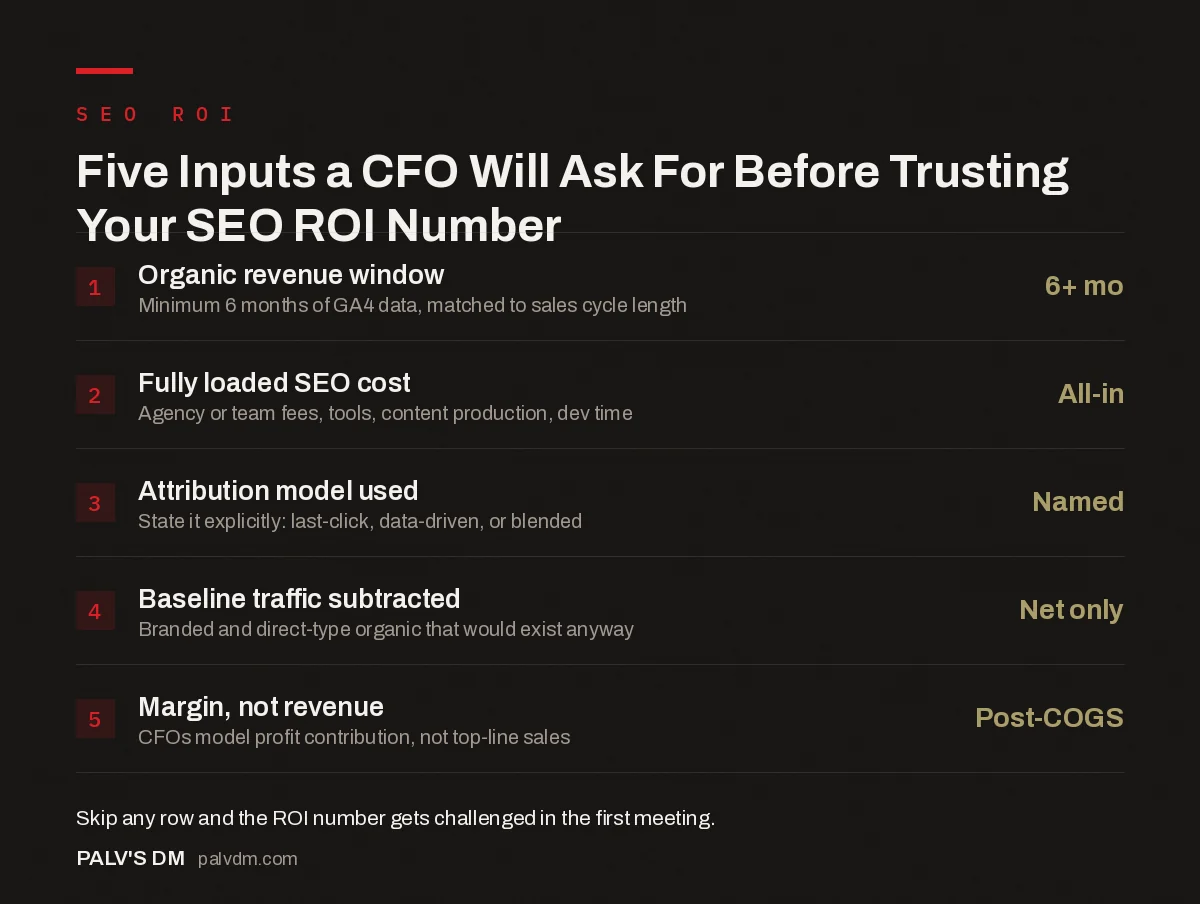
Five inputs a CFO checks before accepting an SEO ROI number
- Organic revenue window — 6+ months. Minimum six months of GA4 data, matched to sales cycle length.
- Fully loaded SEO cost — All-in. Agency or team fees, tools, content production, dev time.
- Attribution model used — Named. State it explicitly: last-click, data-driven, or blended.
- Baseline traffic subtracted — Net only. Branded and direct-type organic that would exist anyway.
- Margin, not revenue — Post-COGS. CFOs model profit contribution, not top-line sales.
What mistakes make an ROI number fall apart under questioning?
A few errors show up repeatedly in SEO ROI reports that otherwise look reasonable on the surface:
- Using list price instead of actual close rate. Counting every form submission or add-to-cart as full revenue, rather than applying the actual conversion-to-close rate for that channel, inflates the number well past what finance will see land in the bank.
- Comparing ROI across mismatched time windows. Reporting six months of revenue against three months of cost, because the SEO work started earlier than the cost tracking, makes the ratio look artificially strong. Cost and revenue windows need to align to the same period.
- Ignoring seasonality in the baseline. A retailer running an SEO push into its peak season will show revenue growth that’s partly seasonal, not purely attributable to the SEO work. Compare against the same period last year, not just the prior quarter, to separate the two.
- Double-counting revenue across channels. If a conversion also gets credited in a paid search or email report for the same period, and the SEO report claims full credit too, the sum of all channel ROI reports will exceed 100% of actual revenue, an inconsistency finance teams catch quickly.
Each of these is a credibility risk, not a math error. The formula stays the same; what breaks trust is an input that doesn’t hold up when someone checks it against a different report.
Should you report revenue or margin?
Margin, wherever the data allows it. A CFO thinks in profit contribution, not top-line revenue, because a ₹36,00,000 revenue figure means something different at 60% gross margin than at 15%. If cost-of-goods data is available for the products or services organic traffic converted on, report ROI against gross profit, not revenue. It’s a smaller, more conservative number, and it’s the one finance actually uses in planning.
Frequently asked questions
How often should SEO ROI be reported?
Quarterly is the practical minimum for most businesses, with a rolling six-month view alongside it so short-term noise doesn’t distort the trend. Monthly reporting on SEO ROI specifically tends to mislead, because ranking and conversion lag the work by weeks, and a single slow month can look like a failure that a longer window shows was normal variance.
What’s a good SEO ROI percentage?
There’s no universal benchmark, because cost structures and margins vary too much across industries. A more useful test is whether the ROI is positive and trending upward after the six-month mark, and whether it beats the ROI of the next-best channel competing for the same budget. Comparing SEO against paid search ROI, using the same attribution model for both, is the comparison that actually drives budget decisions.
Does SEO ROI include brand awareness value?
Not in the standard formula, and that’s deliberate. Brand awareness and share-of-voice gains are real but not reliably monetisable in a single number, so mixing them into a revenue-based ROI figure makes the calculation harder to defend, not easier. Report awareness metrics separately, alongside the ROI figure, rather than folding them into it.
Why does my SEO ROI look worse under data-driven attribution than last-click?
This usually means most of your organic conversions come from searches that happen late in the buyer journey, close to the final decision, rather than early research-stage queries. Data-driven attribution only outperforms last-click for organic search when SEO is doing real upper-funnel work. If it isn’t yet, that’s a content strategy gap worth addressing before the reporting gap.
The bottom line
An SEO ROI number a CFO accepts is not a bigger number, it’s a checkable one. Name the attribution model, state the measurement window, show the fully loaded cost, and report margin where you can. Do that consistently and the conversation moves from “is this number real” to “how do we grow it,” which is the conversation that actually protects SEO budget at renewal time.
If you want a second opinion on how your current reporting would hold up in a finance review, PalV’s DM’s SEO Growth service includes a quarterly ROI reporting framework built around exactly these inputs.
For the reporting foundation this builds on, see our Google Search Console guide. If ranking movement is the piece you still need to translate into a revenue model, our SEO forecasting guide and SEO attribution models post cover the two pieces this post assumes. For a founder-level view of the metrics that actually matter, see SEO KPIs your founder will actually accept.