Service Support — One-Time Services
Stacking One-Time Services Into a DIY SEO Programme
A working DIY SEO plan buys one-time services in order — technical check, keyword research, then content — and implements each before buying the next.

A DIY SEO plan built from one-time services works when you buy them in a fixed order — technical check first, keyword research second, on-page or content strategy third — and do the implementation yourself between purchases. Buy them out of order (a link first, an audit last) and you end up fixing things that were never broken while the real problems sit untouched. The services themselves aren’t the hard part. The sequencing is.
Key takeaway
- A working DIY SEO plan stacks one-time services in a fixed order: technical check, then keyword research, then on-page or content strategy — never a link or an audit first, in isolation.
- The gap between “bought a service” and “improved rankings” is the implementation step you do yourself — writing, publishing and linking between purchases, on your own timeline.
- Treat it as a repeating cycle every 2-4 months, not a one-off shopping list — each round should be informed by what changed since the last one.
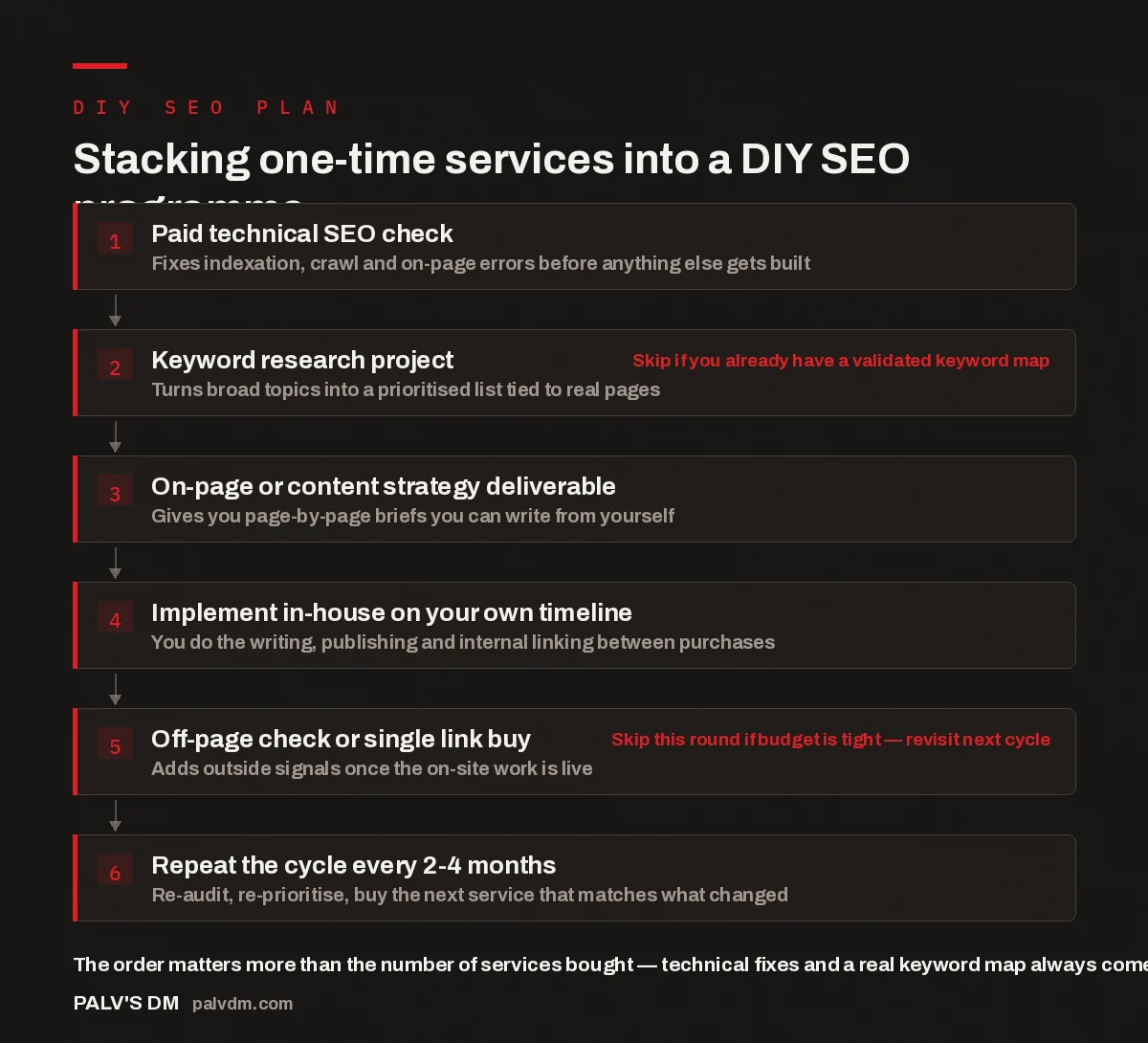
Stacking one-time services into a DIY SEO programme
- Paid technical SEO check. Fixes indexation, crawl and on-page errors before anything else gets built.
- Keyword research project. Turns broad topics into a prioritised list tied to real pages. Skip if you already have a validated keyword map
- On-page or content strategy deliverable. Gives you page-by-page briefs you can write from yourself.
- Implement in-house on your own timeline. You do the writing, publishing and internal linking between purchases.
- Off-page check or single link buy. Adds outside signals once the on-site work is live. Skip this round if budget is tight — revisit next cycle
- Repeat the cycle every 2-4 months. Re-audit, re-prioritise, buy the next service that matches what changed.
Why does the order of purchases matter more than the number of them?
Because each service in a DIY SEO plan depends on information the one before it produces. A keyword research project is only as useful as the site it’s mapped onto — if half your pages aren’t indexed correctly, some of the “opportunities” in that keyword list point at pages Google can’t currently see properly. A content strategy deliverable built without a technical check underneath it can brief you to write ten new articles that then compete with existing pages nobody bothered to check first. The pattern that shows up repeatedly in accounts that come to us after a DIY run: the owner bought good individual services, in the wrong sequence, and spent months fixing avoidable overlap.
Retainers solve this ordering problem by having one team hold the whole sequence in their head. A DIY SEO plan doesn’t have that luxury — you’re the project manager as well as the implementer. That’s fine, and cheaper, provided you fix the order once and stick to it every time you restock the plan.
What’s the actual order to buy one-time services in?
Start with a paid technical SEO check. This finds indexation gaps, broken canonical tags, crawl waste, and on-page issues like missing title tags or duplicate meta descriptions — the kind of thing that silently caps whatever you do next. Fix what the check flags before buying anything else. There’s no point briefing content for a page Google is currently ignoring for a technical reason nobody has looked at yet.
Second, buy a keyword research project, but only after the technical layer is sound. This gives you a prioritised list of terms tied to actual pages on your site rather than a generic volume-sorted spreadsheet. If you’ve done solid keyword work recently and it still reflects your current site and offers, you can skip straight to step three — the point of the order isn’t to force every step every time, it’s to never do step three before step one.
Third, buy an on-page check or a content strategy deliverable, depending on what your site needs more urgently. A site with existing pages that rank poorly benefits more from an on-page check, which tells you exactly what’s wrong with pages you already have. A site with real content gaps benefits more from a content strategy deliverable, which hands you briefs for pages that don’t exist yet. Either way, this step converts research into something you can actually sit down and act on — a list of specific fixes or a set of writable briefs, not a strategy document you have to interpret yourself.
How do you implement the deliverables yourself between purchases?
This is the step most DIY SEO plans quietly skip, and it’s the one that actually produces results. A technical audit report, a keyword list, or a content brief is a set of instructions, not a change to your site. Between each purchase, block real time — a fixed number of hours per week works better than “whenever I get to it” — to work through the findings in priority order: fix the highest-impact technical issues first, write and publish the highest-priority content briefs next, correct titles and internal links on existing pages as you go.
Set a rough deadline for finishing implementation before you buy the next service in the sequence. Buying a keyword research project while a prior technical audit sits half-implemented just adds another document to a pile you’re not working through. A DIY SEO plan moves at the speed of your implementation time, not your purchasing speed — that’s the trade-off for the lower cost compared with a retainer, where someone else does the implementing for you.
Most DIY SEO plans don’t fail because the owner bought the wrong service. They fail because the deliverable sat in a folder for three months while the next purchase was already being made. The order of services matters, but the discipline to actually implement each one before moving to the next matters more.
Palash, Founder, PalV’s DM
When should you add off-page work or a single link?
Off-page work — an off-page check or buying a single do-follow link — belongs after the on-site work is live, not before it. A link pointed at a page with weak on-page fundamentals or a technical problem is a link spent on a page that isn’t ready to convert the extra authority into rankings. If budget is tight in a given cycle, this is the step to skip and revisit next round rather than the technical check or keyword work, which have no substitute earlier in the sequence.
An off-page check first, before buying any links, tells you what your current link profile actually looks like — whether you have obvious gaps, toxic links worth disavowing, or competitors with a meaningfully stronger backlink footprint. That context makes a single link purchase a targeted decision instead of a guess at what might help.
How often should you restock a DIY SEO plan?
Roughly every two to four months, depending on how quickly you can implement between rounds and how much your site or offers change in that window. Buying services faster than you can implement them just builds a backlog of unused audits and briefs. Buying too rarely means you’re working from stale findings — a keyword list from ten months ago doesn’t reflect a new service page you added since, and a technical check from earlier in the year won’t catch issues introduced by a redesign in the meantime.
Each new round doesn’t need to repeat every step from scratch. If the technical layer was solid last time and nothing major changed on the site, a lighter re-check or straight to a content strategy deliverable is reasonable. The discipline that matters is checking what’s actually needed before buying, rather than defaulting to whichever service is cheapest or most familiar.
When does a DIY SEO plan stop making sense?
A DIY SEO plan built from one-time services works well for a site that’s small enough for one person to genuinely absorb the implementation work, and for a business where the owner or a team member can protect real hours for it every week. It stops making sense when implementation time is the actual bottleneck — when audits and briefs are piling up because nobody has the bandwidth to act on them, not because the plan itself is wrong. At that point the honest comparison isn’t “buy more one-time services” but whether ongoing support that includes the implementation, not just the diagnosis, is the better fit. We’ve written separately about when a one-time SEO service beats a retainer and when it’s the other way round, if you’re weighing that decision directly.
It’s also worth checking your own capacity honestly against the plan before you start. If you already know from past experience that briefs and audits tend to sit unactioned, buying more of them on the same DIY basis won’t change that pattern — the fix is either protecting the time or paying for someone to do the implementation, not buying a different one-time service. Our piece on what an in-house team should buy versus do themselves goes into that trade-off in more detail.
Before you buy the next service
- Confirm the previous deliverable is actually implemented, not just delivered.
- Check the order — technical, then keywords, then on-page or content, then off-page — before buying whatever looks appealing.
- Decide honestly whether you have the hours to implement, or whether that’s the actual gap in the plan.
See our one-time SEO services and pick the right starting point
If you’d rather see the reasoning behind the sequence laid out on its own, we’ve written a dedicated breakdown of the order to buy one-time SEO services in that applies whether or not you’re assembling a full DIY plan. And if you’re not sure a formal audit is even the right first purchase for a very small site, how to get value from a one-off audit you can’t implement yet covers the smaller-scale version of this same problem.
What’s the right first purchase for a DIY SEO plan?
A paid technical SEO check, in almost every case. It surfaces indexation and crawl issues that would otherwise undermine anything you buy or build afterward, including keyword research and content briefs. Skipping it to start with content or links usually means redoing work once the technical problems eventually surface.
Can I mix services from different providers in one DIY SEO plan?
Yes, and it’s common — a technical check from one provider, keyword research from another. What matters is that you, not either provider, are holding the overall sequence and making sure each new purchase is informed by what the last one found, since no single provider is managing the full plan for you.
How much does a full DIY SEO plan cost compared to a retainer?
Meaningfully less per month in direct spend, since you’re only paying for discrete deliverables and doing the implementation yourself rather than paying for someone else’s ongoing hours. The trade-off is your own time, which is a real cost even though it doesn’t show up on an invoice — factor that in honestly before assuming DIY is automatically cheaper overall.
Do I need a keyword research project every single cycle?
No. If your keyword map is recent and your site and offers haven’t changed materially, you can move straight to an on-page check or content strategy deliverable in that round. Re-buy keyword research when you’ve added new services or pages, or when it’s been long enough that the search landscape for your terms has likely shifted.
What’s the most common mistake in a DIY SEO plan?
Buying the next service before implementing the last one. Audits, keyword lists and content briefs only produce results once someone acts on them — an unimplemented deliverable is a sunk cost, not progress. The second most common mistake is buying links or off-page services before the on-site work they’re meant to support is actually live.
Short version: a DIY SEO plan works when you buy one-time services in a fixed order — technical check, keyword research, on-page or content strategy, then off-page — and actually implement each deliverable before moving to the next. The services aren’t the bottleneck; unimplemented deliverables and buying out of sequence are. Restock the plan every two to four months, skip steps you’ve genuinely already covered, and be honest about whether you have the hours to keep implementing before you keep buying.