Service Support — One-Time Services
What an In-House Team Should Buy vs Do Themselves
Deciding whether to outsource SEO tasks or keep them in-house? A practical, task-by-task breakdown of what to buy in and what to keep for your own team.

If you run an in-house team, here is the rule that actually holds: outsource SEO tasks that need specialist tooling, cross-account judgment, or that you will only do once or twice a year, and keep the tasks that need daily context about your product, your customers, and your content calendar. That means a technical SEO audit, a keyword research project, and training your team to read the data are usually worth buying in. On-page execution, content writing, and week-to-week reporting are usually worth keeping close, because they need someone who lives inside the business every day. Get this split backwards — buying the things that need daily context, or hoarding the things that need a specialist’s pattern-matching — and you either overpay for expertise you did not need, or underinvest in expertise you actually needed.
Key takeaway
- Outsource SEO tasks that need specialist tooling or infrequent expert judgment — technical audits, keyword research projects, link building, training.
- Keep tasks that need daily context about your own site — on-page execution, content writing, prioritisation, and reporting.
- The real dividing line is frequency and context, not difficulty: how often you will do the task, and how much company-specific knowledge it needs.
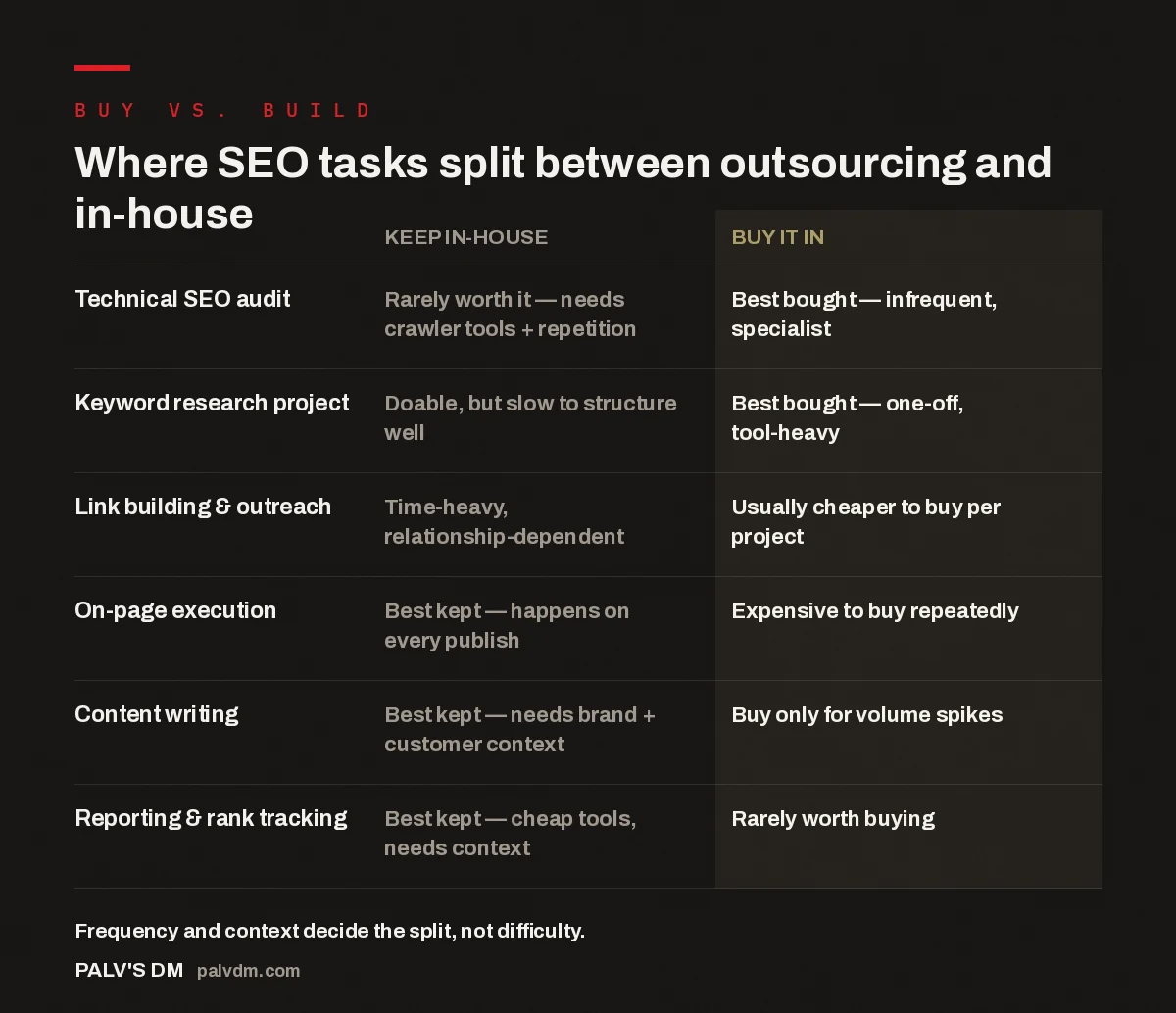
Where SEO tasks split between outsourcing and in-house
| Keep in-house | Buy it in | |
|---|---|---|
| Technical SEO audit | Rarely worth it — needs crawler tools + repetition | Best bought — infrequent, specialist |
| Keyword research project | Doable, but slow to structure well | Best bought — one-off, tool-heavy |
| Link building & outreach | Time-heavy, relationship-dependent | Usually cheaper to buy per project |
| On-page execution | Best kept — happens on every publish | Expensive to buy repeatedly |
| Content writing | Best kept — needs brand + customer context | Buy only for volume spikes |
| Reporting & rank tracking | Best kept — cheap tools, needs context | Rarely worth buying |
What actually separates a task worth outsourcing from one worth keeping in-house?
Two things decide this, and neither of them is “how hard is the task.”
The first is frequency. A technical crawl audit that surfaces indexation problems, orphan pages, and canonical conflicts takes real skill to run properly — but if you only need one done every six to twelve months, building that skill in-house rarely pays for itself. You would be maintaining a capability someone uses twice a year. Compare that to on-page optimisation, which happens every time you publish or update a page, often dozens of times a month for an active site. That frequency alone usually justifies keeping the skill in-house.
The second is context dependency. Writing a blog post in your brand’s voice, deciding which service page to prioritise this sprint, or reading a ranking drop against a product launch you know is coming — these need someone who already knows the business. An outside specialist can be excellent at SEO in general and still get this wrong, not from lack of skill but from lack of context they would need weeks to rebuild for every project.
Put those two filters together and the split becomes obvious: buy tasks that are infrequent and tool-heavy, keep tasks that are frequent and context-heavy.
Which SEO tasks should you outsource first?
A handful of tasks show up on almost every in-house team’s list of SEO tasks worth outsourcing, for the same underlying reasons each time.
- Technical SEO audits. These need crawler software, log-file access, and — more importantly — the pattern recognition that comes from running dozens of audits across different site types. A paid technical SEO check tends to find problems in a first pass that an in-house team without that repetition would spend weeks chasing, and might still miss.
- Keyword research projects. A structured keyword map for a new content plan or a site section is a project with a clear start and end, not an ongoing task. A paid keyword research project usually delivers a cleaner, better-prioritised list in a fraction of the time it would take someone learning the tools alongside their day job.
- Link building and outreach. Earning links well depends on relationships, outreach volume, and a feel for what a given niche’s publishers actually want — none of which an in-house marketer builds by doing it occasionally between other tasks.
- Team training. If the goal is for your in-house team to run SEO well going forward, not to keep buying every task forever, an SEO training session is worth buying once so the knowledge stays inside the company after the specialist’s engagement ends.
What connects all four: none of them need to happen weekly, and all of them get materially better with a repetition an in-house generalist rarely gets the chance to build.
Which SEO tasks are better handled by your in-house team?
The tasks worth keeping share the opposite profile — they happen often, and they need someone who already understands the business.
- On-page execution. Once you have a checklist from an audit, applying it — title tags, internal links, content structure — is repetitive work that benefits from someone who already knows the site’s information architecture. Buying this out repeatedly, page by page, gets expensive fast for something that is not actually specialist work once the framework exists.
- Content writing. A freelancer or agency can write competent content. They cannot write in your product’s voice, reference your actual customer objections, or know which claims your legal or sales team will push back on, without a long and expensive onboarding you would be paying for on every single article.
- Day-to-day reporting and rank tracking. The tools are cheap, and the interpretation only matters if it is tied to what actually changed on your site that week — a launch, a migration, a content push. That context lives with whoever is closest to the work.
- Prioritisation and roadmap decisions. Someone still has to decide what to do with an audit’s findings, in what order, against everything else the team is already committed to. That call needs company context an outside vendor does not have and should not be making for you.
Most in-house teams don’t have an SEO skills problem, they have an SEO priorities problem. They could learn to run a technical audit eventually — they just can’t learn it fast enough to matter for this quarter’s roadmap.
Palash, Founder, PalV’s DM
How do you decide when a task sits in the grey zone?
Not every task sorts itself cleanly, and a few genuinely sit in a grey zone — a competitor content audit, an internal linking overhaul, migration planning. Three questions usually settle it.
Will you need this again inside the next 12 months? If yes, and it is a skill you can reasonably build, lean toward doing it in-house, even slowly the first time. If it is genuinely a one-off — a one-time migration, a rebrand — buying it in usually costs less than the ramp-up.
What does getting it wrong actually cost? A rushed internal linking pass that misses a few opportunities is recoverable in the next content sprint. A botched migration that drops indexed pages can take months to recover from. The higher the downside, the more that argues for buying specialist judgment, at least for the first pass.
Do you already have the access and the tooling? If your team already has a paid crawler tool, Search Console access, and someone who has at least done this once, the marginal cost of doing it in-house drops a lot. If you would need to buy new tooling and licenses just to run one project, that cost belongs in the comparison too.
What does a realistic buy-vs-build split look like across a year?
Stacking one-time services into a DIY SEO programme describes this well: most in-house teams do not buy everything or build everything, they stack a handful of one-time purchases around a core of ongoing internal work.
A pattern that shows up often, in the accounts we work on: a technical audit and a keyword research project bought at the start of a push, to set direction and surface problems the team would not have caught alone. Then months of in-house execution — content production, on-page fixes, internal linking, reporting — using the priorities those two projects set. A training session bought partway through, once the team has enough hands-on experience to ask the right questions. Link building bought in on an ongoing basis, because it rarely gets cheaper to run in-house at the volume most sites need. And the technical audit repeated roughly once a year, since sites drift and new problems surface as they grow and change.
None of this requires guessing. It requires being honest, task by task, about which ones are one-off enough, or specialist enough, that buying them beats the time it would take to get good at them internally.
Not sure where to start?
If you would rather get a second opinion on your team’s current split before committing budget either way, we run fixed-scope, one-time SEO tasks designed to slot into an in-house team’s existing work — no retainer required.
Is it cheaper to outsource SEO tasks or hire in-house?
It depends on frequency, not raw cost. A task you need constantly — content writing, on-page work — is usually cheaper in-house once you account for onboarding a vendor to your context every time. A task you need once or twice a year, like a technical audit, is almost always cheaper to buy than to build and maintain that skill internally.
Can an in-house team learn to do everything an agency does?
Given enough time, mostly yes. The real question is whether the timeline works. Building specialist skill in link building or technical auditing takes months of repetition most in-house teams do not have the bandwidth for while also running their day-to-day work.
What SEO tasks should never be fully outsourced?
Content writing that needs brand voice and customer knowledge, prioritisation of what to fix first, and any decision that depends on context only your team has — a planned launch, a legal constraint, a sales objection. A vendor can inform these decisions, but they should not be the one making them.
How do we outsource SEO tasks without losing control of strategy?
Buy discrete, scoped deliverables — an audit, a research project, a training session — rather than open-ended ongoing work, and keep prioritisation and roadmap decisions in-house. The vendor’s output becomes an input to your plan, not the plan itself.
How often should a technical SEO audit be repeated?
Roughly every six to twelve months for an actively changing site, or after a major change like a migration, redesign, or significant content push, since new technical issues tend to surface as a site grows and changes.
The short version: outsource SEO tasks that are infrequent, tool-heavy, or need a specialist’s pattern recognition across many sites, and keep the tasks that happen constantly and need someone who already knows the business. Most in-house teams do not need to pick one model — they need an honest, task-by-task split, revisited every year or so as the team’s own skills and bandwidth change.