Service Support — One-Time Services
Turning an Audit Into a Prioritised Action Plan
How to build an SEO action plan from an audit: group findings by root cause, score impact vs effort, clear blockers first, then sequence into sprints.

An SEO action plan from an audit is built by grouping findings by root cause, scoring each group on impact and effort, flagging hard technical blockers first, and sequencing the rest into short sprints with a named owner and a re-check date. Most audits fail to produce change not because the findings were wrong, but because nobody turned a 60-page document into a work order someone could pick up on a Monday morning.
Key takeaway
- Group findings by root cause first — a template bug or crawl issue often explains a dozen “separate” findings at once.
- Score by impact and effort, not by the order the audit presents them; audit chapters are organised for thoroughness, not action.
- Every line on the finished plan needs an owner, a sprint, and a “done when” condition, or it quietly becomes a someday task.
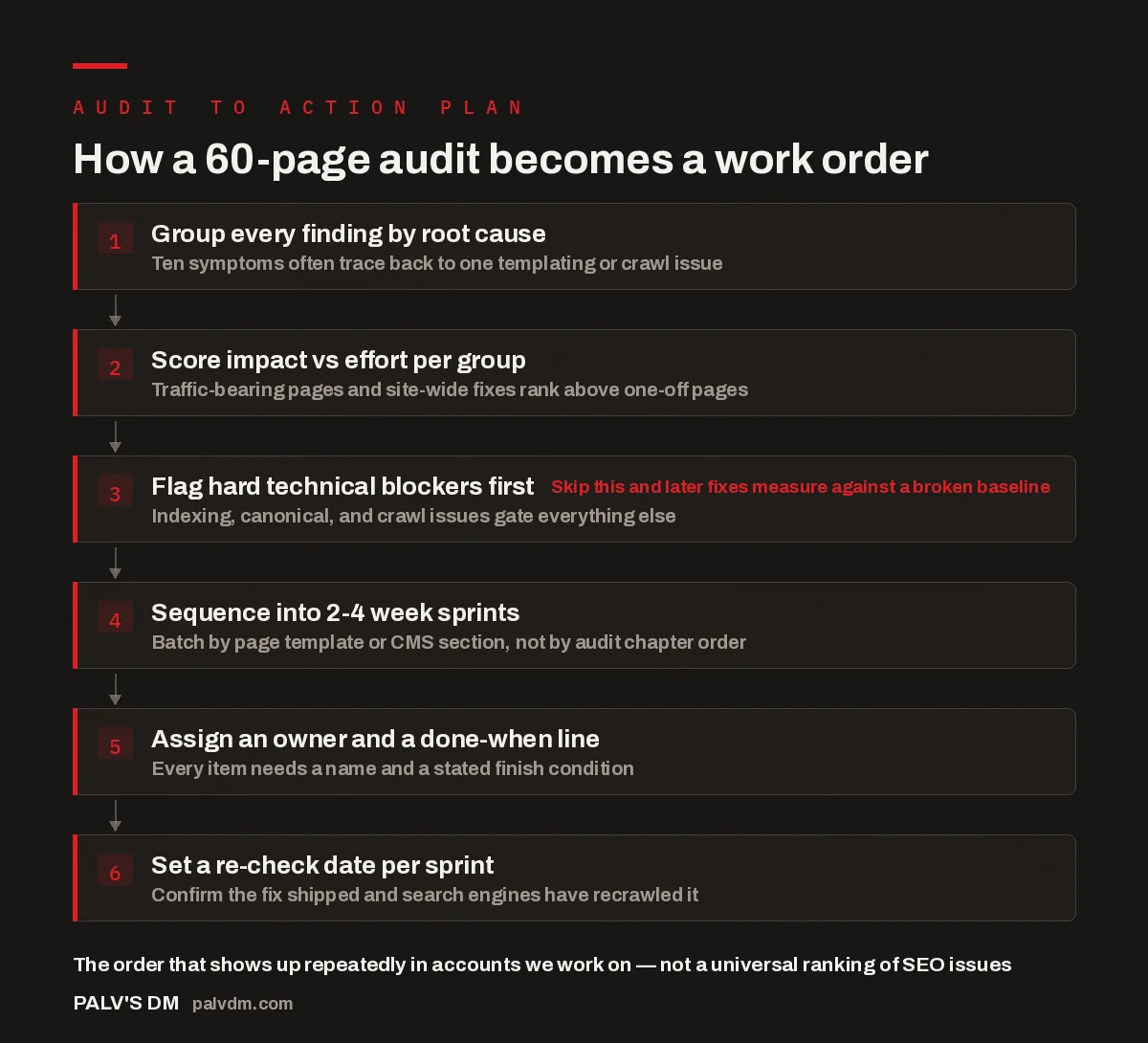
How a 60-page audit becomes a work order
- Group every finding by root cause. Ten symptoms often trace back to one templating or crawl issue.
- Score impact vs effort per group. Traffic-bearing pages and site-wide fixes rank above one-off pages.
- Flag hard technical blockers first. Indexing, canonical, and crawl issues gate everything else. Skip this and later fixes measure against a broken baseline
- Sequence into 2-4 week sprints. Batch by page template or CMS section, not by audit chapter order.
- Assign an owner and a done-when line. Every item needs a name and a stated finish condition.
- Set a re-check date per sprint. Confirm the fix shipped and search engines have recrawled it.
Why Do Most Audits Never Turn Into Action?
A good audit is written to be complete, not actionable. It walks the site systematically — crawlability, indexation, on-page, content, links — and reports every issue in the order the auditor happened to check it. That’s the right way to write an audit. It’s the wrong shape for a to-do list, which is why so many audits get read once, admired, and filed.
The gap sits between “here’s what’s wrong” and “here’s what we do first.” Nobody assigned an owner. Nobody said which of forty findings actually moves rankings versus which is cosmetic. Nobody put a date on anything. In the accounts we work on, this is the most common reason a paid audit sits unused for months — the document never got converted into a schedule with names attached.
How Do You Build an SEO Action Plan From an Audit?
Turning an audit into a plan is a re-sorting exercise more than a re-analysis. You already have the findings — the audit did that work. What you’re doing now is regrouping them by cause, ranking by payoff, and attaching the logistics that make execution possible, in six steps.
- Group every finding by root cause. Read the whole audit once before touching a spreadsheet, then cluster findings that share a cause rather than treating each bullet as its own task.
- Score each group on impact versus effort. Impact means pages that carry traffic or revenue, or fixes that apply site-wide; effort means developer hours, content hours, or approvals required.
- Flag hard technical blockers and move them to the front. Indexing, canonicalisation, and crawl-access issues aren’t just high-impact — they invalidate the payoff of everything scheduled after them.
- Sequence the remaining groups into short sprints. Two to four weeks per sprint keeps each batch small enough to actually finish and measure.
- Assign a named owner and a “done when” line to every item. A task with no owner and no finish condition is a wish, not a plan.
- Set a re-check date for each sprint. Confirm the change shipped, then confirm search engines have actually recrawled and reflected it before declaring the item closed.
How Do You Score Impact Versus Effort Without Fabricating Numbers?
You don’t need a precise projected-traffic figure for every finding to prioritise sensibly — and you shouldn’t invent one, since a made-up percentage lift is worse than no number at all. What you can score honestly is reach and effort. Reach: one page, a template used across hundreds of URLs, or the whole site? Effort: a five-minute edit, a developer ticket, or a re-platform decision? Plot each finding group on those two axes and the priority order becomes visible without a guessed statistic.
A missing meta description on one blog post is low reach and low effort — worth doing, but not first. A canonical tag misconfigured in the product page template is high reach and moderate effort, since fixing the template fixes every product page at once. That item goes to the top even though the audit may have listed the meta description issue three pages earlier.
What Counts as a Hard Technical Blocker?
A hard blocker is any issue that prevents search engines from correctly crawling, indexing, or attributing a page — not one that just makes an already-indexed page perform slightly worse. Examples that belong at the front: pages accidentally noindexed, robots.txt blocking sections that should be crawlable, wrong canonical tags, redirect loops, and duplicate content splitting ranking signals across near-identical pages.
These jump the queue not because they’re the most “important” finding alone, but because every fix scheduled after them is measured against a broken baseline. If a page category is noindexed, improving its copy produces zero visible movement — not because the copy failed, but because the page was never eligible to rank. Clear the blocker first, and the content work behind it starts counting.
An audit tells you what’s wrong. A plan tells you who fixes it, in what order, and by when. Most sites we look at have the first document and never produced the second.
Palash, Founder, PalV’s DM
How Should You Sequence the Work Into Sprints?
Batch by cause, not by audit chapter. If ten findings trace back to thin category descriptions, those ten belong in one sprint even though the audit scattered them across “on-page” and “content” sections. Working top to bottom through the document is the most common way DIY teams burn a quarter without progress — fixes compound when grouped and barely register when scattered.
| Following audit chapter order | Sequencing by grouped priority |
|---|---|
| Fixes are scattered across unrelated pages and root causes | Fixes are batched by the underlying issue they share |
| Effort spent on low-reach items before high-reach ones | Site-wide and traffic-bearing fixes go first |
| No natural point to measure whether a change worked | Each sprint has a clear before/after to check |
| Technical blockers get fixed whenever they appear in the doc | Technical blockers are cleared before dependent work starts |
Two to four weeks per sprint is a practical default — long enough to finish a batch of related fixes, short enough that you’re not waiting months to see if it moved anything. If your team is part-time on this, stretch the window rather than shrinking the batch; a smaller, coherent group of fixes still beats a scattered pile of unrelated ones.
Who Should Own Each Item, and What Does “Done” Mean?
Every line on the finished plan needs three things: a named person (not a department), a sprint number or date, and a one-sentence definition of done. “Fix canonical tags” is a finding. “Dev lead updates the product-page template’s canonical logic so every variant URL points to its parent — done when three sample pages show the correct canonical in page source” is a task someone can close out.
This is where DIY-managed action plans quietly stall even after good prioritisation — a well-scored, well-sequenced plan with no owner attached still sits in a document nobody feels responsible for. If you’re stacking one-time services yourself rather than running a retainer, the plan has to survive without an agency chasing it, so the ownership column matters more. For a fuller view of how one-off services fit together, see how to stack one-time services into a DIY SEO programme.
What Should the Finished Action Plan Actually Look Like?
Strip it down to five columns: finding group, priority tier (blocker / high / medium / low), owner, sprint, done-when. That’s the whole document — it doesn’t need the audit’s narrative or background context, which stay in the audit as reference material. The plan is a working sheet, not a second copy of the report. Most technical and on-page checks arrive detailed enough that this format is largely mechanical once the grouping and scoring above is done; the harder part is finishing those steps honestly.
If your audit came from a paid technical check, findings tend to arrive scoped tightly enough to slot straight into this format — see what a paid technical SEO check actually covers for what that input typically looks like.
What If You Can’t Act on Every Finding Right Now?
Not every business has the developer time or bandwidth to work through the full plan immediately. That’s normal — it means the plan needs an explicit “not now” tier alongside blocker/high/medium/low, so items are consciously deferred rather than silently dropped. See how to get value from a one-off audit you can’t implement yet for keeping an audit useful when full resourcing isn’t there this quarter.
If you’re buying audits and other one-time services piecemeal rather than on a retainer, the order you buy them in also affects how clean this planning step is — an audit bought before a keyword research project gives you priority data the keyword work can build on. The order to buy one-time SEO services in covers sequencing across services, not just within one audit.
Key takeaway
- If the plan-building step is where things keep stalling, that’s usually a resourcing gap, not a knowledge gap — worth naming honestly before the audit ages another quarter.
FAQ: Turning an Audit Into an Action Plan
How long should it take to turn an audit into an action plan?
For a typical small-to-mid-sized site, grouping, scoring, and assigning owners usually takes a few focused hours, not days. The bottleneck is rarely the planning itself — it’s getting sign-off and calendar time from the people who’ll execute each sprint.
Should I fix everything in the audit, or only the high-priority items?
Work through blockers and high-impact groups first, but don’t delete lower-priority findings — move them into a clearly labelled “later” tier. Many become cheap to fix once a developer is already in that part of the codebase for a higher-priority item.
What if two findings in the same group need different owners?
Split the group into sub-tasks with separate owners, but keep the same sprint and root-cause label so it’s still obvious they’re related. The point of grouping is shared context and measurement, not that one person does all of it.
How do I know if a fix actually worked after the sprint ends?
Check the specific thing the “done when” line described — the canonical tag is correct in page source, the page is indexed in Search Console, the description is live — before checking rankings. Technical fixes need to visibly ship and get recrawled first; ranking movement is a slower signal to check afterward.
Can I use this same process for an in-house audit, not just a paid one?
Yes — grouping, scoring, and sequencing don’t depend on who wrote the audit. A paid audit from an outside team usually arrives pre-scoped and consistently formatted, which makes grouping faster than working from internal notes collected over several sprints.
The Short Version
An audit is a diagnosis. A plan is a schedule with names on it. Get from one to the other by grouping findings by root cause, scoring by reach and effort rather than guessed numbers, clearing hard technical blockers before anything downstream, batching the rest into short sprints, and attaching an owner and a done-when line to every item. Skip the grouping and you’ll spend a quarter fixing scattered, disconnected things. Skip the ownership and the document quietly stops moving. Do both, and the audit you paid for finally turns into finished work.