AI Search Market Share: Who Actually Gets Used
ChatGPT's AI-search referral share fell from about 86.7% to 64.5% in a year while AI Mode passed a billion users. Why no single engine is a sufficient target.

AI search usage has consolidated less than most people assume. ChatGPT still leads AI-search referral share, but its dominance has eroded sharply — from roughly 86.7% in January 2025 to around 64.5% in January 2026, as Gemini, Perplexity and Claude took ground. Meanwhile Google’s AI Mode passed a billion monthly users, with queries reportedly doubling each quarter. The practical implication for visibility work: no single engine is a sufficient target, and the mix shifts fast enough that annual assumptions go stale.
Key takeaway
- ChatGPT’s AI-search referral share fell from roughly 86.7% to around 64.5% between January 2025 and January 2026.
- Google’s AI Mode passed a billion monthly users, making Google’s AI surfaces a major destination in their own right.
- Optimise across engines rather than for one, and re-check the mix rather than relying on last year’s numbers.
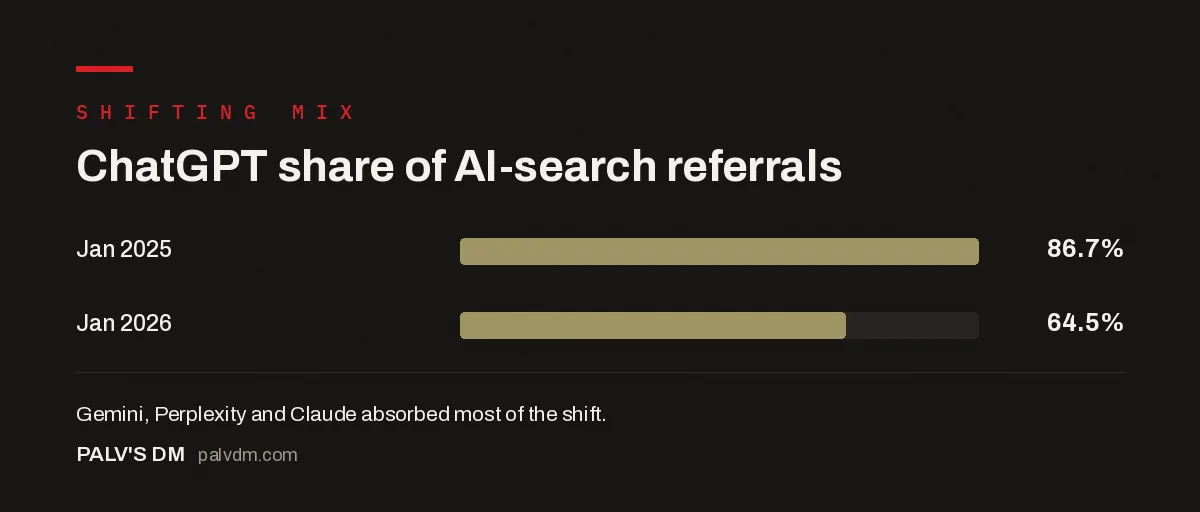
ChatGPT share of AI-search referrals
| Metric | Value |
|---|---|
| Jan 2025 | 86.7% |
| Jan 2026 | 64.5% |
Source: Similarweb data via industry reporting, 2026
The shift in referral share
Similarweb data reported through industry coverage shows ChatGPT’s share of AI-search referral traffic dropping from about 86.7% in January 2025 to roughly 64.5% a year later. That’s still a commanding lead, but losing more than twenty points of share in twelve months tells you the category is contested rather than settled. Gemini, Perplexity and Claude absorbed most of that movement. For anyone planning visibility work, the trend matters more than the snapshot: a single-engine strategy built on 2025 assumptions is already misallocated.
86.7% → 64.5%
ChatGPT’s share of AI-search referral traffic between January 2025 and January 2026, as Gemini, Perplexity and Claude gained ground. Still the leader, but no longer close to the whole market.
Source — Similarweb data via industry reporting, 2026
Google’s AI surfaces are their own story
Referral-share figures for AI assistants understate Google’s position, because AI Overviews and AI Mode largely answer within Google rather than sending measurable referrals to a separate AI product. AI Mode passed a billion monthly users according to announcements at Google I/O 2026, with query volume reportedly doubling per quarter, and it uses query fan-out to explore related sub-questions. AI Overviews appear across a large share of informational queries. So Google’s AI surfaces are a major visibility target regardless of where they sit in assistant referral rankings.
What the numbers should change
- Test across engines, not one. Your prompt set should run on ChatGPT, Google’s AI surfaces, Perplexity and Copilot at minimum. Position varies meaningfully between them.
- Cover both major indexes. Bing indexing supports Copilot and ChatGPT search; Google indexing supports Gemini, AI Overviews and AI Mode. Neglecting either closes doors.
- Weight by your own audience. Aggregate share tells you the landscape; your buyers’ actual habits should drive where you focus.
- Re-check periodically. Twenty points of share moved in a year. Treat any market-share figure, including these, as a snapshot with a short shelf life.
Read these figures carefully
Market-share numbers in this space deserve caution. Different providers measure different things — referral traffic, monthly active users, query volume — and those aren’t interchangeable. Referral-based figures capture only interactions that produced a click, systematically undercounting engines whose answers resolve in place. Definitions of “AI search” vary between analysts. So use these numbers to understand direction and rough proportion rather than as precise allocations, and verify current figures against primary sources when something material depends on them.
Frequently asked questions
Which AI search engine has the most users?
ChatGPT leads AI-search referral share, at roughly 64.5% in January 2026, down from about 86.7% a year earlier as Gemini, Perplexity and Claude gained. But Google’s AI surfaces are enormous on their own terms — AI Mode passed a billion monthly users — and referral figures understate them because those answers largely resolve within Google rather than referring out.
Is ChatGPT still dominant in AI search?
It leads, but far less overwhelmingly than a year ago. Losing more than twenty points of referral share between January 2025 and January 2026 indicates a contested rather than settled category. A visibility strategy built solely around ChatGPT is already misallocated, and the pace of change suggests any single-engine assumption will keep going stale.
Which engines should I optimise for?
Test and optimise across ChatGPT, Google’s AI surfaces, Perplexity and Copilot at minimum, weighting by your own audience’s actual habits. Practically this means covering both major indexes — Bing supports Copilot and ChatGPT search, Google supports Gemini, AI Overviews and AI Mode — since neglecting either closes off a substantial share of AI answers.
How reliable are AI search market share figures?
Treat them as directional. Providers measure different things — referral traffic, monthly users, query volume — which aren’t interchangeable, and referral-based figures undercount engines whose answers resolve without a click. Definitions of “AI search” also vary between analysts. Use these numbers for direction and rough proportion, and verify current figures against primary sources when something material depends on them.
The bottom line
ChatGPT still leads AI-search referrals but shed over twenty points of share in a year, while Google’s AI Mode crossed a billion monthly users. The category is contested and moving quickly. Optimise across engines, cover both Bing and Google indexes, weight by your own audience, and re-check the numbers rather than planning against last year’s snapshot.
We track visibility across every major AI engine, not just the biggest one. Part of our AI Visibility service.