How AI Search Engines Actually Retrieve and Cite Sources
AI engines chunk the web, embed it by meaning, retrieve the closest passages, and cite what they can attribute. The four-stage pipeline, and what each stage means for getting cited.
AI search engines retrieve and cite sources through a pipeline called retrieval-augmented generation: they break the web into passages, convert each into a mathematical representation of its meaning, retrieve the passages closest to a user’s question, and feed those into a language model that writes an answer and cites the sources it leaned on. Understanding each stage of that pipeline tells you exactly where citations are won and lost. This guide walks through how retrieval actually works and what each stage means for getting your content cited.
Key takeaway
- AI engines don’t rank pages — they retrieve passages, synthesise an answer, and cite the passages that shaped it. The unit of competition is the passage, not the page.
- Retrieval is semantic: it matches on meaning, not keyword overlap, so writing naturally about a topic beats stuffing exact-match phrases.
- Only 17% of AI Overview citations now come from pages ranking in Google’s top 10, down from 76% in mid-2024 — citation and ranking have decoupled.
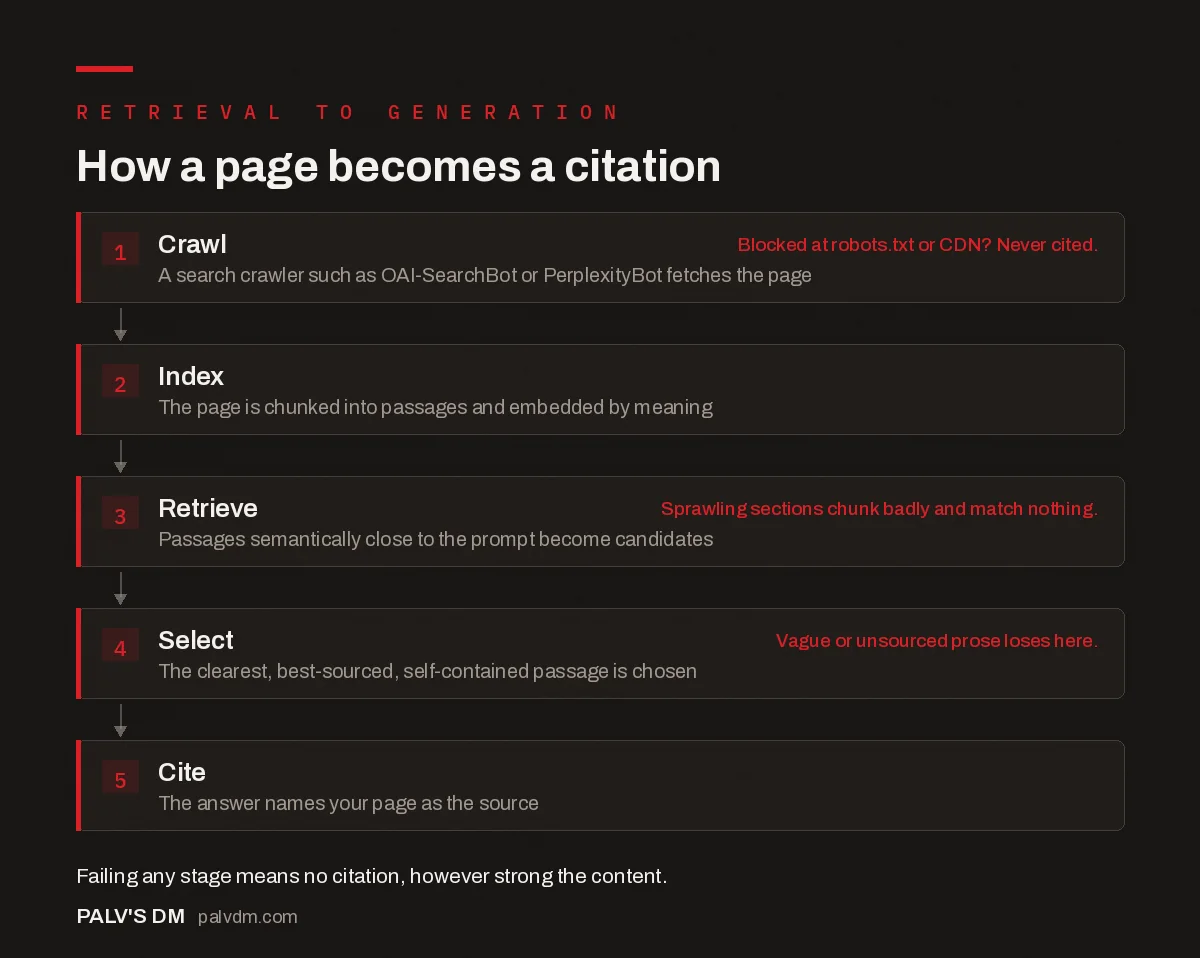
How a page becomes a citation
- Crawl. A search crawler such as OAI-SearchBot or PerplexityBot fetches the page. Blocked at robots.txt or CDN? Never cited.
- Index. The page is chunked into passages and embedded by meaning.
- Retrieve. Passages semantically close to the prompt become candidates. Sprawling sections chunk badly and match nothing.
- Select. The clearest, best-sourced, self-contained passage is chosen. Vague or unsourced prose loses here.
- Cite. The answer names your page as the source.
How does an AI search engine answer a question?
When you ask an AI engine a question, it runs a four-stage pipeline: it retrieves candidate passages from an index, ranks them by relevance to your question, feeds the top passages to a language model as context, and generates an answer that cites the sources those passages came from. This is retrieval-augmented generation, or RAG, and it’s the architecture behind ChatGPT Search, Perplexity, Google’s AI Overviews and most other AI answer engines.
The critical thing to grasp is that the model doesn’t answer from memory alone. For anything current or specific, it answers from the passages retrieved in that moment. So your job in getting cited isn’t to be memorised by the model — it’s to be the passage the retrieval system pulls when your buyer’s question comes in.
Stage one: chunking the web into passages
Before any question is asked, the engine breaks documents into chunks — passages roughly the size of a section or a few paragraphs. Your 1,500-word page isn’t stored as one unit; it’s stored as a dozen or so separate chunks, each independently retrievable.
This is why page-level thinking fails for AI search. The engine never retrieves your whole page. It retrieves the one chunk that best matches the question. A page with clean section boundaries chunks into coherent, self-contained passages; a page that’s a wall of text chunks arbitrarily, sometimes splitting an argument in half. Clear, frequent headings are, in effect, you telling the engine where to cut.
Stage two: embedding meaning as numbers
Each chunk is then converted into an embedding — a long list of numbers that captures the chunk’s meaning. Chunks about similar topics get similar embeddings and sit close together in a mathematical space. A passage about “reducing cart abandonment” and a question about “why shoppers leave without buying” can match even with no shared words, because their meanings are close.
This is the single most important shift from classic SEO. Retrieval is semantic, not lexical. It matches on meaning, not exact-phrase overlap. Repeating a target keyword fifteen times doesn’t make your embedding a better match — it just makes the prose worse. Writing clearly and completely about the actual concept is what produces an embedding that matches the questions people ask.
17%
Share of Google AI Overview citations that now come from pages ranking in the organic top 10, down from 76% in mid-2024. Retrieval increasingly pulls from a far wider pool than the first page of results — which is why ranking and citation have visibly decoupled.
Source — BrightEdge, February 2026; ALM Corp, March 2026
Stage three: retrieval and ranking
When a question arrives, the engine embeds the question the same way it embedded your chunks, then finds the chunks whose embeddings sit closest to it. Those become the candidate set. Many engines then apply a second ranking pass, weighing signals like source authority, freshness and how directly the passage answers the query, before selecting the handful that will actually inform the answer.
Two things decide whether your chunk survives this stage. First, semantic closeness — does the passage genuinely address the question? Second, the quality signals layered on top — is the source trusted, is the content recent, does the passage answer cleanly rather than circling the topic? A passage that’s semantically close but vague, dated or buried in an untrusted page can still lose to a sharper competitor.
Stage four: generation and citation
The top passages are handed to the language model as context, and it writes an answer grounded in them, citing the sources they came from. Here the engine favours passages that give it something concrete and attributable — a specific number, a named source, a direct statement it can stand behind. Vague prose gives the model nothing to cite, so even a retrieved passage can go unmentioned if a clearer competitor sits alongside it.
This is why the peer-reviewed research on AI citation found that adding statistics, quotations and citations was so effective. Those additions aren’t decoration; they’re the raw material the generation stage reaches for when it decides what to attribute. Aggarwal and colleagues, in the KDD 2024 paper that established the field, found these methods could lift a source’s visibility in generated answers by up to 40%.
What the pipeline tells you to do
Run your content through the four stages and the optimisation checklist writes itself:
- For chunking: use clear, frequent headings and clean section breaks so your page splits into coherent passages.
- For embedding: write naturally and completely about the real concept; drop keyword stuffing, which the research shows actively hurts.
- For retrieval: make each passage self-contained, directly responsive, current, and on a trustworthy page.
- For generation: give every important passage a concrete, attributable fact — a statistic, a named source, a direct answer the model can cite.
Frequently asked questions
Do AI engines answer from memory or from live search?
For anything current or specific, they answer from live retrieval, not memory. The engine retrieves passages from an index at the moment you ask, feeds them to the language model, and generates an answer citing those sources. The model’s trained knowledge fills in general context, but the specific, citable claims come from passages retrieved in real time — which is what you can influence.
Does keyword matching still work for AI search?
No. AI retrieval is semantic — it matches on meaning through embeddings, not exact-phrase overlap. A passage can match a question with no shared keywords if their meanings are close. Repeating a target phrase doesn’t improve your match and can worsen the prose. Writing clearly and completely about the actual concept produces the embedding that matches real questions.
Why does ranking on Google no longer guarantee AI citation?
Because retrieval draws from a far wider pool than the first page of results. Only 17% of AI Overview citations now come from the organic top 10, down from 76% in mid-2024. The engine retrieves the most relevant, extractable passages wherever they sit, so a lower-ranked page with cleaner, more citable passages can be chosen over a higher-ranked one.
What makes a passage more likely to be cited?
A passage is more citable when it’s self-contained, directly answers the question, sits on a trusted and reasonably fresh page, and contains something concrete to attribute — a statistic, a named source, or a clear direct statement. The generation stage reaches for attributable material, so vague prose gets retrieved but not cited, while a sharp, sourced passage gets named.
The bottom line
AI citation isn’t a black box once you see the pipeline. Engines chunk the web, embed it by meaning, retrieve the closest passages, and cite the ones with something concrete to attribute. Every optimisation that works maps to a stage of that process. Structure for clean chunks, write for semantic match, make passages self-contained, and give each one an attributable fact — and you become the source the pipeline pulls.
We optimise for every stage of the AI retrieval pipeline as part of our AI Visibility service — from chunk structure to citable, sourced passages.