Generative Engine Optimization: The Complete Guide
Generative engine optimization (GEO) makes AI engines like ChatGPT and Perplexity quote and cite you. What the KDD 2024 research proves, and the exact page changes that work.
Generative Engine Optimization (GEO) is the practice of structuring your content so that AI answer engines — ChatGPT, Google’s AI Overviews, Perplexity, Gemini and Copilot — quote it, cite it, and recommend you when someone asks a question your business should answer. It overlaps with SEO but it is not the same job. Ranking makes you eligible to be pulled into an answer. Being quotable is what gets you pulled. This guide covers what actually moves AI citation, what the peer-reviewed research proves, and the specific changes you can make to a page this week.
Key takeaway
- GEO optimises for synthesis: engines read a question, gather passages from several sources, write one answer, and cite a few. You win by being a passage worth pulling in — not by owning a ranking position.
- The strongest three moves, all tested in peer-reviewed research, are adding relevant quotations, citing authoritative sources, and replacing vague claims with real statistics. Keyword stuffing scored below doing nothing.
- Citation is more winnable from an underdog position than a #1 ranking is. A source ranked fifth roughly doubled its AI visibility after these changes; the top-ranked source lost share.
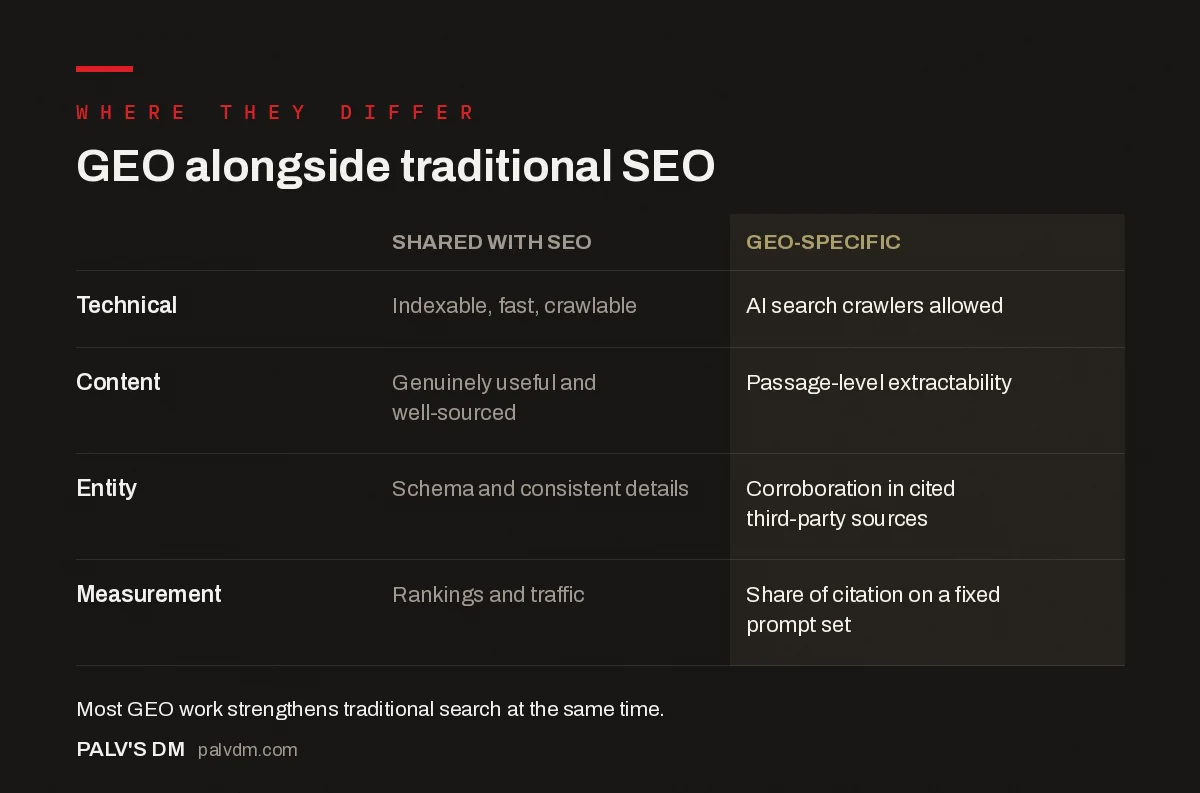
GEO alongside traditional SEO
| Shared with SEO | GEO-specific | |
|---|---|---|
| Technical | Indexable, fast, crawlable | AI search crawlers allowed |
| Content | Genuinely useful and well-sourced | Passage-level extractability |
| Entity | Schema and consistent details | Corroboration in cited third-party sources |
| Measurement | Rankings and traffic | Share of citation on a fixed prompt set |
What is generative engine optimization?
Generative engine optimization is the process of shaping content, structure and off-page presence so that large language models retrieve, quote and cite it when generating answers. Where classic SEO competes for a ranked position in a list of blue links, GEO competes for inclusion in a single synthesised answer that the engine writes itself.
The distinction is not academic. When a buyer asks ChatGPT “which SEO agency should a D2C brand in India hire,” there is no position two. Your brand is either named in that answer or it is absent. And the thing the engine selects isn’t your homepage — it’s a specific passage from a specific page that stood on its own well enough to be lifted into the response.
This is why a page can rank beautifully on Google and never surface in an AI answer. Ranking and citation run on different selection logic. One rewards a page that satisfies a human who clicks through and reads. The other rewards a passage a machine can extract, trust, and attribute without the surrounding page.
GEO, AEO and SEO: how they differ
Three acronyms get used interchangeably, and the sloppiness costs you. They target different mechanisms.
SEO targets ranking. You optimise a page to appear high in a list of results a person browses. AEO (answer engine optimization) targets extraction — featured snippets, People Also Ask, voice answers, where the engine lifts one passage from your page and displays it verbatim. GEO targets synthesis — the engine reads several sources, writes an original answer, and cites a subset.
~16%
Share of Google searches where AI Overviews now appear, and considerably higher on comparison and high-intent queries — the exact queries where buyers decide who to shortlist. The zero-click answer is no longer an edge case; for many commercial terms it is the default result.
Source — Search Engine Land, February 2026
The practical consequence: these three jobs share a foundation but reward different final moves. Good SEO makes you eligible for AI retrieval, because engines draw heavily on pages that already rank. But eligibility is not selection. You still have to earn the citation with structure the ranking never asked for.
What the research actually proves
Most GEO advice online is vendor marketing dressed as fact. The foundational peer-reviewed work is Aggarwal, Murahari, Rajpurohit, Kalyan, Narasimhan and Deshpande, “GEO: Generative Engine Optimization,” published at KDD 2024 and tested across roughly 10,000 queries spanning 25 domains against a live generative engine.
The researchers state their central result plainly: their methods can “boost the visibility of source content in generative engine responses by up to 40%.” That headline number is worth carrying carefully — it reflects the models and retrieval setup available at the time — but the ranking of what worked has held up across industry replication since.
Here is what moved the needle, in rough order of effect:
- Adding quotations from credible sources was the single strongest method tested.
- Citing sources — linking out to authoritative references for your claims.
- Adding statistics — replacing qualitative claims with quantitative, attributable ones.
- Fluency and language optimisation — cleaner, more readable, easier-to-parse prose.
And the finding that changes the strategic picture for anyone who isn’t already dominant: the effect was strongest for pages that weren’t ranked first. A source sitting around position five roughly doubled its visibility after adding citations, quotations or statistics, while the top-ranked source actually lost share. AI citation is more winnable from position five than the featured snippet is from position one.
What failed is as useful as what worked. Keyword stuffing scored below the unoptimised baseline — it made pages less visible than doing nothing. Cosmetic tone changes that only made content sound authoritative, without adding substance, produced no significant improvement. The engines are already robust to that trick.
How AI engines retrieve and cite sources
To optimise for the mechanism you have to know the mechanism. Modern AI answer engines mostly work through retrieval-augmented generation: the engine breaks the web into passages, embeds them, retrieves the passages most relevant to a query, and feeds those into a language model that writes the answer and attributes the sources it leaned on.
The load-bearing word is passages. Generative engines optimise at the passage level, not the page level. They retrieve chunks. A brilliant 3,000-word guide with no self-contained, extractable passages will lose to a plain 900-word page that answers the question cleanly in its first two sentences under a clear heading.
This reframes almost every content decision. Your heading isn’t a label — it’s the retrieval system’s signal for what the passage beneath it is about. Your opening sentence isn’t a warm-up — it’s the candidate the engine evaluates for extraction. A section that only makes sense if you’ve read the section before it is, to a retrieval system that arrives mid-page with no context, unusable.
The core GEO moves for any page
Translate the research into edits. These are the moves that carry the weight.
- Answer first. The first 40 to 60 words after any question heading must be a complete, standalone answer — not a preamble to one. This is the single passage most likely to be quoted. Everything else on the page earns the right to be read after it.
- Write self-contained sections. This is the highest-leverage structural move and the most commonly skipped. Every section must survive being extracted alone. Kill orphan pronouns — “this approach,” “these tools,” “that method” pointing back at a previous section. Restate the noun. It costs three words and it is the difference between citable and skipped.
- Add the triad: statistics, quotations, citations. Every substantial post should carry at least one real statistic with a named source, at least one named quotation, and outbound links to authoritative references. This isn’t decoration. In the KDD study it was the mechanism.
- Be specific to the point of discomfort. Dates, figures, versions, prices, timeframes, names. “Most sites improve” is worthless and unquotable. “Sites that fixed this recovered indexation within two to three weeks” is a sentence an engine can lift and attribute.
- Build a real FAQ block. Three to six genuine questions from People Also Ask, each answered in a self-contained 40-to-60-word paragraph. This one block feeds featured snippets, PAA, voice answers and generative citation from a single piece of work.
800M+
Weekly active users OpenAI reported for ChatGPT in 2026, with Google’s Gemini app past 750 million monthly users. This is the surface your buyers now use before they ever type your category into a search box — which is why passage-level citability is a commercial concern, not a technical one.
Source — Search Engine Land, February 2026
Why brand mentions beat backlinks for AI
On-page work makes you citable. Off-page work makes you findable by the retrieval layer, and the rules there are different from link-building. For generative engines, being mentioned across many authoritative third-party sites correlates more strongly with citation than backlink metrics do.
The reason is mechanical: retrieval draws on whatever the web says about you, and most of the web isn’t your website. The sources that disproportionately feed AI answers are Reddit, Wikipedia, LinkedIn, review and comparison platforms like G2 and Clutch, trade press and industry publications. A brand named consistently across those gets synthesised into answers even when its own domain is quiet.
For an Indian agency or D2C brand, the practical version of this is unglamorous and effective: earn genuine mentions in trade publications, place original research and expert commentary, maintain a real presence on the review platforms your category uses, and participate honestly in the communities where your buyers already ask questions.
How to measure AI visibility
You cannot manage what you refuse to measure, and rank tracking alone will not show you this. Track four layers. Presence: do you appear at all for target prompts? Citation: are you explicitly linked? Mention: are you named without a link — still valuable, still invisible to analytics? Downstream: referral traffic and conversions.
At small scale, manual prompt testing is the most reliable method. Build a fixed set of 20 to 30 prompts a real buyer would ask, run each several times across ChatGPT, Perplexity, Gemini and Copilot on a set cadence, and log which domains get cited. Run each prompt more than once — outputs vary between runs, so a single test tells you almost nothing.
Be honest about the blind spots. A large share of AI-referred sessions arrive with no referrer and land in your analytics as Direct traffic. Clicks that originate inside mobile apps are largely untrackable. AI Overview clicks are attributed as ordinary Google organic. Assume your measured AI traffic materially understates the real number, and set client expectations accordingly.
Frequently asked questions
Is GEO different from SEO?
Yes. SEO optimises a page to rank in a list of links a person browses. GEO optimises passages so an AI engine quotes and cites them in a synthesised answer. They share a foundation — ranking makes you eligible for AI retrieval — but citation requires structure the ranking never demanded, chiefly answer-first passages, self-contained sections, and attributable statistics.
Does ranking on Google guarantee AI citation?
No. Ranking makes you eligible, because retrieval draws heavily on pages that already rank, but eligibility is not selection. Research found that lower-ranked pages actually gained the most AI visibility from adding citations, quotations and statistics, while the top-ranked page lost share. A page can rank first and still be quoted by nothing.
How long does GEO take to show results?
Retrieval-based citation can shift within roughly four to eight weeks of content changes, because engines re-crawl and re-retrieve continuously. Changing what a base model “knows” without retrieval takes a full training cycle — months at minimum, and not directly controllable. Any vendor promising guaranteed AI citations by a fixed date is selling something.
What is the single most effective GEO change?
Rewrite the first sentence under each heading to answer that heading’s question outright, in one self-contained sentence with a real number where possible. In the KDD 2024 study, adding quotations and statistics produced the largest visibility gains. In practice the answer-first rewrite is the cheapest change that makes a page extractable at all.
Where to start
Don’t rebuild your site. Take the five pages that answer real buying questions in your category, and on each one do three things: rewrite the opening sentence to answer the question outright, add one real statistic with a named source, and make every section readable on its own. Then build a 20-prompt test set and run it monthly so you can see whether citation is moving.
GEO isn’t a trick layered on top of good content. It’s making genuine usefulness legible to a machine that reads in passages and cites what it can trust. If your page is the most useful and most quotable answer to a real question, the engines are increasingly good at finding it — and increasingly good at ignoring everything else.
Want your brand cited in AI answers, not just ranked on Google? That’s exactly what our AI Visibility service is built to do — grounded in the research above, measured with a fixed prompt set, reported monthly.