Building an Author Page That Actually Signals Expertise
Most author pages are decoration rather than evidence. What separates one that establishes real credibility from one that just fills a template.
An author page works when a sceptical reader could verify the expertise claim in about thirty seconds. Most author pages fail that test, because they contain adjectives rather than evidence. “Passionate about digital marketing with a keen eye for detail” tells a reader nothing checkable. “Five years in SEO, 1,000+ articles published, Google Analytics and Search Console certified, speaks at [named event], LinkedIn profile linked” gives them something to test. Google’s published self-assessment questions ask directly who created the content and whether it demonstrates first-hand expertise — an author page is the mechanism by which a site answers that, and a generic one answers it badly.
To be precise about what is and is not claimed here: Google has denied that it computes an author authority score, and there is no “AuthorRank”. What is documented is that its quality guidance asks about provenance and expertise, and that its search rater guidelines lean heavily on the reputation of creators. The author page is how you make that answerable.
Why most author pages do nothing
The default WordPress author archive is a list of posts with a one-line bio pulled from a profile field nobody filled in properly. It exists because the theme generates it, not because anyone designed it. Three specific failures recur:
Adjectives instead of evidence. “Experienced,” “passionate,” “results-driven,” “expert.” None of these can be checked, and unverifiable claims add nothing to a trust assessment.
No off-site corroboration. A claim of expertise that exists only on the site making the claim is circular. If nothing anywhere else confirms this person exists and does this work, the page is asserting rather than evidencing.
Impossible breadth. One author credibly covering SEO, cryptocurrency, skincare and personal finance undermines the signal rather than building it. Real expertise is narrow, and pretending otherwise is a tell.
What to actually put on the page
The identity block
Full real name and a real photograph of that person. Not a stock image, not an illustration of a generic professional. If the person is not willing to be publicly identified, an author page is the wrong tool — attribute to a named editor or reviewer instead, or publish a methodology page.
Credentials, stated specifically
Replace every adjective with a number, a date, an institution or a named thing. Years in the field. Qualifications and who issued them. Companies worked with, where confidentiality permits. Volume of work produced. If a claim cannot be expressed as something checkable, it is not a credential.
Evidence of having done the work
This is the “experience” half of E-E-A-T, and it is where most pages are thinnest. Case studies with real numbers (the strongest form of information gain), talks given, articles published elsewhere, tools or templates built, open-source contributions, an active professional profile. First-hand experience shows through specifics: the mistakes made, the thing that did not work, the detail nobody who had not done it would know.
Corroborating links
LinkedIn at minimum. Professional registers or certification directories where they exist. Conference speaker listings. Publications. These are the thirty-second verification path, and their absence is conspicuous.
A stated scope
Say plainly what this person covers and, implicitly, what they do not. “Palash writes about technical SEO, Google algorithm updates, and AI-answer visibility” is stronger than a page implying omniscience.
A way to reach them
An email, a form, a social profile that accepts messages. Contactability is a trust signal in its own right — accountable people can be contacted.
The schema layer
Everything above is for the reader. This part makes the same relationships machine-readable, which matters for both search and AI-answer surfaces.
Use Person schema on the author page with name, jobTitle, knowsAbout covering the stated scope, sameAs pointing at the corroborating profiles, and worksFor linking to the Organization. Then reference that same Person @id from the author field of every Article, so the entity is consistent across the site rather than repeated as unlinked strings.
The rule that matters: schema must match visible content. Marking up credentials that do not appear on the page is a trust problem, not a shortcut.
Connecting it to the articles
An author page nobody reaches does little. Three connections do most of the work.
- Every article byline links to it. Obvious, frequently missing — many themes render the name as plain text.
- A short author block at the end of each article, with two or three lines of the strongest credentials and a link through. This is where a reader who found the piece useful goes looking for who wrote it.
- Consistent naming everywhere. One canonical form of the name across the site, schema and off-site profiles. “P. Sharma” in one place and “Priya Sharma” in another fragments the entity.
The AI-answer angle
There is a second reason to do this properly, and it is newer than the E-E-A-T argument.
Generative engines cite sources, and a named expert with stated credentials is a stronger thing to attribute a claim to than an unattributed page. Peer-reviewed research on generative engine optimisation (Aggarwal et al., KDD 2024) found that adding quotations from named sources — alongside statistics and citations to authoritative sources — lifted visibility in generative answers by up to around 40%.
That finding is about quoting named sources within content, but the same logic applies to your own authorship: content attributable to an identifiable expert is easier for an engine to cite with confidence. Why anonymous content is losing ground covers the wider argument.
What not to do
- Do not invent authors. Fabricated personas with stock photographs are the one move here that can actively backfire, and they are increasingly easy to detect. No byline is better than a fake one.
- Do not attribute retrospectively to someone who did not do the work. Attribute to whoever genuinely wrote, edited or verified it.
- Do not create fifteen thin author pages. One substantive page beats fifteen templated ones.
- Do not list every topic on the site under every author. Breadth without depth reads as a template, because it is one.
- Do not noindex the author page. A technical audit catches this. Some SEO plugins do this by default. If it carries genuine credibility signals, it should be indexable.
A quick audit
Open your own author page and ask: could a stranger verify, in thirty seconds, that this person knows what they are talking about? Is there a single checkable fact on it? Does anything off-site confirm the claim? Would you hire this person based on what is here?
If the honest answer to any of those is no, the page is decoration. Fixing it is a couple of hours of work and it applies retroactively to every article that links to it — which makes it one of the highest-leverage things available on most sites, and one of the most consistently skipped.
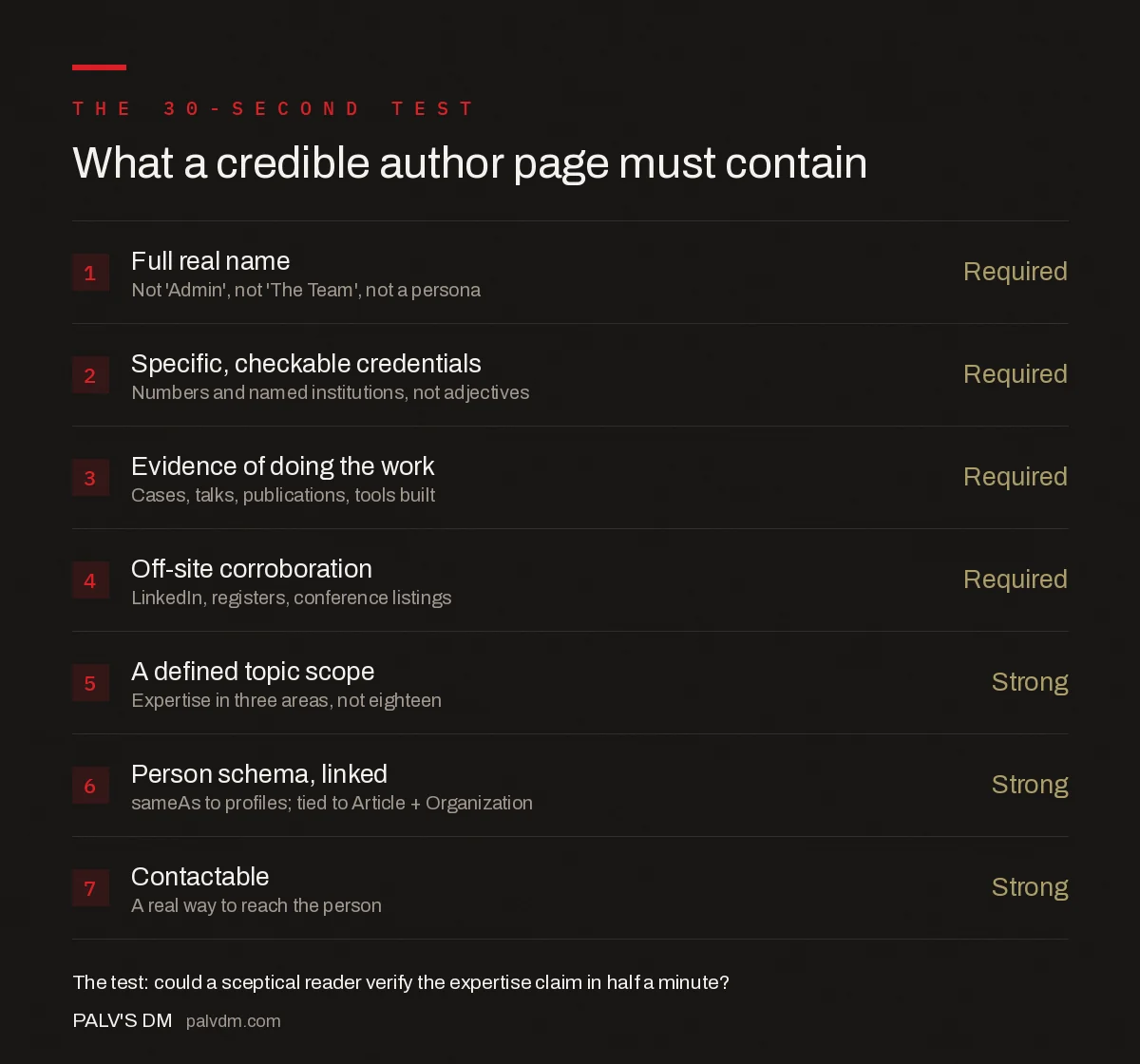
What a credible author page must contain
- Full real name — Required. Not ‘Admin’, not ‘The Team’, not a persona.
- Specific, checkable credentials — Required. Numbers and named institutions, not adjectives.
- Evidence of doing the work — Required. Cases, talks, publications, tools built.
- Off-site corroboration — Required. LinkedIn, registers, conference listings.
- A defined topic scope — Strong. Expertise in three areas, not eighteen.
- Person schema, linked — Strong. sameAs to profiles; tied to Article + Organization.
- Contactable — Strong. A real way to reach the person.
Frequently asked questions
Do author pages help SEO?
Indirectly, and the mechanism matters. Google has denied computing an author authority score, so there is no AuthorRank to build. What is documented is that Google’s self-assessment questions ask who created the content and whether it demonstrates first-hand expertise, and that its rater guidelines weigh creator reputation. An author page is how a site makes those questions answerable.
What should an author page include?
A full real name and photograph, credentials stated as checkable specifics rather than adjectives, evidence of having done the work such as case studies or talks, links to off-site profiles that corroborate the claim, a clearly defined topic scope, a way to make contact, and Person schema with sameAs links tying it to the Organization and to each Article.
Is it bad to publish content without an author byline?
It creates a structural gap rather than a penalty. Google’s first self-assessment question asks who created the content, and unbylined pages cannot answer it. Anonymous content is also harder for generative engines to cite with confidence. If a writer cannot be publicly identified, attributing to a named editor or reviewer, or publishing a transparent methodology page, is better than nothing.
Can I use a made-up author persona?
No. Fabricated authors with stock photographs are the one approach here that can actively damage trust, and they are increasingly straightforward to detect. Publishing with no byline is a smaller problem than publishing under an invented one, because a discovered fake undermines the credibility of everything else on the site.
Should one author cover every topic on the site?
No — breadth undermines the signal. One person credibly writing across many unrelated subjects reads as a template rather than as expertise, and Google’s guidance emphasises first-hand knowledge and depth. Define a narrow scope for each author and state it plainly, so both readers and Google’s systems can form a clear picture of what that person actually knows.
Sources
- Creating helpful, reliable, people-first content — Google Search Central
- Google Search Quality Rater Guidelines
- GEO: Generative Engine Optimization (Aggarwal et al., KDD 2024)
Want this done on your site?
Every PalV’s DM engagement starts with a free audit of your actual website — a 12-point
crawl covering what is blocking indexation, on-page gaps against your primary keywords, speed
findings, and the three to five fixes worth making first. Delivered in two working days. No
payment details, and the findings are yours whether you hire us or not.