Translating Content vs Writing Native: Multilingual Strategy
Should you translate content or write native for each language? A page-by-page filter for blog posts, product pages, and legal content, with real trade-offs.
Published August 2026 · Content team at PalV’s DM
Translating your best-performing English content is faster and cheaper than writing native content in each new language, but it works only for a narrow set of content types: product pages, help docs, and legal or policy pages where accuracy matters more than cultural fit. For blog content, comparison guides, and anything meant to rank or get cited in a local language, writing native almost always outperforms translation, because search intent, idioms, and even the questions people ask change from language to language, not just the words.
Most Indian D2C brands and B2B companies expanding beyond English-language search face this decision within the first year of serious content investment: Hindi, Tamil, Bengali, Marathi, or a regional mix. The wrong call either wastes a translation budget on content nobody searches for, or burns a native-writing budget on pages that didn’t need it.
What’s the real difference between translating and writing native?
Translation takes an existing piece of content and converts its words into another language, preserving structure, examples, and argument order. Native writing starts over: same topic, same target keyword intent, but researched and structured for how people in that language actually search and read.
The distinction matters because search engines increasingly reward content that matches local search behaviour, not just local vocabulary. A Hindi-language query about “best skincare for oily skin” doesn’t map word-for-word onto the English version — the products people compare, the price anchors they expect, and even the level of formality expected in the copy differ.
When does translation actually work?
Translation is the right call when the underlying information doesn’t change by geography or culture — only the language does.
- Product specifications and technical documentation. A washing machine’s dimensions are the same in Hindi and English.
- Legal, policy, and compliance pages. Terms of service, privacy policy, and DPDP Act disclosures need to say the same thing in every language version, not a locally-flavoured rewrite.
- Transactional UI copy. “Add to cart,” “Track your order,” and checkout flows are functional, not persuasive — translate them and move on.
- Support and help-centre content. A troubleshooting guide for a software bug behaves identically regardless of the reader’s language.
In each of these cases, a professional human translation (not raw machine translation left unedited) is faster to produce, cheaper per page, and just as effective as a native rewrite, because the value of the content lies in the information, not the framing.
When does native writing win?
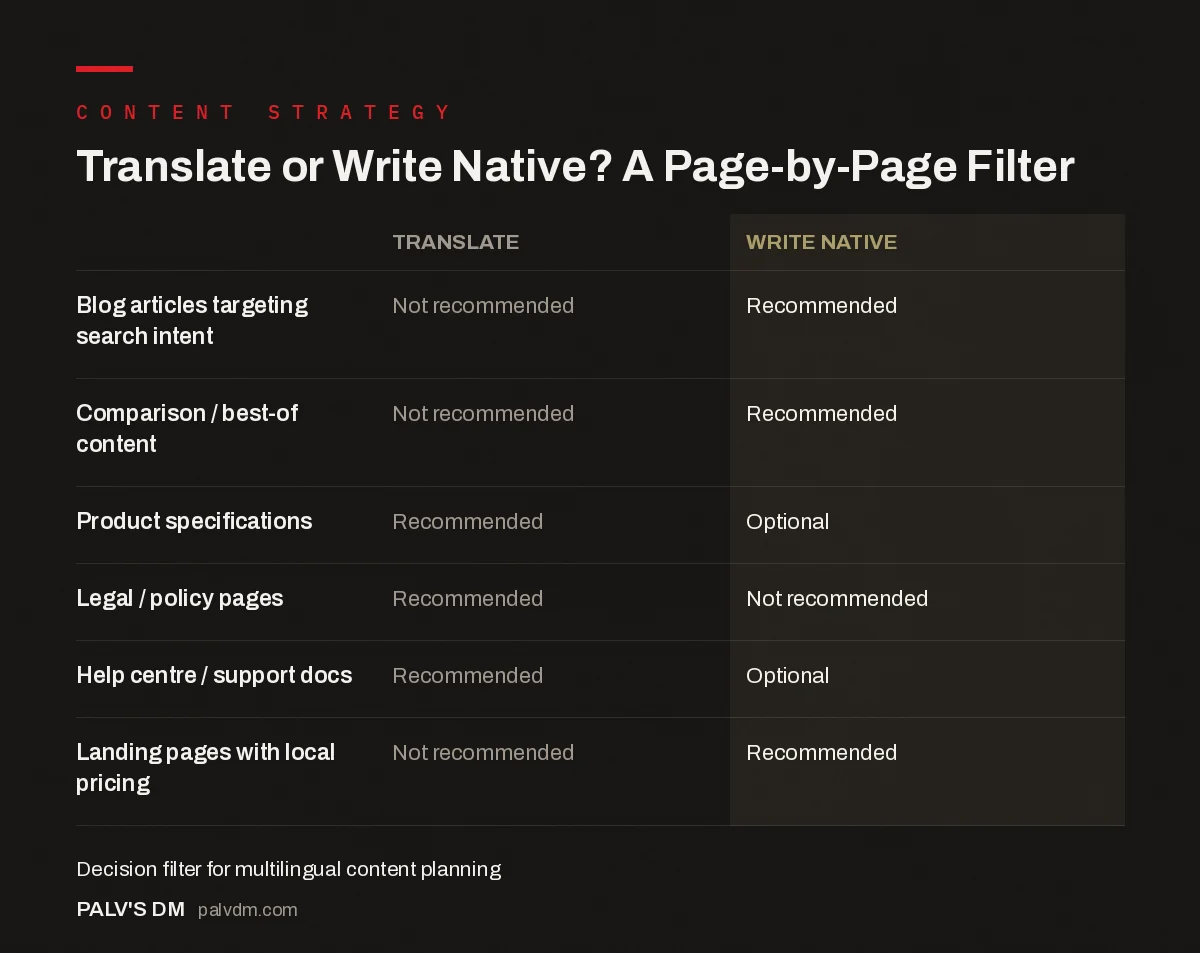
Translate or Write Native? A Page-by-Page Filter
| Translate | Write Native | |
|---|---|---|
| Blog articles targeting search intent | Not recommended | Recommended |
| Comparison / best-of content | Not recommended | Recommended |
| Product specifications | Recommended | Optional |
| Legal / policy pages | Recommended | Not recommended |
| Help centre / support docs | Recommended | Optional |
| Landing pages with local pricing | Not recommended | Recommended |
Native writing wins whenever the content’s job is to rank for a keyword a real local audience searches, persuade someone to buy, or get cited by an AI assistant answering a question in that language.
| Content type | Translate | Write native |
|---|---|---|
| Blog articles targeting search intent | No | Yes |
| Comparison / “best X” content | No | Yes |
| Landing pages with local offers or pricing | No | Yes |
| Product specifications | Yes | Optional |
| Legal / policy pages | Yes | No |
| Help centre / support docs | Yes | Optional |
| Brand storytelling / About pages | No | Yes |
Google’s own guidance on multi-regional and multilingual sites treats each language version as a separate content surface that needs to serve its own audience, not a mirror of the English page. That’s a strong signal that thin, literal translations of high-intent content work against the page, not for it.
What does it cost to get this wrong?
The most common mistake is translating a 2,000-word English blog post word for word into Hindi or Tamil and expecting it to rank. It usually doesn’t, for three concrete reasons:
- The keyword doesn’t map 1:1. The English phrase and its literal translation often have completely different search volumes, or the literal translation isn’t what people actually type.
- Examples and references don’t transfer. A pricing comparison built around unfamiliar brands means little to a reader searching in Marathi from Pune.
- Machine-translated tone reads as foreign. Even a well-edited translation tends to carry English sentence rhythm, which native speakers notice even if they can’t always name what’s off.
Hreflang tags help Google understand which language version to serve, but they don’t fix a page that was never written for its audience in the first place. If you’re already managing multiple language versions, it’s worth checking your hreflang implementation separately from the content-quality question — they’re related but not the same fix.
How should you decide, page by page?
A simple three-question filter works for most content decisions:
- Does this page need to rank for a keyword, or just convey information to someone who already arrived? If it needs to rank, write native.
- Does the content include examples, prices, or comparisons specific to a market? If yes, write native.
- Is the content purely functional (specs, legal terms, UI)? If yes, translate.
Run your top 20 pages by traffic or intended traffic through this filter before committing budget either way. Most content libraries turn out to be a mix — some translatable, the rest better served by native writing — though the exact split depends on how much of the site is transactional versus editorial.
What about AI-assisted translation tools?
Tools like DeepL and Google Translate’s neural models have improved considerably, and for internal use — understanding a competitor’s foreign-language page, or getting the gist of a support ticket — they’re good enough. The gap shows up specifically in published, customer-facing content where tone, idiom, and cultural reference carry weight.
A practical test: run a paragraph of your best English copy through a translation tool, then hand the output to a native speaker on your team with no context. Ask them one question — would you send this to a customer? In our experience briefing writers across Hindi, Tamil, and Bengali projects, the honest answer is almost always no for marketing copy, and almost always yes for a returns policy. That gap is the whole argument for this article.
Where AI translation genuinely helps is as a first draft for a human editor to work from on functional content, cutting editing time versus starting from a blank page. It should never be the last step before publishing anything meant to persuade or rank.
What does a hybrid workflow look like in practice?
A workable middle path for most Indian brands running English-plus-two-languages sites:
- Audit existing content and tag each page as “translate” or “rewrite native” using the filter above.
- Translate the functional pages first — this is quick, low-risk work that removes friction for non-English readers immediately.
- For blog and landing content, do fresh keyword research in the target language rather than translating the English keyword list. Search volumes and phrasing rarely match.
- Brief native-speaking writers with the target keyword and intent, not with the English article as a source text to translate.
- Track performance separately by language — a Hindi page competing in a thinner SERP can outperform its English equivalent surprisingly fast if it’s genuinely native, not translated.
FAQs
Is machine translation ever good enough for SEO content?
Raw, unedited machine translation is not good enough for content meant to rank or convert. It can work as a first-pass draft for functional content like specs or policies if a native speaker edits it afterward, but publishing it unedited risks both poor rankings and a weak experience for native readers.
How much more does native writing cost than translation?
Native writing typically costs more per page than translation because it requires fresh research, not just language conversion. The exact multiple varies by market and language pair, so get quotes for your specific language combination rather than assuming a fixed ratio.
Should every language version of a blog have the same structure?
Not necessarily. The core topic and search intent should match, but H2s, examples, and even word count can vary if that performs better for that language’s audience and SERP. Forcing identical structure across languages is a translation habit, not a native-content habit.
Do hreflang tags help translated content rank better?
Hreflang tags help Google serve the correct language version to the correct audience, which prevents duplicate-content confusion. They don’t improve the underlying quality or relevance of a page — that still depends on whether the content matches what the audience is actually searching for.
Can one writer handle both translation and native writing?
Only if they’re a native or near-native speaker of the target language with genuine content-marketing experience in that market. A bilingual translator without content-strategy training will default to translating even when asked to write native, because that’s the skill they have.
Multilingual content decisions get easier once you have a clear content strategy to work from — see our content strategy guide for the broader planning framework this fits into. If you’re managing this across freelancers, our notes on briefing freelance writers who aren’t SEO specialists and enforcing a quality bar across freelancers cover the operational side.
If your team is weighing translation against native content at scale, PalV’s DM’s content writing service can help you audit the split and brief native writers correctly from the start.