
Chunking: Why AI Engines Cite Passages, Not Pages
AI engines chunk pages into passages, embed each one, and retrieve the closest to the query. Understand chunking and you know exactly how to structure content to get cited.

Chunking is the reason AI engines cite passages instead of pages. Before an engine can answer a question, it breaks the web into small pieces — chunks — embeds each one as a mathematical representation of its meaning, and retrieves the chunks closest to the query. Your page never competes as a whole. Its individual chunks do. Understanding how chunking works tells you exactly how to structure content so the right pieces get retrieved and quoted. This post explains the mechanism and what to do about it.
Key takeaway
- AI engines split pages into chunks, embed each chunk, and retrieve the ones most semantically relevant to a query — the page is never the unit of retrieval.
- Clear headings and section breaks help engines chunk your content along meaningful boundaries instead of splitting mid-thought.
- Each chunk should carry one complete idea with its own context, because a chunk retrieved alone is all the engine sees.
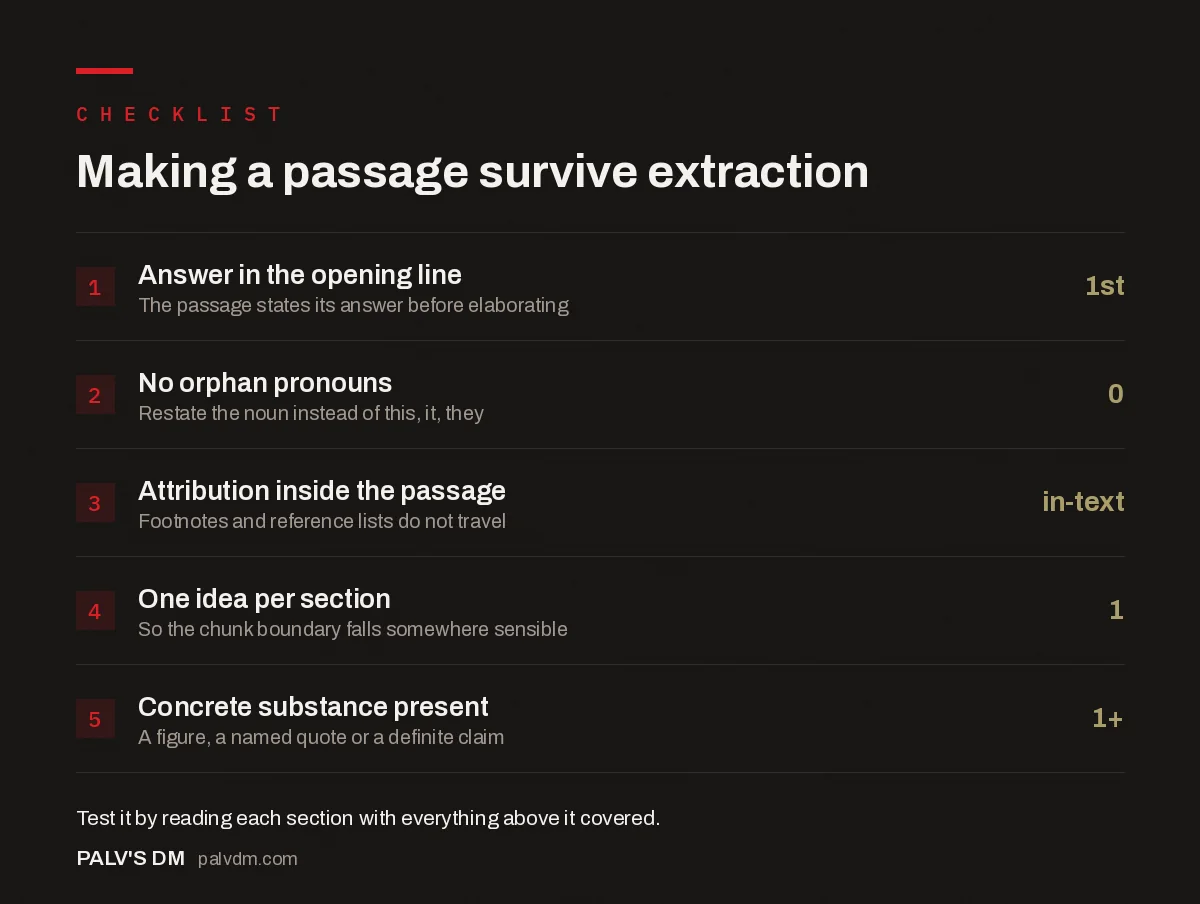
Making a passage survive extraction
- Answer in the opening line — 1st. The passage states its answer before elaborating.
- No orphan pronouns — 0. Restate the noun instead of this, it, they.
- Attribution inside the passage — in-text. Footnotes and reference lists do not travel.
- One idea per section — 1. So the chunk boundary falls somewhere sensible.
- Concrete substance present — 1+. A figure, a named quote or a definite claim.
What is chunking in AI search?
Chunking is the process by which an AI retrieval system divides a document into smaller passages before storing and searching it. Rather than treating your 1,500-word page as one indivisible unit, the system breaks it into chunks — often roughly section-sized or paragraph-sized — and treats each chunk as a separately retrievable piece of information.
This happens because language models have limited context and because precise retrieval needs precise units. If a system retrieved whole pages, it would feed the model huge amounts of mostly-irrelevant text to answer a narrow question. By chunking, it can retrieve just the paragraph that answers the query and ignore the rest of the page. Efficient for the engine, and decisive for you: it means your content is judged one chunk at a time.
How embeddings and retrieval work
After chunking, each chunk is converted into an embedding — a long list of numbers that represents the chunk’s meaning in a way a computer can compare. Chunks about similar topics end up with similar embeddings, sitting close together in a mathematical space. This is semantic, not keyword-based: a chunk about “lowering your bounce rate” and a query about “keeping visitors on the page” can match even without shared words, because their meanings are close.
When a user asks a question, the engine embeds the question the same way, then retrieves the chunks whose embeddings sit closest to it. Those retrieved chunks are fed to the language model, which writes an answer and cites the sources the winning chunks came from. So the entire contest is: is your chunk semantically close to the question, and is it self-contained enough to be useful once retrieved?
Passage > page
The core structural insight of generative engine optimization: engines optimise at the passage level, not the page level. A mediocre page with clean, self-contained chunks can beat a brilliant page whose chunks split mid-thought and carry no standalone context.
Source — GEO practice, grounded in Aggarwal et al., KDD 2024
Why bad structure produces bad chunks
Here’s where structure becomes concrete. If your page has clear headings and clean section breaks, the chunking system splits it along those meaningful boundaries — each chunk is a coherent section about one thing. If your page is a wall of undifferentiated paragraphs with vague or missing headings, the system splits it arbitrarily, sometimes mid-argument, producing chunks that start halfway through an idea and end before the point lands.
A chunk that begins “and the third reason is speed, which matters because…” is a poor retrieval candidate — it references a list the reader can’t see and assumes context that got left in a different chunk. A chunk that begins “Page speed affects AI citation for three reasons” is a strong one, because it names its subject and stands alone. Same information, different chunk quality, entirely because of where the section boundaries fell.
You don’t control the exact chunking algorithm, and it varies between engines. But you strongly influence where the natural boundaries are by how you structure the page. Good headings and clean sections are, in effect, you doing the engine’s chunking for it, along the boundaries that serve you.
How to structure content for clean chunking
- Use clear, descriptive headings often. Headings signal chunk boundaries. A page with a heading every 150 to 300 words gives the system obvious, meaningful places to split. Long stretches with no heading force arbitrary splits.
- Put one idea in each section. A section built around a single question chunks into a single coherent unit. A section that wanders across three topics either chunks badly or gets retrieved for the wrong query.
- Make each section self-contained. Because a chunk is retrieved alone, it must carry its own context — name its subject, define its terms, avoid pointing back at earlier sections. This is the same discipline that self-contained sections require, and chunking is exactly why it matters.
- Front-load each section. State the section’s key point in its first sentence. Retrieval and generation both weight the start of a chunk, and a front-loaded chunk answers the query before any padding.
- Keep paragraphs focused. Short, single-point paragraphs chunk more cleanly than sprawling ones that bundle several ideas a system might want to separate.
What this means for long content
Chunking reframes the length debate. A long page isn’t penalised for being long — it’s penalised for being an undifferentiated mass. A 3,000-word page structured as fifteen clean, self-contained, well-headed sections is fifteen strong retrieval candidates. The same 3,000 words as six sprawling sections is a handful of muddy chunks.
So depth is fine, even valuable, as long as it’s organised into cleanly-chunkable units. Write comprehensively, then break the comprehensiveness into sections that each stand alone. Length plus structure wins. Length without structure buries your best passages inside chunks no engine can cleanly retrieve.
Frequently asked questions
What is content chunking?
Content chunking is how AI retrieval systems divide a page into smaller passages before storing and searching it. Instead of treating your page as one unit, the system breaks it into chunks — roughly section or paragraph sized — embeds each one, and retrieves the individual chunks most relevant to a query. Your content is judged one chunk at a time, not as a whole page.
How do I control how my content gets chunked?
You can’t control the exact algorithm, but you strongly influence the boundaries. Clear, frequent headings and clean section breaks give the system obvious, meaningful places to split, so chunks align with coherent sections instead of splitting mid-thought. Structuring each section around one self-contained idea is effectively doing the chunking yourself, along boundaries that serve you.
Does chunking mean shorter content is better?
No. Chunking means well-structured content is better, at any length. A long page organised into many clean, self-contained, well-headed sections is many strong retrieval candidates. The same length as a few sprawling sections produces muddy chunks. Depth is valuable as long as it’s broken into cleanly-chunkable units — length plus structure wins.
What are embeddings?
An embedding is a list of numbers representing a chunk’s meaning so a computer can compare it to others. Chunks about similar topics get similar embeddings and sit close together mathematically. When you ask a question, the engine embeds it too and retrieves the chunks whose embeddings are closest — which is why semantic relevance, not keyword matching, decides what gets retrieved.
The bottom line
Chunking is why “make each section stand alone” is advice with teeth rather than a style note. Engines break your page into pieces, judge each piece on its own, and cite the pieces that win. Give them clean boundaries with frequent clear headings, one idea per section, and self-contained context, and your best passages become retrievable. Leave the page as an undifferentiated wall, and those same passages disappear into chunks nothing can use.
We structure content for clean chunking and retrieval as part of our AI Visibility service — headings, boundaries, and self-contained passages built for how engines actually read.