Building a Content Style Guide From Scratch
A content style guide should be short enough to actually use. Here is what to include -- voice, grammar, banned words, formatting -- and how to build it.
Published: August 2026
A content style guide is a working document that tells anyone writing for a brand how it sounds, how it formats, and what it never does — built so a new writer can produce on-brand content without needing a senior editor to rewrite it first. The most useful ones are short enough to actually get used: a handful of pages covering voice, grammar rules specific to the brand, formatting conventions, and a list of banned words or phrases, not a fifty-page document nobody opens after week one.
Most content teams either have no style guide, which means every writer makes their own calls and consistency depends entirely on one editor’s memory, or they have a style guide too long and too abstract to actually change how anyone writes. This post covers what to include, in what order, to build one that gets used.
What should a content style guide actually contain?
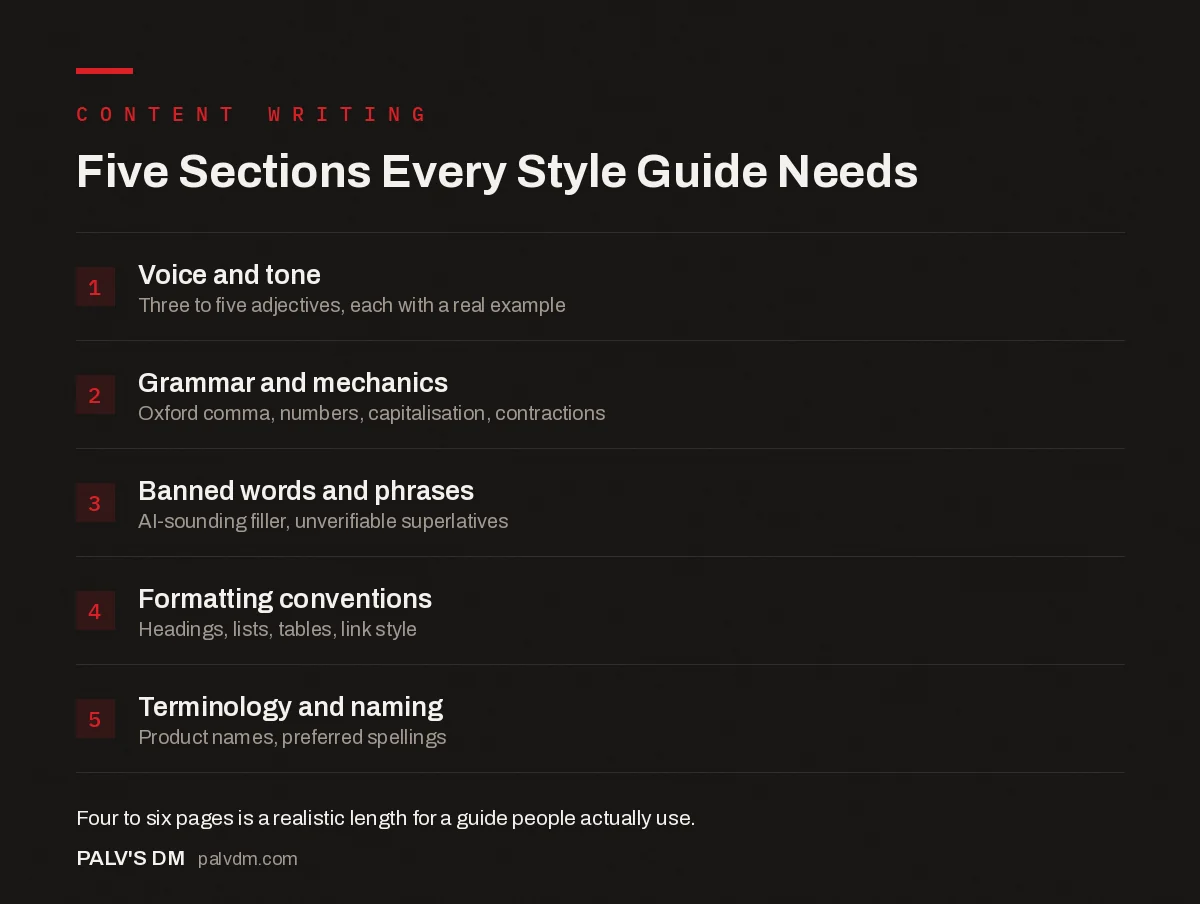
A working style guide covers five areas, roughly in this order of how often writers will reference them:
| Section | What it covers | Why writers check it often |
|---|---|---|
| Voice and tone | Three to five adjectives describing how the brand sounds, with examples of on-brand and off-brand sentences | Sets the ceiling for every other decision in the doc |
| Grammar and mechanics | Oxford comma stance, number formatting, capitalisation rules, contraction policy | Comes up in nearly every sentence written |
| Banned words and phrases | Specific words the brand avoids, and why | Fastest thing to check before submitting a draft |
| Formatting conventions | Heading structure, list usage, table usage, link style | Keeps structure consistent across writers |
| Terminology and naming | Product names, capitalisation of brand-specific terms, preferred spellings | Prevents inconsistent references to the same thing |
How do you define a brand’s voice without vague adjectives?
“Friendly” and “professional” mean almost nothing on their own, because every brand would claim both. A voice definition becomes useful only once it’s paired with concrete before-and-after examples showing what the adjective actually changes in a real sentence.
A workable format: pick three to five voice adjectives, then for each one, write one sentence that fits the brand and one that doesn’t, with a short note on why. “Direct” might mean writing “This costs ₹8,000 a month” instead of “Pricing starts at a competitive rate” — the example does more work than the adjective ever could on its own.

Five Sections Every Style Guide Needs
- Voice and tone. Three to five adjectives, each with a real example.
- Grammar and mechanics. Oxford comma, numbers, capitalisation, contractions.
- Banned words and phrases. AI-sounding filler, unverifiable superlatives.
- Formatting conventions. Headings, lists, tables, link style.
- Terminology and naming. Product names, preferred spellings.
What belongs on the banned words list?
Every brand’s banned list differs, but the categories worth checking are consistent:
- Generic AI-sounding phrases. “Delve,” “leverage,” “robust,” “seamless,” “in today’s landscape” — words that signal templated writing more than they communicate anything specific.
- Unverifiable superlatives. “Best-in-class,” “revolutionary,” “game-changing” — claims that require evidence the brand usually doesn’t have on hand.
- Words that don’t match the brand’s actual register. A brand aiming for plain, direct language might ban corporate jargon like “synergy” or “circle back,” regardless of whether those words are inherently bad.
- Competitor names, if the brand’s policy is not to name them directly.
The list works best when it’s a living document. Add a phrase the moment an editor catches themselves removing it from a draft for the third time — that’s the signal it belongs on the list rather than being corrected ad hoc forever.
How do you get a style guide actually used, not just written?
A style guide that sits in a shared drive nobody opens fails at its only job. What makes the difference:
- Keep it short. Four to six pages is a realistic target; anything requiring a table of contents is too long to be checked mid-draft.
- Put it where writing happens. Linked directly in the brief template or CMS, not buried three folders deep.
- Review it in actual edits. When an editor corrects something covered by the guide, reference the specific rule rather than just fixing it silently — that’s how writers learn the guide exists and applies to them.
- Update it from real disagreements. Every editorial debate about phrasing or formatting is a prompt to either add a rule or confirm the existing one still holds.
How is a style guide different from brand guidelines?
Brand guidelines typically cover visual identity — logo usage, colour palette, typography — and sometimes a high-level mission statement. A content style guide is narrower and more tactical: it’s specifically about how words get chosen and arranged on the page. The two should agree with each other, but a content style guide needs far more granular, writing-specific detail than most brand guideline documents provide, which is why most content teams end up building a separate one even when brand guidelines already exist.
How do you build the first version if nothing exists yet?
Starting from a blank page is harder than editing an existing guide, so the fastest path is usually to reverse-engineer one from content that’s already working. Pull five to ten pieces of the brand’s best-performing or most on-brand content, and look for patterns: sentence length, how often contractions appear, whether numbers are always specific or sometimes vague, how the brand handles disagreement or criticism in its own writing.
Draft the voice and grammar sections from those patterns first, since they’re grounded in evidence rather than aspiration. The banned words list and formatting conventions can follow once the voice section is solid, because both of those are really just the voice section’s rules made specific and checkable. A style guide built this way tends to match how the brand actually writes, which makes it easier for writers to follow without feeling like they’re performing a persona.
What does a real style guide entry look like, start to finish?
Abstract advice about style guides is easy to nod along to and hard to apply, so it helps to see one complete entry. Take the “contractions” rule, which sounds trivial but trips up more drafts than almost any other mechanical rule:
Rule: Use contractions in body copy (don’t, it’s, we’re), but avoid them in headings and CTAs. Reasoning: contractions in body text match how the brand actually talks to customers in support chats and sales calls; formal headings read cleaner without them, and CTAs like “Get Started” or “Book a Call” sound more direct without a contraction softening them. Example that follows the rule: “We don’t guarantee rankings, because nobody honestly can.” Example that breaks it: “We do not guarantee rankings, as this cannot be honestly promised by any agency,” which is grammatically fine but sounds like it was written by legal rather than by the brand.
That single entry is four sentences and one paired example, and it resolves a decision a writer would otherwise make inconsistently draft to draft. A full style guide is essentially twenty to thirty entries built the same way, organised under the five sections above.
What mistakes derail a style guide rollout?
Three patterns show up repeatedly when a new style guide fails to change how a team actually writes. The first is rolling it out without revisiting existing content — writers see the guide but the archive of old posts still models the pre-guide voice, so new hires copy the wrong examples by accident. Auditing and updating even a handful of flagship pages to match the new guide gives writers a working reference beyond the document itself.
The second is treating the guide as a one-way instruction rather than a negotiated document. A style guide written entirely by one person and handed down tends to generate quiet resistance — writers follow the letter of the rules while disagreeing with them, which shows up as stiff, joyless copy that technically complies. Guides built with input from the writers who’ll use them daily get followed with more conviction because the writers understand the reasoning, not just the rule.
The third is confusing a style guide with an editing checklist. A style guide should explain why a rule exists, in enough depth that a writer can extend the logic to situations the guide doesn’t explicitly cover. A checklist just lists dos and don’ts with no reasoning, which works for catching mechanical errors but does nothing when a writer hits an edge case the list didn’t anticipate.
FAQs
Who should own the content style guide?
Usually the person doing final editorial review, whether that’s a content lead, editor, or marketing manager. Ownership matters because the guide needs a single decision-maker when writers disagree about a rule, rather than being edited by consensus and slowly becoming contradictory.
How often should a style guide be updated?
Whenever a real disagreement or repeated correction surfaces a gap, plus a scheduled review every six to twelve months to catch rules that have quietly gone stale as the brand’s positioning shifts.
Should freelancers get the same style guide as in-house writers?
Yes, and arguably freelancers need it more, since they lack the ambient context an in-house writer picks up from sitting in on brand conversations. A clear, specific style guide reduces the number of revision rounds needed on freelance work significantly.
Does a style guide need to cover SEO formatting too?
It helps to include baseline conventions — heading hierarchy, internal linking habits, meta description length — even if deeper SEO strategy lives in a separate document. Writers benefit from having formatting and voice guidance in one place rather than switching between documents mid-draft.
What’s the biggest reason style guides go unused?
Length and vagueness, usually together. A forty-page document full of abstract principles gets skimmed once and never opened again. A short document with concrete before-and-after examples gets checked mid-draft because it actually answers the question a writer has in the moment.
Where a style guide fits in a content programme
A style guide is most useful once tone of voice is documented separately in enough depth that the style guide can reference it rather than redefine it from scratch, and it pairs with formatting conventions for scannable content so writers aren’t guessing at heading structure and paragraph length post by post. Within a broader plan, the style guide should be treated as infrastructure supporting the content strategy, not a one-off deliverable.
Building a style guide that writers actually reference, rather than one that gets written once and forgotten, takes iteration based on real drafts. PalV’s DM’s content writing team builds style guides from a client’s existing best content, then tests them against new drafts before calling them finished.