
Word Count Targets: Deriving Them From Competitors, Not Guesses
Stop guessing blog post length. Learn to derive word count targets from top-10 SERP competitor averages and real subtopic coverage.

The right word count for a blog post is whatever the top 5-10 ranking pages for that keyword average, adjusted up or down based on how completely they cover the topic. There is no universal number. A definitional post answering “what is a pillar page” might need 700 words. A comparison guide covering ten CRM tools might need 3,500. The mistake most content teams make is picking a round number like 1,500 or 2,000 and applying it to every brief, regardless of what the query actually demands.
Published August 2026.
Why picking a fixed word count for every post is a mistake
A fixed target treats every keyword as if it needs the same depth of answer, which is rarely true. “Content governance” and “what is a meta description” are both content topics, but one needs a framework with roles and approval stages, the other needs three sentences. When you force both into a 1,800-word template, the short-answer post gets padded with filler and the complex one gets cut short before it’s actually useful.
Search engines don’t reward length on its own. Google’s own guidance on helpful content repeatedly stresses that content should be created for people first, with the depth that best serves the query, not a target length chosen in advance. Word count is a proxy for comprehensiveness, and proxies break down the moment you optimise for the proxy instead of the thing it’s standing in for.
How do you find the real word count target for a keyword?
Open the top 8-10 organic results for your primary keyword and record the visible body word count for each, excluding navigation, comments, and boilerplate. Ignore the top one or two results if they’re clearly outliers (a Wikipedia page or a government site with domain authority no blog can compete with on merit alone). Average the rest. That average is your floor, not your ceiling.
From there, look at what those pages actually cover: their H2s, the subtopics they touch, the questions they answer. Build a list of every subtopic that appears across at least three of the top 10 pages. That combined list is your coverage requirement. If covering it properly takes you 20% more words than the competitor average, write the 20% more. If you can cover it completely in fewer words because you’re explaining things more efficiently, a shorter post that fully answers the query will usually outperform a padded longer one.
A simple process for setting the target
- Pull word counts for the top 8-10 ranking pages. Manual copy-paste into a spreadsheet works fine for one keyword; if you’re doing this across dozens of briefs, a crawler like Screaming Frog can pull body word counts in bulk.
- Drop obvious outliers. A 6,000-word Wikipedia entry sitting at position 3 for a commercial keyword isn’t a target, it’s noise.
- Calculate the average of what’s left. This is your baseline.
- List the subtopics the top pages cover in common. These are non-negotiable inclusions.
- Set your target as the baseline, adjusted for what full coverage actually requires. Write to that number, not past it.
Does a longer post always rank better?
No, and treating length as a ranking factor on its own leads to bloated, padded content that readers bounce from. Ahrefs and other SEO research groups have repeatedly found that word count alone shows a weak correlation with ranking position once you control for backlinks and content quality; the correlation people see in raw data is mostly because comprehensive content happens to be longer, not because length itself causes rankings. A 900-word post that answers the query completely, with no throat-clearing, will often outrank a 2,400-word post that says the same thing three times in different words.
The practical test: read your draft and ask if every paragraph would be missed if deleted. If a section could disappear without the reader losing anything, it’s padding, and padding hurts both readability and, increasingly, how AI answer engines select passages to cite. Generative engines tend to pull tight, self-contained explanations, not the longest paragraph on the page.
What word count ranges work for different content types?
| Content type | Typical range | Why |
|---|---|---|
| Definitional (“what is X”) | 600-1,200 words | The query wants a direct answer, not a treatise |
| Standard how-to guide | 1,200-2,200 words | Needs prerequisites, numbered steps, and common mistakes |
| Comparison or “X vs Y” | 1,500-2,500 words | A fair comparison needs a table plus context for each side |
| Pillar or hub page | 2,000-3,500 words | Has to summarise an entire topic cluster and link out to it |
| Listicle | Varies with item count | Roughly 120-200 words per self-contained item, plus intro |
| News or update | 300-700 words | Timeliness matters more than exhaustive coverage |
These ranges are starting points, not rules. Always check what’s actually ranking for your specific keyword before locking a target into a content brief.
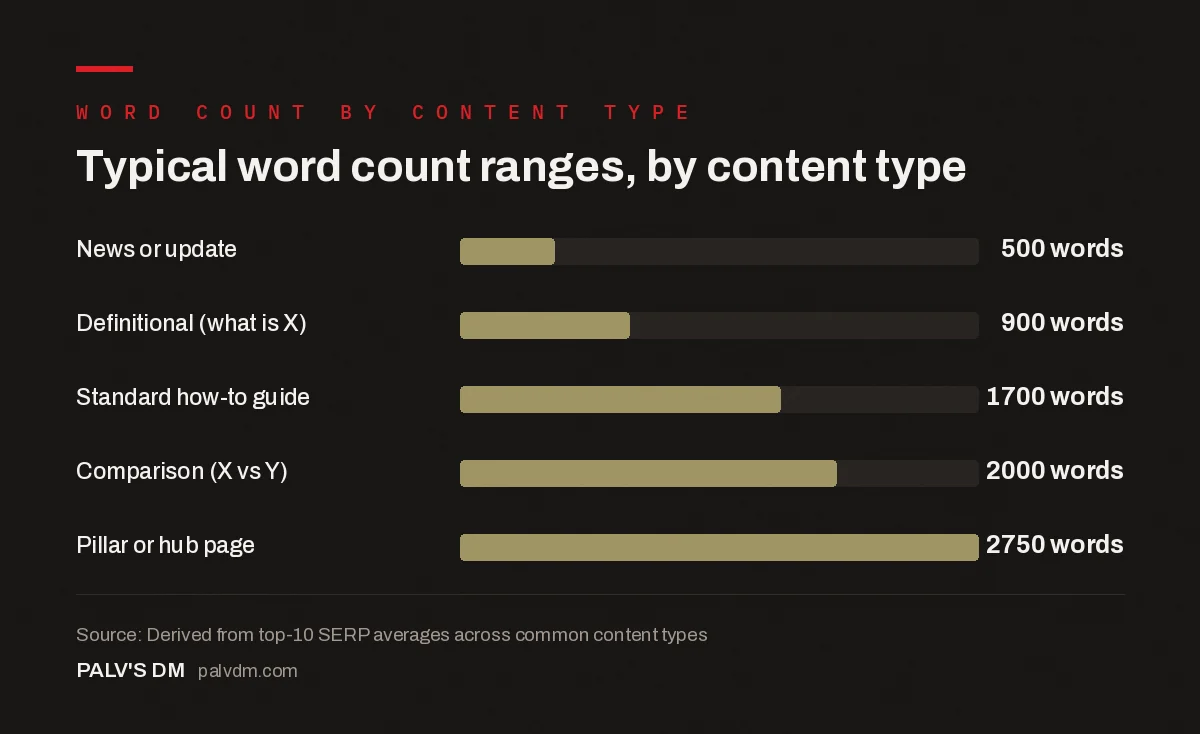
Typical word count ranges, by content type
| Metric | Value |
|---|---|
| News or update | 500 words |
| Definitional (what is X) | 900 words |
| Standard how-to guide | 1700 words |
| Comparison (X vs Y) | 2000 words |
| Pillar or hub page | 2750 words |
Source: Derived from top-10 SERP averages across common content types
How do you set word count targets at scale without doing this by hand every time?
If you’re producing more than a handful of briefs a month, manually eyeballing the top 10 for every keyword doesn’t scale. Most teams solve this with a lightweight version of the same process: a spreadsheet template that records competitor word counts, subtopic lists, and the resulting target for every keyword in the content calendar, built once per content pillar rather than once per post. A tool like Screaming Frog’s custom extraction or a rank tracker with content analysis features can automate the word-count pull; the subtopic union still benefits from a human actually reading the top results, because subtopic relevance is a judgment call, not a number.
The other scale lever is reusing research. If five posts in a cluster all compete against similar SERPs, the subtopic list and rough word count band you build for the first post will mostly transfer to the others, saving research time on each subsequent brief.
What happens if your post is much shorter than competitors?
A shorter post can still outrank longer competitors if it answers the query more directly and completely, but “shorter” only works when it means “no padding,” not “incomplete.” If your 700-word post is missing three subtopics that every other top-10 result covers, the gap will show up as thin content relative to searcher expectations, and it will struggle regardless of how well-written the 700 words are. Before publishing short, confirm the subtopic union is genuinely covered, not just that the word count feels efficient.
Frequently asked questions
Is there a minimum word count Google requires for a page to rank?
No. Google has stated repeatedly that there’s no minimum word count for ranking; pages of a few hundred words rank for simple queries all the time. What matters is whether the page fully answers the query at hand, which for simple queries can take very few words and for complex ones can take thousands.
Should every post in a content cluster be the same length?
No. Each post should be sized to its own keyword’s competitive landscape and search intent. A pillar page in a cluster will typically run longer than the supporting posts underneath it, because it has to summarise the whole topic and link out, while individual cluster posts go deep on one narrow subtopic.
How often should word count targets be revisited?
Check the target again if the post isn’t ranking after 8-12 weeks, or roughly once a year as part of a content refresh cycle, since SERPs shift as competitors update their own content. A target that was accurate at launch can drift as the competitive set changes.
Does adding more words to an existing post help it rank better?
Only if the addition covers a real subtopic gap. Padding an existing post with restated points or filler sections tends to dilute the page rather than strengthen it. Before expanding a post, run the same competitor teardown you’d run for a new brief and add only what’s actually missing.
Setting targets that hold up
Word count targets built from actual competitor data hold up better than targets pulled from a style guide, because they respond to what a specific query actually requires. The process is straightforward: pull the top 10, drop the outliers, average what’s left, list the shared subtopics, and write to full coverage of that list rather than to a number. If your team is producing content briefs at volume and doesn’t have time to run this teardown on every keyword, our content writing service builds word count targets into every brief as a standard step, derived from the live SERP rather than a template.
For the rest of the planning process, from keyword lists to a working publishing calendar, see our content strategy guide. If you’re also deciding how often to publish alongside how long each post should be, our post on blog publishing frequency covers the volume side of the same trade-off. And if word count decisions are part of a broader content audit, our content audit framework shows how to score existing pages against the same coverage logic.