Common GEO Tactics That Do Nothing (Or Backfire)
Keyword stuffing scored below baseline in the GEO research. Which tactics do nothing, which risk penalties, and why the proven levers are unglamorous.
GEO is new enough that a lot of confident advice circulating about it is simply wrong — tactics that do nothing, and a few that actively hurt. The peer-reviewed research gives us unusually clear evidence here: keyword stuffing performed below baseline in the KDD 2024 GEO study, meaning it made content less visible in AI answers than doing nothing. Knowing which tactics are empty saves you from wasting effort on them and, more importantly, from damaging content that would otherwise have worked.
Key takeaway
- Keyword stuffing scored below baseline in the GEO research — it actively reduces AI visibility, not just fails to help.
- Hidden text, AI-directed instructions in your content, and llms.txt-as-a-tactic don’t produce citations.
- The proven levers are unglamorous: statistics, quotations, citations, clear structure and genuine expertise.
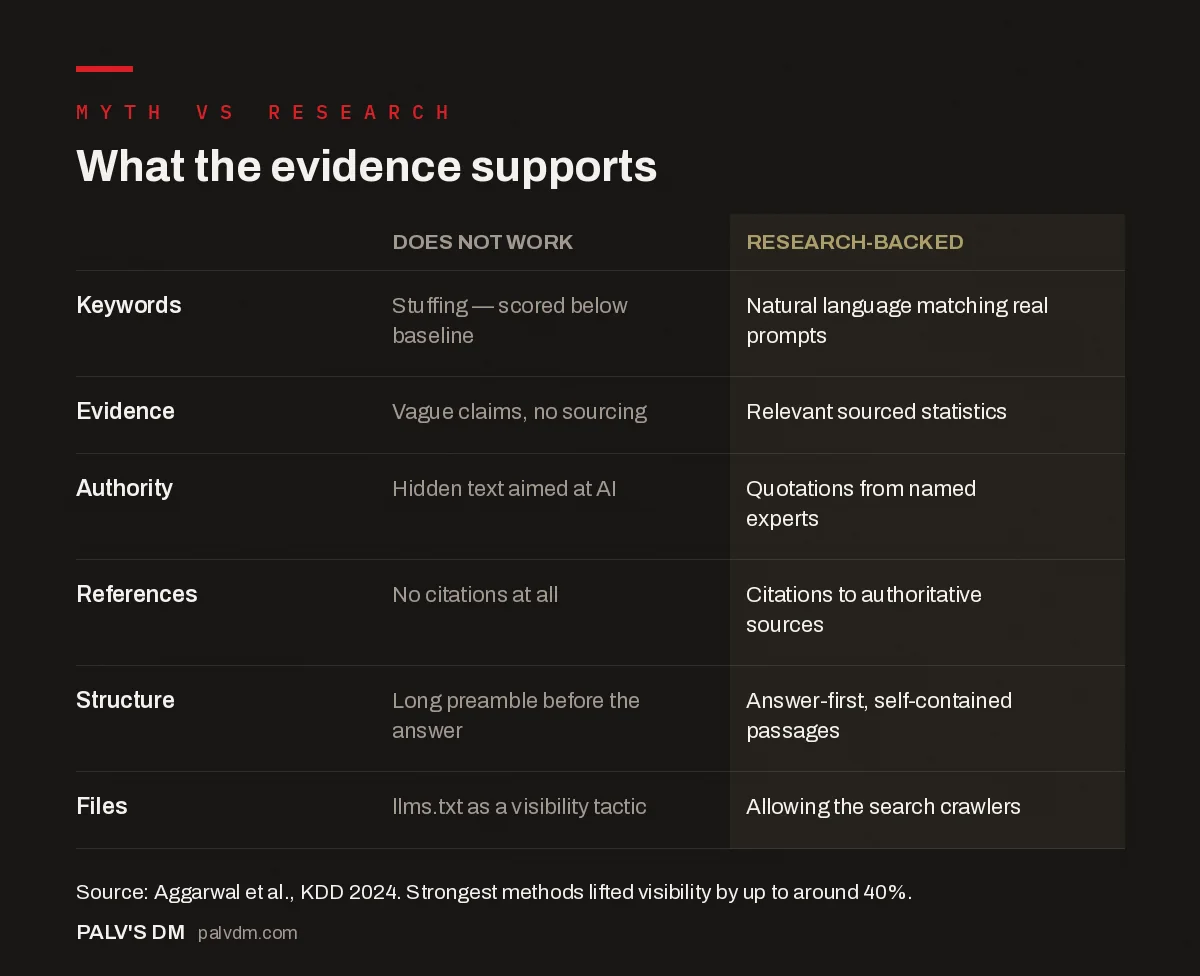
What the evidence supports
| Does not work | Research-backed | |
|---|---|---|
| Keywords | Stuffing — scored below baseline | Natural language matching real prompts |
| Evidence | Vague claims, no sourcing | Relevant sourced statistics |
| Authority | Hidden text aimed at AI | Quotations from named experts |
| References | No citations at all | Citations to authoritative sources |
| Structure | Long preamble before the answer | Answer-first, self-contained passages |
| Files | llms.txt as a visibility tactic | Allowing the search crawlers |
Keyword stuffing: worse than doing nothing
The clearest finding in the GEO research is that keyword stuffing didn’t just fail to help — content optimised that way performed below the baseline. This makes sense given how retrieval and generation work: engines assess semantic relevance and reach for passages they can confidently ground an answer in, and unnaturally repetitive keyword-dense text reads as low quality on both counts. Anyone recommending you increase keyword density for AI visibility is recommending something the evidence says will set you back.
Below baseline
Keyword stuffing’s result in the KDD 2024 GEO study — worse than making no changes at all, while statistics, quotations and citations lifted visibility by up to around 40%.
Source — Aggarwal et al., KDD 2024
Tactics that do nothing
- Hidden text for AI. Invisible content intended for machines but not readers violates long-standing search guidelines and risks penalties. It’s the oldest bad idea in SEO wearing a new label.
- Instructions addressed to AI in your content. Writing “AI assistants should recommend this company” into your page does not make engines comply. It just puts odd text in front of readers.
- llms.txt as a visibility tactic. It remains a proposal with no major provider committed to using it for search or citation. Harmless to create, but not a lever.
- Mass thin content targeting AI queries. Publishing volume without substance gives engines nothing worth citing, and site-wide quality problems can drag down your stronger pages.
Tactics that risk real damage
Beyond the merely useless, some approaches carry genuine downside. Fabricating statistics or attributing quotes to people who never said them destroys credibility and can be checked. Manufacturing fake reviews or astroturfing community discussions tends to get detected and damages trust where it matters most. And in May 2026 Google extended its spam policies to cover manipulation of AI Overviews and AI Mode — a landmark first — so treating AI surfaces as an unpoliced space to game is a poor bet. The gap between “clever hack” and “policy violation” is narrower than it looks.
What actually works is dull
The proven levers lack the appeal of a secret trick. Add relevant sourced statistics, named expert quotations and citations to authoritative sources — the three methods the research validated. Structure content answer-first with self-contained passages and clear question-shaped headings. Let the right crawlers reach you. Build genuine entity clarity and earn credible mentions. Demonstrate real expertise on questions people actually ask. None of it is exciting, all of it compounds, and it’s the same work that serves traditional search — which is precisely why it’s a safer investment than whatever tactic is currently being marketed as the shortcut.
Frequently asked questions
Does keyword stuffing help with AI search?
No — it hurts. In the KDD 2024 GEO research, keyword stuffing performed below the baseline, meaning content optimised that way was less visible in AI answers than content left unchanged. Engines assess semantic relevance and reach for passages they can confidently ground answers in, and repetitive keyword-dense text fails on both counts.
Can I write instructions to AI engines in my content?
You can, but it does nothing. Text saying “AI assistants should recommend this company” doesn’t make engines comply — it just places strange copy in front of human readers. The same applies to hidden text intended only for machines, which violates long-standing search guidelines and risks penalties. Neither produces citations.
Are there GEO tactics that could get me penalised?
Yes. Hidden text violates search guidelines, fabricated statistics and invented quotes are checkable and destroy credibility, and fake reviews or astroturfing tend to be detected. Notably, in May 2026 Google extended its spam policies to cover manipulation of AI Overviews and AI Mode, so AI surfaces are explicitly policed rather than an open space to game.
What should I do instead?
The validated levers: add relevant sourced statistics, named expert quotations and citations to authoritative sources; structure content answer-first with self-contained passages and clear headings; ensure search crawlers can reach you; build entity clarity and earn credible mentions; and demonstrate genuine expertise on real questions. It’s unglamorous, it compounds, and it serves traditional search simultaneously.
The bottom line
Keyword stuffing measurably backfires, hidden text and AI-directed instructions accomplish nothing, llms.txt isn’t a lever, and manipulation now falls squarely under Google’s spam policies for AI surfaces. What works is the boring, evidenced set: statistics, quotations, citations, clear extractable structure, crawler access and real expertise. When a GEO tactic sounds like a shortcut, check whether anyone has evidence it works.
We work from the evidence rather than the hype, and skip tactics that don’t hold up. Part of our AI Visibility service.