Penguin: How Link Spam Stopped Working
Google Penguin launched 24 April 2012 and hit 3.1% of English queries. What it targeted, what the 2016 rewrite changed, and what link risk means in 2026.
Google Penguin was a webspam ranking system announced on 24 April 2012 that demoted sites using link schemes and other manipulative tactics, and it ended the era in which buying links reliably worked. Google said the change affected about 3.1% of queries in English to a degree a regular user would notice, around 3% in German, Chinese and Arabic, and roughly 5% in Polish. Penguin is no longer a separate system. Google’s ranking systems documentation lists it under retired systems and states it was “integrated into our core ranking systems in 2016”.
The important part of the Penguin story is not the 2012 launch. It is the 2016 rewrite, which changed link spam from something that could sink a whole domain into something Google quietly ignores. That single design change explains most of what is and is not true about link risk today.
What was the Google Penguin update?
Google announced Penguin in a post titled “Another step to reward high-quality sites”, published on 24 April 2012 and written by Matt Cutts. Google described it as “an important algorithm change targeted at webspam” that would “decrease rankings for sites that we believe are violating Google’s existing quality guidelines”.
Google gave two worked examples in that post: a page using keyword stuffing, and a page with outgoing links completely unrelated to its content, sitting inside text that had been spun beyond readability. Both examples matter, because they show Penguin was never purely about links — it was about manipulative on-page and off-page signals together, with link schemes as the dominant case.
For scale, Google explicitly compared it to its earlier quality work: “the initial Panda change affected about 12% of queries to a significant degree; this algorithm affects about 3.1% of queries in English”. Penguin was narrower than Panda by design, because it was aimed at a specific behaviour rather than at general content quality.
What did Penguin actually target?
Penguin targeted attempts to manufacture ranking signals that the site had not earned. In practice, the recurring patterns were:
- Paid and exchanged links acquired specifically to pass ranking signals, which remains the clearest case in Google’s link spam policy and the reason buying backlinks carries real risk.
- Link networks built to link at each other, the ancestor of every private blog network still being sold today.
- Over-optimised anchor text, where a disproportionate share of inbound links used the exact commercial phrase the site wanted to rank for. Natural profiles do not look like that, which is why anchor text distribution became a diagnostic rather than a lever.
- Article directories, widget links and footer links placed at scale across unrelated sites.
- Keyword stuffing, included in Google’s own launch examples.
Google was also explicit that the targets were not always obvious. Sites affected, the announcement said, “might not be easily recognizable as spamming without deep analysis or expertise”, but shared a common thread: they were doing much more than ethical SEO in order to manipulate rankings. That framing is worth keeping, because it rules out the reading that Penguin only hit crude, visibly broken spam sites.
None of these were new violations in 2012. They were already against Google’s published guidelines. What Penguin changed was enforcement: for the first time, the guidelines had an algorithm behind them that ran at scale rather than depending on human review.
What changed with Penguin 4.0 in 2016?
On 23 September 2016 Gary Illyes announced the update that mattered most. Google made two changes to Penguin, and both were direct responses to what site owners had been asking for.
Penguin became real-time. Google’s post explained that Penguin’s data had previously been “periodically refreshed at the same time”, meaning a site that cleaned up its link profile sat frozen until the next refresh — sometimes for more than a year. After 2016, changes took effect “shortly after we recrawl and reindex a page”. Google added that it would not comment on future refreshes, and it has not.
Penguin became granular. In Google’s words, Penguin “devalues spam by adjusting ranking based on spam signals, rather than affecting ranking of the whole site”. This is the sentence that most link-building advice still has not caught up with. A bad link is far more likely to be discounted — treated as if it were not there — than to drag your domain down.
| Phase | Date | What it meant for site owners |
|---|---|---|
| Penguin launch | 24 April 2012 | Algorithmic demotion for link schemes; ~3.1% of English queries affected |
| Disavow tool released | October 2012 | A way to tell Google to ignore specific inbound links |
| Periodic refresh era | 2012–2016 | Cleaned-up sites waited for the next refresh before recovering |
| Penguin 4.0 | 23 September 2016 | Real-time and granular; devaluation replaced site-wide demotion |
| Absorbed into core | 2016 onward | No named Penguin updates; link spam handled by core and spam systems |
Is there still a Penguin penalty in 2026?
There is no Penguin penalty, because there is no Penguin. Link spam is now handled inside Google’s core ranking systems and its spam detection systems, including SpamBrain, and it surfaces publicly as link spam updates on the Search Status Dashboard rather than as Penguin refreshes. The December 2022 link spam update, which ran 29 days from 14 December 2022, was the last one announced under that name.
That leaves exactly two mechanisms that can actually punish a link profile, and they behave completely differently from each other:
- Algorithmic devaluation. Google ignores the links. Rankings that depended on them fall away. Nothing appears anywhere in Search Console, and there is nothing to appeal.
- A manual action for unnatural links. A human reviewer at Google penalises the site and a notice appears under Security & Manual Actions in Search Console, naming the problem. Understanding the difference between a manual action and algorithmic demotion decides which of the two responses is correct.
Thirty seconds in Search Console tells you which one you are dealing with. If the Manual Actions report is empty, the “penalty” people are worried about does not exist, and the drop is more likely a core update, a spam update or something self-inflicted.
Should you disavow links after a ranking drop?
Usually not. The disavow tool was built in October 2012 for the periodic-refresh Penguin era, when a manipulative link genuinely could hold a whole site down until the next refresh. Since 2016, Google’s stated behaviour is to devalue rather than demote, and Google has repeatedly said most sites never need the tool at all.
Disavowing is the right call in two situations: you have a manual action naming unnatural links, or you knowingly acquired links in violation of Google’s link spam policies and cannot get them removed. Outside those cases, using the disavow file mostly removes signals that were helping you. Panic-disavowing after a core update is one of the most common self-inflicted wounds in SEO, and the wider category of so-called toxic backlinks is largely a tool-vendor construct rather than a Google concept.
What Penguin means for link building now
Penguin’s legacy is not that links stopped mattering. Google’s own 2016 post described Penguin as “just one of more than 200 signals we use to determine rank”, and links remain among them. What Penguin ended was the reliability of buying them.
- Assume manufactured links are worth zero, not negative. Budget accordingly. A link that will be discounted is wasted spend, which is the practical argument against most cheap link packages.
- Test every prospective link editorially. Would this link exist if search engines did not? The editorial link test is a better filter than any authority metric.
- Watch anchor text as a symptom. Heavy exact-match anchors are evidence of a manufacturing process, not a cause of demotion in themselves. Recognising spam anchor patterns in your own profile is a warning about your acquisition method.
- Build things worth citing. Original data, tools and genuine reporting are the only reliably repeatable link sources, which is the whole premise of a modern link building programme.
- Do not conclude links are obsolete. The question of whether backlinks still matter has a boring answer: they do, they are just harder to fake.
What Penguin was never able to do
Three claims about Penguin outlived the system itself, and each one still sells services.
- Negative SEO by link blasting. The fear that a competitor can point spam at your domain and demote you assumes the site-wide demotion model Google abandoned in September 2016. Under devaluation, links a site did not earn are discounted rather than counted against it. Google has consistently said its systems are built to ignore such links.
- A single toxicity score. No Google system publishes a per-link risk figure. The scores in third-party tools are vendor models trained on vendor data, not readings from Google.
- Instant recovery by cleanup. Removing manufactured links does not restore rankings, because those rankings were being produced by links that are now discounted. There is nothing being held back to release.
The cleanest way to hold Penguin in your head is this. Between 2012 and 2016, bad links were a liability you had to clean up. Since 2016, bad links are mostly a cost with no return. That is a less dramatic problem, but it is a far more expensive one for anyone still paying for them.
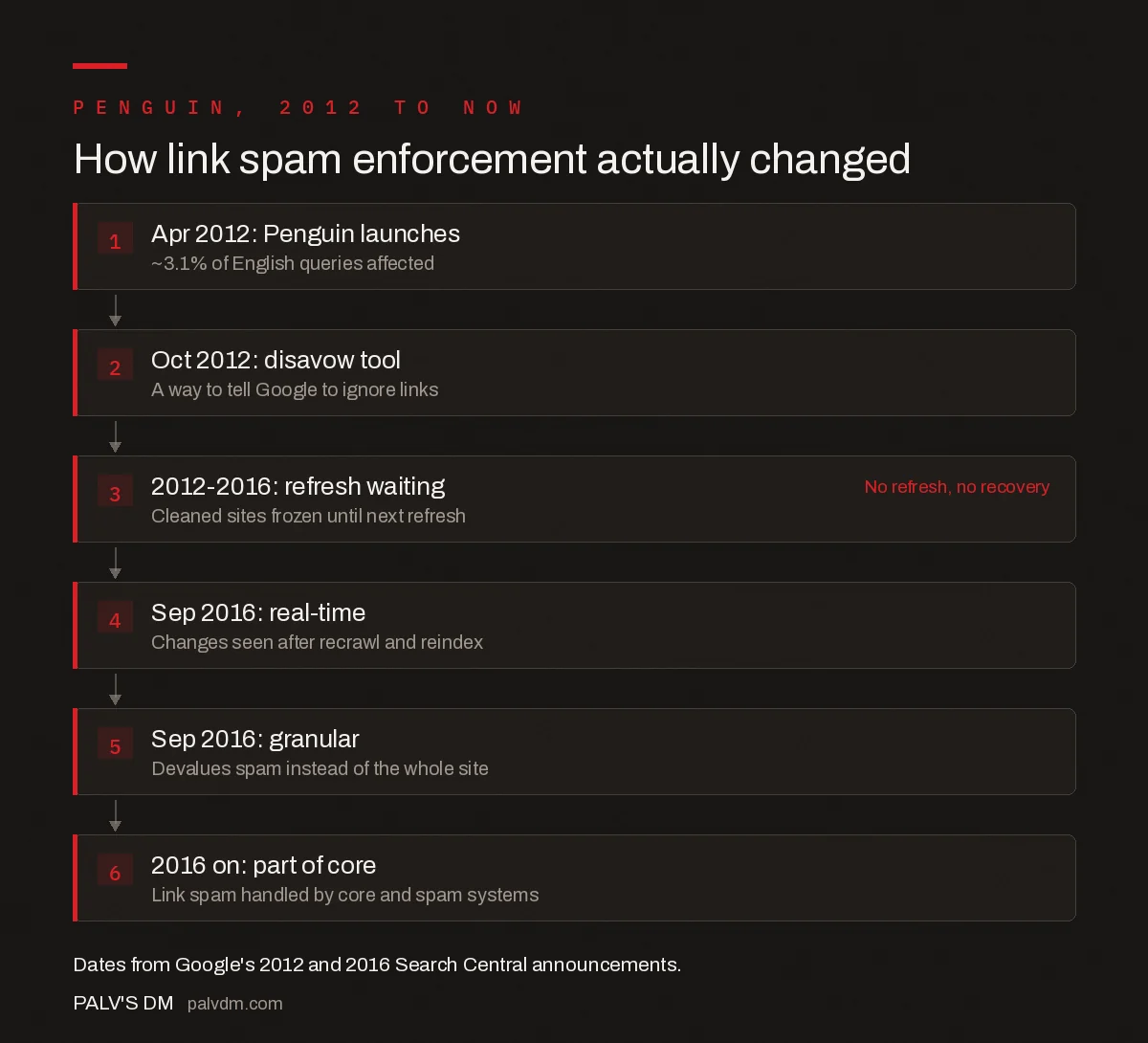
How link spam enforcement actually changed
- Apr 2012: Penguin launches. ~3.1% of English queries affected.
- Oct 2012: disavow tool. A way to tell Google to ignore links.
- 2012-2016: refresh waiting. Cleaned sites frozen until next refresh. No refresh, no recovery
- Sep 2016: real-time. Changes seen after recrawl and reindex.
- Sep 2016: granular. Devalues spam instead of the whole site.
- 2016 on: part of core. Link spam handled by core and spam systems.
Frequently asked questions
What was the Google Penguin update?
Google Penguin was a webspam ranking system announced on 24 April 2012 that reduced rankings for sites violating Google’s quality guidelines, principally through link schemes and keyword stuffing. Google said it affected about 3.1% of queries in English, around 3% in German, Chinese and Arabic, and roughly 5% in Polish. Google’s documentation states Penguin was integrated into core ranking systems in 2016.
Is Google Penguin still running?
Not as a separate, named system. Google’s guide to Search ranking systems lists Penguin under retired systems and says it became part of core ranking in 2016. Link spam is now handled by core ranking systems and Google’s spam detection systems, including SpamBrain, and appears publicly as link spam updates on the Search Status Dashboard rather than as Penguin refreshes.
Can bad backlinks still hurt my site?
Since the September 2016 Penguin update, Google’s stated behaviour is to devalue link spam rather than demote the whole site. In Google’s own wording, Penguin devalues spam by adjusting ranking based on spam signals rather than affecting the ranking of the whole site. The practical result is that manipulative links are usually ignored, so they waste money rather than causing a penalty.
Should I disavow backlinks?
In most cases no. Disavow is appropriate when you have a manual action naming unnatural links, or when you knowingly acquired links that break Google’s link spam policies and cannot get them removed. Google has said repeatedly that most sites never need the tool. Disavowing legitimate links can remove signals that were helping your rankings.
What is the difference between Penguin and a manual action?
Penguin was algorithmic: it applied automatically, no notice was ever sent, and there was nothing to appeal. A manual action is applied by a human reviewer at Google, always appears as a notice under Security and Manual Actions in Search Console, names the specific problem, and requires a reconsideration request once fixed. Only one of the two tells you it has happened.
Do backlinks still matter after Penguin?
Yes. Google’s 2016 Penguin announcement described the system as just one of more than 200 signals used to determine rank, and link analysis systems including PageRank remain listed in Google’s current ranking systems documentation. What changed is that manufactured links are largely discounted, so earned citations are the only reliable route.
Sources
- Another step to reward high-quality sites — Google Search Central — The Penguin launch announcement, 24 April 2012
- Penguin is now part of our core algorithm — Google Search Central
- A guide to Google Search ranking systems
- Google Search spam policies
Want this done on your site?
Every PalV’s DM engagement starts with a free audit of your actual website — a 12-point
crawl covering what is blocking indexation, on-page gaps against your primary keywords, speed
findings, and the three to five fixes worth making first. Delivered in two working days. No
payment details, and the findings are yours whether you hire us or not.