Panda: The Update That Made Content Quality a Ranking Factor
Google Panda launched on 24 February 2011 and hit 11.8% of queries. What it targeted, why it was retired into core ranking, and what still applies in 2026.
Google Panda was a ranking system launched on 24 February 2011 that demoted low-quality, thin and copied pages across the whole index. It was the first time Google publicly treated content quality as a ranking input in its own right rather than something inferred from links. Google’s launch post said the change “noticeably impacts 11.8% of our queries” and was designed to reduce rankings for “low-quality sites — sites which are low-value add for users, copy content from other websites or sites that are just not very useful”. Panda no longer exists as a separate system: Google’s ranking systems documentation lists Panda under retired systems and states that it “evolved and became part of our core ranking systems in 2015”.
That retirement is exactly why Panda still matters. The name went away; the logic was absorbed. Every broad core update Google has run since 2015 carries assumptions Panda introduced, which is why a 2011 update is still the cleanest explanation of why thin pages lose ground in 2026.
What was the Google Panda update?
The Google Panda update was an algorithmic change announced on the Official Google Blog on 24 February 2011 by Amit Singhal and Matt Cutts. It launched in the United States only, and Google added an update to the same post on 11 April 2011 confirming it had rolled out globally to all English-language Google users.
Three details from Google’s launch post are worth keeping, because most retellings of Panda drop them:
- The stated scale was 11.8% of queries. That is Google’s own figure for the initial US launch, not an industry estimate.
- Google described both directions. The update was designed to demote low-quality sites and to “provide better rankings for high-quality sites — sites with original content and information such as research, in-depth reports, thoughtful analysis and so on”.
- Google validated it against user behaviour. Google compared the sites its algorithm identified against the most-blocked domains from its Personal Blocklist Chrome extension and reported that the change addressed 84% of the top most-blocked domains.
“Panda” was never an official product name. Google’s documentation calls it “the nickname of the ‘Panda'”, and the nickname came from Navneet Panda, the engineer whose work underpinned the system. The wider history of Google algorithm updates is full of these industry nicknames that Google later adopted because everyone else already had.
What did Panda actually demote?
Panda targeted pages that added no value beyond what already existed. Google’s launch language named three patterns: low value-add for users, content copied from other websites, and pages that were simply not very useful. The industry shorthand at the time was “content farms” — sites publishing high volumes of shallow articles built around search demand rather than around anything the publisher actually knew.
In May 2011 Google followed up with a post titled “More guidance on building high-quality sites”, which published a list of questions site owners could ask about their own pages. Several of those questions are still the sharpest diagnostic available, fifteen years on:
- Would you trust the information presented in this article?
- Is the article written by an expert or enthusiast who knows the topic well, or is it more shallow in nature?
- Does the site have duplicate, overlapping, or redundant articles on the same or similar topics with slightly different keyword variations?
- Does this article provide a complete or comprehensive description of the topic?
- Are the pages produced with great care and attention to detail versus less attention to detail?
Notice what is missing from that list. No word counts, no keyword targets, no technical thresholds. Panda’s guidance was editorial from the first week, and the pages that lost were the ones that could not survive an honest reading. That is still the test worth running — auditing your library against those questions finds more than a crawl does.
Is Panda still running in 2026?
Not as a named, separately announced system. Google’s guide to Search ranking systems places Panda in its “Retired systems” section and states plainly that it became part of the core ranking systems in 2015. There has been no “Panda refresh” to wait for in over a decade.
The practical consequences of that absorption are larger than they sound:
- There is no Panda penalty and no Panda recovery. Quality assessment runs continuously as part of core ranking. Nothing is flagged against your domain, which is the same reason core updates are not penalties either.
- Quality-driven drops now surface through core updates. When a site loses ground on thin content today, it usually happens during a broad rollout. Understanding what a core update actually is matters more than hunting for a specific content filter.
- You cannot wait out a refresh cycle. In the Panda era, a cleaned-up site sat frozen until the next refresh. That waiting game is gone, though meaningful recovery still tends to land with a subsequent core update rather than between them.
What happened to Panda’s guidance?
Panda’s questions did not disappear. They were rewritten, expanded and republished under different names. The table below maps the 2011 wording to where the same idea lives in Google’s current documentation.
| Panda-era question (2011) | Where the same idea lives now |
|---|---|
| Does this article provide original content or information, original reporting, original research? | Google’s helpful content guidance asks whether content provides substantial value compared to other pages in search results |
| Is the article written by an expert or enthusiast who knows the topic well? | The experience, expertise, authoritativeness and trust framework in the quality rater guidelines |
| Would you trust the information presented in this article? | Trust, described by Google as the most important member of that framework |
| Does the site have duplicate, overlapping, or redundant articles? | Keyword cannibalisation and Google’s scaled content abuse policy |
| Are the pages produced with great care and attention to detail? | The “who, how and why” self-assessment Google points site owners to after every core update |
The clearest single descendant is the helpful content work. Google announced the helpful content system in 2022 as a distinct system, then folded it into core ranking in March 2024 — the same trajectory Panda followed, roughly a decade later. The full helpful content update history reads as Panda’s second act.
How do you tell if you have a Panda-shaped problem in 2026?
Panda-shaped problems have a recognisable signature: broad, gradual erosion across a large body of similar pages, rather than a sharp drop on a handful of URLs. Work through it in this order.
- Segment by page type, not by URL. Group blog posts, category pages, location pages and programmatically generated pages separately in Search Console. Panda-shaped losses cluster inside one template.
- Find the pages nobody would miss. Pull every URL with impressions but effectively no clicks over 12 months. Thin content rarely announces itself; it just quietly fails to earn anything.
- Check for internal near-duplicates. Multiple pages targeting slight keyword variations of one topic was on Google’s 2011 list and remains a problem. Consolidate rather than rewrite, and be honest about what duplicate content actually costs you.
- Test each surviving page for something new. Ask what a reader gets here that they cannot get from the current top ten. That is the same instinct behind information gain, and it is the hardest test most published content fails.
- Fix attribution. Content with no named author cannot answer “who wrote this”, which is one third of Google’s post-core-update self-assessment and a documented weakness of content published with no byline at all.
- Rebuild against a standard, not a hunch. A written content quality checklist applied to every page beats reacting to individual rankings.
What Panda was never about
Panda accumulated more folklore than almost any other Google update, and several of those myths still drive bad decisions.
- It was not a manual penalty. No notice ever appeared in Webmaster Tools for Panda, and none appears in Search Console today. That distinction between manual actions and algorithmic demotion is still the first thing to check when traffic falls.
- It was not a word-count rule. Google has never published a minimum length. Short pages that answer the question completely have never been the target; padded pages that answer nothing always were.
- It was not about keyword density. The keyword density myth predates Panda and survived it, but Google’s 2011 guidance never mentions a ratio.
- It did not create a duplicate content penalty. Google demoted sites built on copied material; it did not penalise every page with overlapping text.
One more myth deserves burial: that Panda was site-wide and therefore hopeless. Google’s launch post said explicitly that “some sites will go up and some will go down”, and Google has since described its ranking systems as working primarily at page level while using site-wide signals as contributing evidence. A site is not condemned by its worst pages, but a large enough share of weak pages does become a site-wide signal in its own right. That is the case for pruning rather than endlessly rewriting.
The one lesson Panda leaves intact is uncomfortably simple. Google decided in 2011 that a page which adds nothing to what already exists should not rank, and it has never reversed that decision — it has only kept restating it under new names. If your pages would struggle to justify their own existence to a reader who has already read three competitors, no amount of on-page optimisation closes that gap.
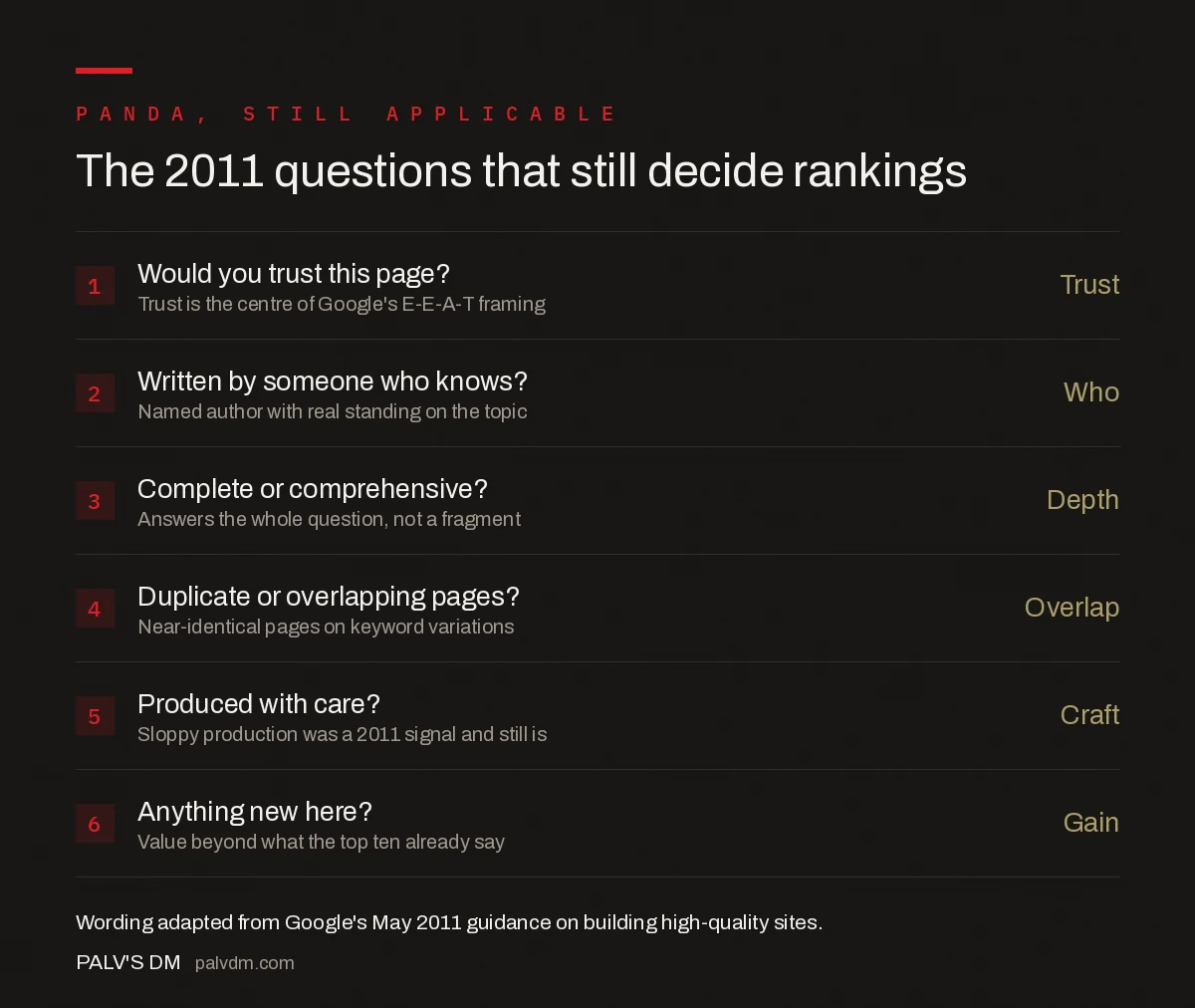
The 2011 questions that still decide rankings
- Would you trust this page? — Trust. Trust is the centre of Google’s E-E-A-T framing.
- Written by someone who knows? — Who. Named author with real standing on the topic.
- Complete or comprehensive? — Depth. Answers the whole question, not a fragment.
- Duplicate or overlapping pages? — Overlap. Near-identical pages on keyword variations.
- Produced with care? — Craft. Sloppy production was a 2011 signal and still is.
- Anything new here? — Gain. Value beyond what the top ten already say.
Frequently asked questions
What was the Google Panda update?
Google Panda was a ranking system launched on 24 February 2011 that reduced rankings for low-quality, thin and copied content. Google said at launch that it noticeably affected 11.8% of queries and targeted sites that were low value-add for users, copied content from other websites, or were simply not very useful. It launched in the United States and went global for English-language searches in April 2011.
Is Google Panda still active?
Not as a separate system. Google’s guide to Search ranking systems lists Panda under retired systems and states that it became part of Google’s core ranking systems in 2015. Content quality is now assessed continuously as part of core ranking, so there are no Panda refreshes to wait for and no Panda-specific recovery process.
How do you recover from a Panda-type content quality problem?
Segment your site by page template, identify pages that earn impressions but almost no clicks, consolidate near-duplicate pages targeting slight keyword variations, and rebuild the survivors so each one offers something the current top results do not. Google states that the largest recoveries from quality-driven losses tend to arrive with a subsequent core update rather than between them.
Why was it called Panda?
Panda was an industry and internal nickname, not an official product name. Google’s own documentation refers to it as the nickname of the Panda, and the name came from Navneet Panda, the Google engineer whose work underpinned the system. Google originally announced it simply as an algorithmic improvement to ranking, with no name attached.
Did Panda penalise duplicate content?
Panda demoted sites built largely on content copied from other websites, and Google’s 2011 guidance also asked whether a site had duplicate, overlapping or redundant articles on similar topics with slightly different keyword variations. It did not create a blanket penalty for any page containing overlapping text, and Google has repeatedly said no such penalty exists.
What replaced Google Panda?
Nothing replaced it directly; it was absorbed into core ranking in 2015. The clearest successor in spirit is Google’s helpful content work, announced as a separate system in 2022 and folded into core ranking systems in March 2024. Google’s current helpful content documentation asks many of the same questions Panda’s 2011 guidance did.
Sources
- Finding more high-quality sites in search — Official Google Blog — The Panda launch announcement, 24 February 2011
- More guidance on building high-quality sites — Google Search Central
- A guide to Google Search ranking systems — Lists Panda under retired systems
- Creating helpful, reliable, people-first content
Want this done on your site?
Every PalV’s DM engagement starts with a free audit of your actual website — a 12-point
crawl covering what is blocking indexation, on-page gaps against your primary keywords, speed
findings, and the three to five fixes worth making first. Delivered in two working days. No
payment details, and the findings are yours whether you hire us or not.