Do Core Updates Penalise Sites? The Distinction That Matters
Core updates are not penalties, and treating them as one leads to expensive mistakes. What the difference means for how you respond to a drop.

No. A Google core update is not a penalty, and your site was not singled out. A core update reassesses how content across the entire index is evaluated, and positions shift as a consequence. Nothing was flagged against your domain, no rule was broken, there is no notice to read and no appeal to file. This sounds like semantics until you watch what happens when people get it wrong: they disavow healthy links, delete pages that dropped three positions, and file reconsideration requests that go nowhere — spending months undoing an infraction that never existed.
The distinction is not academic comfort. It determines which of two completely different jobs you are doing: undoing a violation, or becoming a better result.
What “penalty” actually means at Google
Google uses the word narrowly, and it is worth adopting the same precision.
A manual action is a penalty. A human reviewer at Google looked at your site, decided it violates a specific policy, and applied a sanction. You are told: a notice appears in Search Console under Security & Manual Actions, naming the problem and its scope. You fix it and file a reconsideration request, and a person reviews your case.
Algorithmic spam enforcement is a penalty in effect. Google’s spam systems detect a violating practice — link schemes, cloaking, doorway pages, scaled content abuse — and suppress the site. You are not notified individually, but something on your site genuinely matched a published policy, and removing it is the path back.
A core update is neither. It is a change to the systems that decide which of many legitimate pages best answers a query. Every page is re-evaluated. Some rise, some fall, most barely move. No judgement was passed on your conduct.
The full three-way breakdown sits in core update vs spam update vs manual action.
Google’s own framing
Google has been unusually consistent here. Its guidance states that pages dropping after a core update have not violated anything, that there is nothing to fix in the sense of a penalty, and that a ranking drop does not necessarily mean anything is wrong with your pages.
The analogy Google itself uses is a best-films list refreshed a few years later. A film that slipped from #5 to #15 did not get worse. New films were released, and the criteria for judging them matured. The film has not been penalised. It has been re-ranked against a changed field.
That framing explains something people find hard to accept: you can do nothing wrong, change nothing, and still lose traffic. Your competitors improved, or Google got better at recognising which pages actually satisfy the query. Both are movements in the field around you.
Why the mistaken diagnosis is expensive
Four common reactions to a core update, each of which follows logically from believing you were penalised, and each of which is wasted or harmful.
Disavowing links. If you were penalised, links are a plausible culprit, so people disavow aggressively. But there is no link violation to undo, and disavow tells Google to ignore links — including ones that were helping. Google has said repeatedly that most sites never need the disavow tool. After a core update, it is close to always the wrong reach.
Deleting or noindexing pages that dropped. Pruning genuinely weak content is legitimate and often useful. Deleting a page because it fell from position 4 to position 11 removes an asset that was still earning impressions, and destroys the page history you would need to diagnose anything later.
Filing a reconsideration request. These apply only to manual actions. Filing one after a core update accomplishes nothing except confirming to yourself that something is wrong when nothing is.
Panic-rewriting mid-rollout. The most costly of the four. Core updates roll out over 12 to 18 days and rankings genuinely swing during that window — the May 2026 core update moved in three distinct waves across twelve days. Rewriting on day three means optimising against a state that will change twice more, and permanently entangling your edits with the update so that afterwards you cannot tell what caused what.
How to know which one you are actually dealing with
- Search Console → Security & Manual Actions. Thirty seconds. A notice means manual action. An empty panel means you do not have one, full stop.
- Check the dates on Google’s Search Status Dashboard. If a core update was running, you have a likely explanation. If nothing was confirmed, do not invent one — August 2026 is the cautionary example, where trackers spiked, the industry named an update, and Google’s dashboard showed no incident at all.
- Ask honestly whether you match a spam policy. Bought links, AI-generated pages at volume, doorway pages, a rented subfolder. If yes, that is your answer regardless of what else was happening.
- Rule out yourself. Deployments, migrations, a robots.txt edit, a plugin. More traffic drops are self-inflicted than algorithmic — was it an update or was it you walks the sequence.
What the correct response looks like
Once you accept that nothing was flagged, the work changes character entirely. You are no longer searching for a fault. You are asking why other pages now answer the query better than yours.
That means pulling the specific URLs and query clusters that lost, finding what now ranks in their place, and comparing honestly. Usually the gap is specificity: real numbers, first-hand experience, a named author with relevant credentials, or something genuinely new that the rest of the results do not contain.
Google’s own post-update self-assessment questions are built around three axes — who produced the content, how it was produced, and why it exists. Content published under no byline cannot answer the first. Content generated at volume to fill a keyword gap struggles to answer the third honestly. If your pages cannot answer all three convincingly, you have found the work, and it is content work rather than remediation work.
Expect the payoff to arrive with a later core update rather than between them. Google states this directly, and it is the single most common source of frustration: you make real improvements, nothing happens for weeks, and then a subsequent rollout moves you. The 30-day recovery plan sequences that properly.
The one exception worth naming
Occasionally a core update and a spam update run close together, and the resulting drop gets attributed to the wrong one. In 2026 this happened twice in five weeks: the March 2026 spam update ran 24–25 March, and the March 2026 core update began on 27 March, two days later.
If your drop began on 24 or 25 March, you were looking at spam enforcement — which is a penalty in effect, and does require removing a violating practice. Same week, opposite diagnosis, opposite response. Check the date before you decide what kind of problem you have.
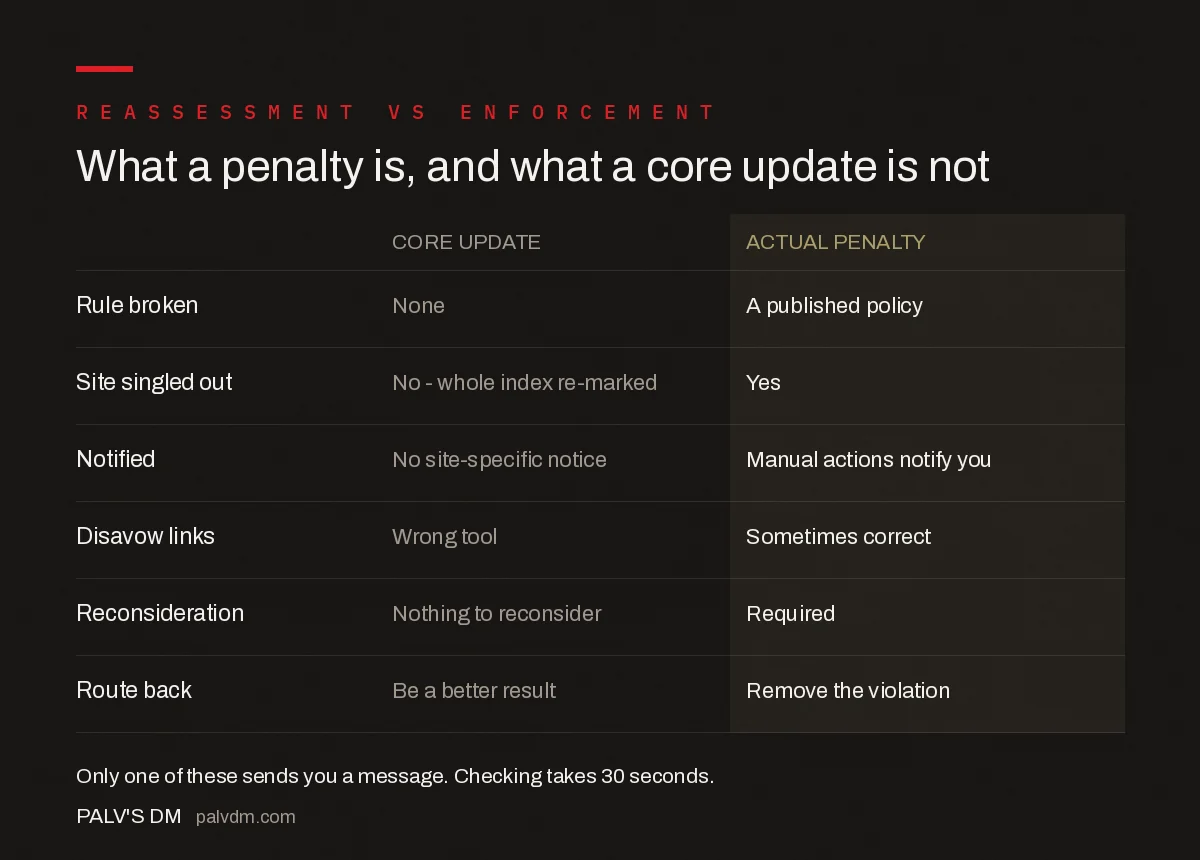
What a penalty is, and what a core update is not
| Core update | Actual penalty | |
|---|---|---|
| Rule broken | None | A published policy |
| Site singled out | No – whole index re-marked | Yes |
| Notified | No site-specific notice | Manual actions notify you |
| Disavow links | Wrong tool | Sometimes correct |
| Reconsideration | Nothing to reconsider | Required |
| Route back | Be a better result | Remove the violation |
Frequently asked questions
Do Google core updates penalise websites?
No. A core update reassesses how content across the whole index is evaluated and ranked. Nothing is flagged against your site, no rule has been broken, and there is no notice or appeal process. A site can lose positions without having done anything wrong, simply because Google’s assessment of what best answers a query changed or competing pages were reassessed upward.
Should I disavow links after a Google core update?
Almost never. Disavow is appropriate when you have a manual action for unnatural links, or you knowingly acquired links that violate Google’s link spam policies. After a core update there is no link violation to undo, and disavowing can remove signals that were helping you. Google has said repeatedly that the majority of sites never need the disavow tool at all.
Can I file a reconsideration request after a core update?
You can file one, but it will not help. Reconsideration requests exist only for manual actions, where a human reviewer at Google has penalised your site and you have fixed the named problem. Core updates and algorithmic spam enforcement have no human decision to appeal, so there is nothing for a reviewer to reconsider.
Why did my rankings drop if I did nothing wrong?
Because ranking is relative. Core updates re-evaluate every page against a changed field, so you can lose position when competitors improve or when Google gets better at recognising which pages genuinely satisfy a query. Google’s own analogy is a best-films list refreshed years later: a film that slipped down the list did not get worse, but new films arrived and the criteria matured.
How do I know whether it was a core update or a spam update?
Check the exact dates against Google’s Search Status Dashboard, because the two can run days apart. In March 2026 the spam update ran 24 to 25 March and the core update began on 27 March. A drop starting on 24 March points to spam enforcement, which does require removing a violating practice, while a drop from 27 March onward points to the core update, which does not.
Sources
- Google core updates and your website — Search Central
- Google Search spam policies
- Google Search Status Dashboard
Want this done on your site?
Every PalV’s DM engagement starts with a free audit of your actual website — a 12-point
crawl covering what is blocking indexation, on-page gaps against your primary keywords, speed
findings, and the three to five fixes worth making first. Delivered in two working days. No
payment details, and the findings are yours whether you hire us or not.