A 30-Day Recovery Plan After a Core Update
A week-by-week plan for after a core update: what to diagnose, what to fix, and what not to touch. Built around how recovery actually arrives.

There is no thirty-day fix for a core update — Google states plainly that recovery usually arrives with a subsequent core update rather than between them. What thirty days buys you is a correct diagnosis and the right work started, so that when the next rollout runs you are ready for it rather than beginning then. This plan is built around that reality. Week one is measurement only. Week two is diagnosis. Weeks three and four are the actual work. Nothing structural gets touched until you know what you are fixing.
The single biggest mistake after a core update is starting at week three. People rewrite before they diagnose, and afterwards cannot tell whether anything helped.
Before you start: is it even a core update?
Two checks, five minutes, and a meaningful proportion of “core update recoveries” end here.
- Search Console → Security & Manual Actions. A notice means a manual action, which is a completely different problem with a completely different fix.
- Google’s Search Status Dashboard. Confirm an update was actually running on those dates. If nothing was confirmed, you are diagnosing something else — see was it an update or was it you and the August 2026 volatility, where the industry named an update that did not exist.
Also confirm the rollout has finished. Assessing mid-rollout produces conclusions that expire. The May 2026 core update moved in three separate waves across twelve days.
Week 1: measure, change nothing
This week feels unproductive and is the highest-value week in the plan. You are establishing what actually happened while the evidence is still clean.
- Set clean comparison windows. Equal-length periods, both entirely outside the rollout dates. Never straddle. Choosing the right comparison window covers the detail.
- Export Search Console data by page, by query, by device, by country. Four separate exports. The pattern lives in the segmentation, not the total.
- Split positions, impressions and clicks. Falling positions is a ranking change. Falling clicks at stable positions is a SERP-feature or title problem, not a quality problem.
- Isolate Search from Discover and News. They move independently and are separated in Search Console’s search type filter.
- Write down every change you shipped in the ninety days before. Deployments, migrations, template edits, plugin changes. If you have no change log, start one now — this is the input you will wish you had next time.
- Freeze structural changes. No rewrites, no deletions, no redirects, no internal linking overhauls.
If a change was already scheduled before the update, ship it and record the date. Otherwise wait.
Week 2: diagnose the pattern
Now find out what the update actually rewarded, using your own data rather than commentary.
Group the losers. Sort by lost clicks and look for what they share — a template, a content type, a funnel stage, a publication era, an author. Core updates rarely hit everything evenly, and the shared attribute is the diagnosis. Pages from one 2022 content sprint dropping together tells you something specific.
Identify what replaced you. For your ten biggest losing queries, look at who now ranks where you did. This is the most informative half-hour of the whole month and most people skip it.
Compare honestly. Against each winner, ask: does it contain original data, first-hand testing, a named author with credentials, or a materially better explanation? Usually at least one is present and absent from yours. That gap is your brief.
Run Google’s three questions against your losing pages. Who produced this — is there a real, credentialed name on it? How was it produced — could you describe the process without embarrassment? Why does it exist — for a reader, or to occupy a keyword? These are from Google’s own published self-assessment list, and the third one is where most volume-produced content fails.
Check whether the losers are actually thin. Not short — thin. A 400-word page that fully answers a narrow question is fine. A 2,000-word page restating the top ten is not. Information gain is the test.
Weeks 3–4: do the work
Now you can act, and the actions are prioritised by leverage rather than by anxiety.
Fix the worst offenders properly, not everything superficially
Take the five to ten pages with the largest losses that also failed the week-two comparison, and genuinely improve them. Add the thing they lack — real data, a documented test, a named author, the better explanation. A superficial pass across sixty pages achieves nothing; a substantive rebuild of eight can.
Prune or consolidate what should not exist
Since quality is assessed partly at site level, pages that add nothing are a small ongoing cost. For each, choose one: improve it substantially, merge it into a stronger page with a redirect, or remove it. Do not noindex everything reflexively — that hides the problem rather than resolving it.
Fix attribution site-wide
Cheap, fast, and it addresses Google’s “who” question directly. Real bylines, a substantive author page with verifiable credentials, and Person schema linking them. Building an author page that actually signals expertise covers what makes one credible rather than decorative.
Strengthen internal linking to the pages you are rebuilding
Descriptive anchors, from relevant existing pages. This is the cheapest ranking support available and it is routinely neglected.
What not to do, at any point
| Do not | Why |
|---|---|
| Disavow links | There is no link violation to undo. You may remove signals that were helping. |
| File a reconsideration request | Applies only to manual actions. Achieves nothing here. |
| Delete pages that dropped a few positions | Removes an asset still earning impressions, and destroys the history you need to measure recovery. |
| Buy links to compensate | Converts a reassessment into an actual policy problem. |
| Rewrite everything at once | You lose all ability to attribute cause. Change in tranches you can measure. |
| Republish with a new date and no changes | Google is explicit that faking freshness does not work. |
| Expect recovery within the month | It usually arrives with the next core update. Judging this plan at day 30 will make you abandon work that was going to pay. |
Day 30 onward: what to expect
You may see partial movement between updates, and it is worth watching, but the meaningful reassessment comes when Google next runs a core update. Recent cadence puts that roughly every two to three months — March and May in 2026, with none confirmed since.
Between now and then: keep shipping improvements in measurable tranches, keep the change log current, and re-run the week-two comparison monthly to see whether the winners have changed. When the next rollout is announced, freeze changes again and repeat week one.
One honest caveat. Sometimes a site drops because a structurally stronger competitor entered the space or because the query’s intent shifted, and no amount of improvement to your existing pages recovers that position. The week-two comparison is where you find out. If the winners are doing something you genuinely cannot match, the right decision is to redirect effort toward queries you can win rather than spending a year on one you cannot — and saying so early is more valuable than optimism.
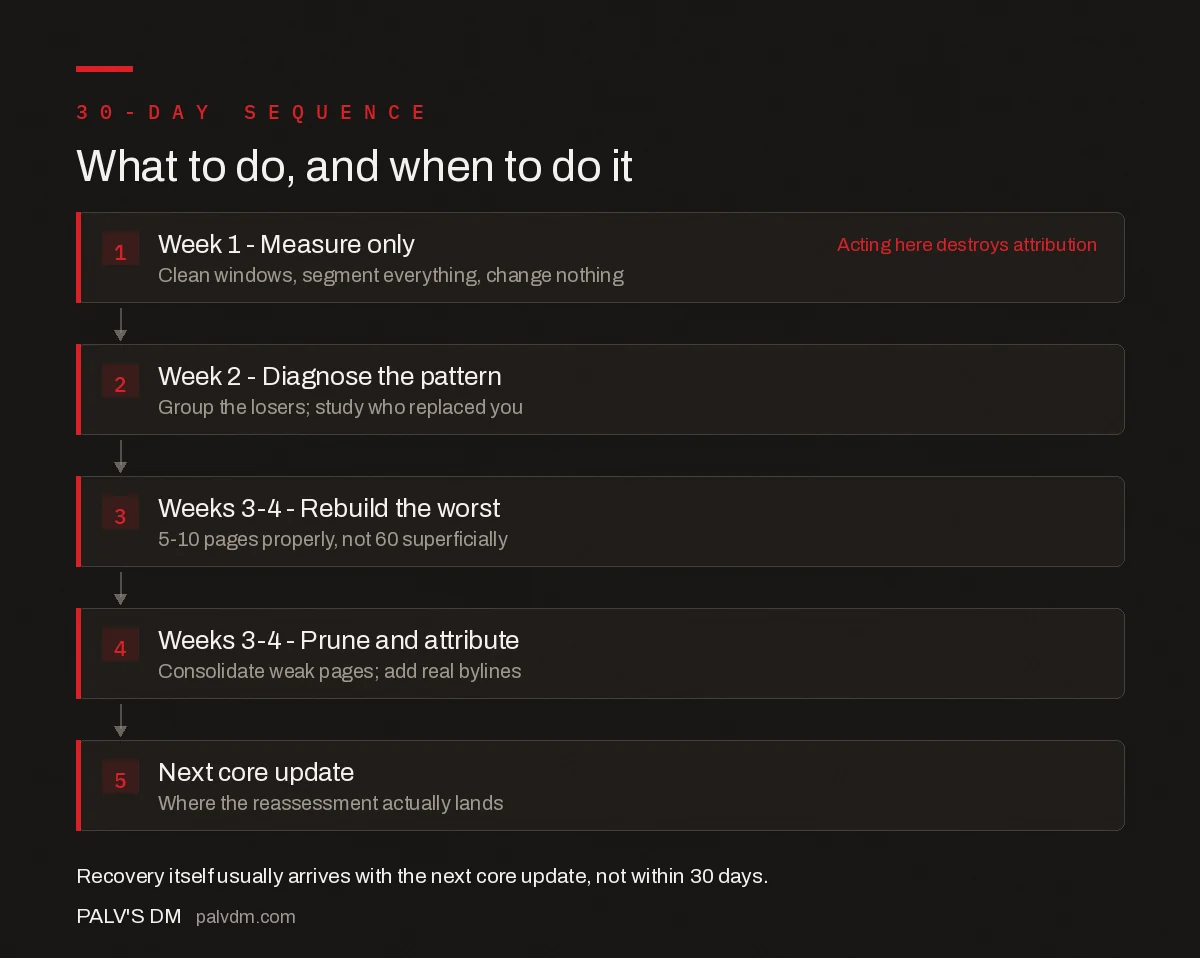
What to do, and when to do it
- Week 1 – Measure only. Clean windows, segment everything, change nothing. Acting here destroys attribution
- Week 2 – Diagnose the pattern. Group the losers; study who replaced you.
- Weeks 3-4 – Rebuild the worst. 5-10 pages properly, not 60 superficially.
- Weeks 3-4 – Prune and attribute. Consolidate weak pages; add real bylines.
- Next core update. Where the reassessment actually lands.
Frequently asked questions
How long does it take to recover from a Google core update?
Recovery usually arrives with a subsequent core update rather than between them, which on recent cadence means roughly two to six months. Google states there are no specific actions that guarantee recovery and that a drop does not necessarily mean anything is wrong with your pages. You may see partial movement between updates, but the meaningful reassessment comes at the next rollout.
What should I do first after a core update hits?
Nothing structural. Spend the first week measuring: set comparison windows entirely outside the rollout dates, export Search Console data segmented by page, query, device and country, separate positions from impressions from clicks, isolate Search from Discover, and write down every change you shipped in the previous ninety days. Diagnosis before action is what makes the later work attributable.
Should I delete pages that lost rankings in a core update?
Not simply because they dropped. Pruning genuinely weak content is legitimate, since quality is assessed partly at site level, but deleting a page that fell a few positions removes an asset still earning impressions and destroys the history you need to measure recovery. For each weak page choose deliberately: improve substantially, merge into a stronger page with a redirect, or remove.
Can I make changes while a core update is still rolling out?
Avoid it. Rankings genuinely swing during a rollout — the May 2026 core update moved in three distinct waves across twelve days — so you would be optimising against a state that keeps changing. Worse, your edits become entangled with the update and you permanently lose the ability to tell what caused what. If a change was already scheduled, ship it and log the date.
Why isn't my traffic recovering even though I improved the content?
Most likely because the next core update has not run yet, and that is when the reassessment happens. It is also worth checking whether the pages now outranking you are doing something you have not matched — original data, first-hand testing, or named expertise. Occasionally a stronger competitor has entered the space or query intent has shifted, in which case redirecting effort to winnable queries beats persisting.
Sources
- Google core updates and your website — Search Central
- Creating helpful, reliable, people-first content — Google Search Central
- Google Search Status Dashboard
Want this done on your site?
Every PalV’s DM engagement starts with a free audit of your actual website — a 12-point
crawl covering what is blocking indexation, on-page gaps against your primary keywords, speed
findings, and the three to five fixes worth making first. Delivered in two working days. No
payment details, and the findings are yours whether you hire us or not.