August 2026 Volatility: Update, Bug, or Coincidence?
Google confirmed no August 2026 update. Its status dashboard was clear all week. Here is what really moved, and how to diagnose your own traffic drop.
There was no confirmed Google algorithm update in August 2026. Google announced nothing, and its Search Status Dashboard recorded no ranking, indexing, crawling or serving incident between 1 and 6 August 2026 — the exact window in which the industry was loudly declaring an update. Third-party trackers did show real movement, with roughly fourteen tools registering spikes across 1–3 August and again on 5–6 August. But at least three unrelated problems landed in the same few days, and treating them as one event is the reason so many diagnoses from that week were wrong.
This matters beyond August. The pattern — trackers spike, the industry names an update, Google confirms nothing — repeats several times a year. Learning to work through it properly is worth more than knowing what happened in one particular week.
What did Google actually confirm in August 2026?
Nothing. The last confirmed Google update before August was the June 2026 spam update, which completed on 26 June 2026. Between that date and 17 August 2026, Google’s Search Status Dashboard shows no new ranking update.
The dashboard is not a courtesy. It is the mechanism Google built specifically so site owners could distinguish confirmed changes from noise, and it logs each ranking update with start and completion timestamps — see how to read it properly, and the full 2026 timeline. When it is silent during a week the industry is calling an update, the honest report reads “unconfirmed volatility”, not “August 2026 core update”.
So what actually moved?
Three separate things, plus ordinary search churn. They had different causes, different affected populations, and different fixes — which is precisely why bundling them produced bad advice.
| What happened | When | Who it hit | What it was not |
|---|---|---|---|
| GA4 reporting bug | Early August 2026 | Anyone diagnosing from GA4 | Not a ranking change — a measurement failure in the tool people were using to measure |
| Google Ad Manager disruptions | Early August 2026 | Publishers running Ad Manager | Not organic search at all — a monetisation issue read as a traffic issue |
| Google Discover traffic decline | Began mid-July 2026 | Discover-dependent publishers | Not an August event — it predates the window entirely |
| Search results volatility | 1–3 and 5–6 August 2026 | Varied by vertical | Not confirmed by Google as an update |
The Discover point is the one most often missed. A publisher who saw traffic fall and blamed an August algorithm update was frequently looking at a decline that had started weeks earlier in a completely different surface. The dates do not line up, and nobody checked, because the story was already written.
The GA4 bug compounds everything else, and deserves particular attention. If the tool you are using to measure the damage is itself broken, every conclusion you draw from it that week is unreliable. Several people rewrote content in response to a drop that partly did not exist.
Why do volatility trackers spike when Google confirms nothing?
Because trackers measure ranking movement, not causation. They cannot tell you why positions changed, and several ordinary things move positions without any algorithm update:
- Ordinary index churn. Pages are added, removed and recrawled constantly. Google has said search results always show some level of daily fluctuation.
- Infrastructure bugs. Google has publicly confirmed ranking bugs in the past that were not intentional updates.
- SERP feature changes. If Google expands AI Overviews on a query set, every organic position shifts down without any ranking system changing.
- Seasonality. Query mix changes month to month, and different pages rank for different query mixes.
- Tracker methodology. Different tools sample different keyword sets in different locations. Fourteen tools agreeing that “something moved” is fourteen tools observing the same churn, not fourteen independent confirmations of an update.
The removal of the &num=100 parameter in September 2025 is the cautionary tale here. It broke how rank trackers collected data across the entire industry, and produced dramatic apparent changes in Search Console impressions that had nothing to do with human behaviour. Tooling artefacts can look exactly like algorithm updates.
How do you diagnose a traffic drop when Google has confirmed nothing?
Work through this in order. Each step eliminates a category of cause, and most drops resolve before step six.
- Check the Search Status Dashboard for the exact dates. Learn to tell confirmed from unconfirmed updates. If nothing is listed, stop calling it an update in your reporting.
- Check Search Console for a manual action. Security & Manual Actions. Thirty seconds, rules out the worst case.
- Separate positions, impressions and clicks. These tell three different stories. Falling positions with steady impressions is a ranking change. Falling impressions with steady clicks is usually a measurement or SERP-feature change. Falling clicks with steady positions and impressions is a click-through problem — often an AI Overview appearing above you.
- Isolate Search from Discover from News. Search Console lets you filter by search type. These surfaces move independently, and in August 2026 conflating them was the single most common diagnostic error.
- Verify your analytics against a second source. Compare GA4 against Search Console clicks and, if possible, server logs. If they disagree materially, trust the one that is not currently known to be buggy.
- Check your own change log. This is the whole point of was it an update or was it you. Deployments, theme updates, plugin changes, robots.txt edits, a CDN configuration change, an expired certificate. In practice this is the most common cause of traffic drops that get blamed on Google.
- Segment by page, query, device and country. A real algorithmic reassessment usually shows a pattern — a content type, a template, a query cluster. A uniform drop across everything more often points to a technical or measurement cause.
What should you tell a client during an unconfirmed volatility week?
The temptation is to name the update, because “Google rolled out an update” is a comfortable explanation that places the cause outside anyone’s control. It is also, in a week like early August 2026, false.
A more defensible message: search results showed elevated volatility on specific dates, Google has confirmed no update, we have ruled out manual actions and our own deployments, we are separating Search from Discover, and we are not making structural changes until the picture is stable. That is less satisfying and considerably more useful — and it protects you when the volatility reverses two weeks later and the “update” you named turns out never to have existed.
It also preserves your ability to establish causation later. If you rewrite forty pages during an unconfirmed volatility week, you have permanently destroyed your ability to know whether the recovery came from your changes or from the noise settling.
The rule worth keeping
Confirmed updates come from Google’s Search Status Dashboard. Everything else is an observation awaiting an explanation. Volatility trackers tell you the sea is rough; they cannot tell you whether it is a storm, a tide or a passing ship.
In August 2026, the answer turned out to be a passing ship, a broken instrument, and a tide that had been going out since mid-July.
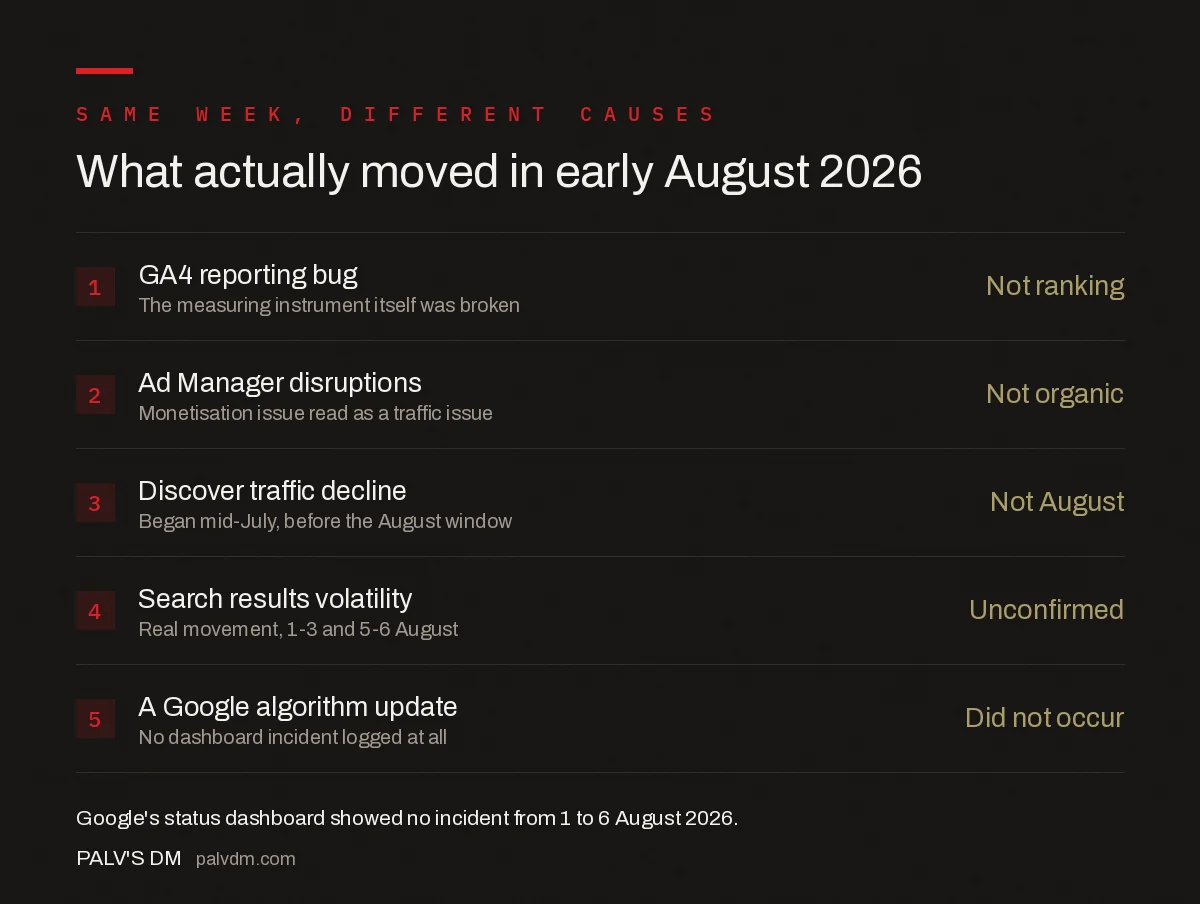
What actually moved in early August 2026
- GA4 reporting bug — Not ranking. The measuring instrument itself was broken.
- Ad Manager disruptions — Not organic. Monetisation issue read as a traffic issue.
- Discover traffic decline — Not August. Began mid-July, before the August window.
- Search results volatility — Unconfirmed. Real movement, 1-3 and 5-6 August.
- A Google algorithm update — Did not occur. No dashboard incident logged at all.
Frequently asked questions
Was there a Google algorithm update in August 2026?
No. Google announced no algorithm update in August 2026, and its Search Status Dashboard showed no ranking, indexing, crawling or serving incident between 1 and 6 August 2026. Third-party tools did register volatility on 1–3 and 5–6 August, but tracker movement is an observation, not confirmation that Google changed its ranking systems.
Why did my Google traffic drop in August 2026 if there was no update?
Several unrelated issues landed in the same window. A GA4 reporting bug affected the analytics many site owners were using to measure the drop, Google Ad Manager had disruptions, and a Google Discover traffic decline had begun in mid-July, before August. Separate Search from Discover from News in Search Console, verify GA4 against a second source, and check your own deployment log before concluding anything.
Can I trust volatility trackers like Semrush Sensor?
Trust them to tell you that rankings moved, not why. Trackers cannot distinguish an algorithm update from an infrastructure bug, a SERP feature expansion, seasonal query mix changes or ordinary index churn. Multiple tools spiking simultaneously means they are observing the same movement, not independently confirming a cause. Google’s Search Status Dashboard is the only authoritative confirmation.
How do I know if a traffic drop is Google's fault or mine?
Check your own change log first. Deployments, theme updates, plugin changes, robots.txt edits and CDN configuration changes cause more traffic drops than algorithm updates do. Then look for a pattern: a genuine algorithmic reassessment usually affects a specific content type, template or query cluster, while a uniform drop across everything more often indicates a technical or measurement problem.
What was the last confirmed Google update before August 2026?
The June 2026 spam update, which ran from 24 to 26 June 2026 and took roughly two days. Google announced no new spam policies alongside it. Between that completion date and 17 August 2026, Google’s Search Status Dashboard listed no further ranking update.
Sources
- Google Search Status Dashboard — showed no incident 1–6 August 2026
- August 2026 Google Webmaster Report — Search Engine Roundtable — volatility, Search Console and bug round-up
- Google June 2026 spam update done rolling out — Search Engine Land — the last confirmed update before August
Want this done on your site?
Every PalV’s DM engagement starts with a free audit of your actual website — a 12-point
crawl covering what is blocking indexation, on-page gaps against your primary keywords, speed
findings, and the three to five fixes worth making first. Delivered in two working days. No
payment details, and the findings are yours whether you hire us or not.