What to Tell a Client the Week an Update Lands
The week a Google update lands, silence gets filled by trackers and forum threads. What to send in 24 hours, what to promise, and what never to promise.

Send the client an email within twenty-four hours of a confirmed update that says three things: an update is rolling out, we are not drawing conclusions until it finishes, and here is the date you will get a real assessment. The most damaging thing an agency can do in that week is go quiet, because silence gets filled — usually by a competitor’s newsletter, a volatility tracker screenshot, or someone on the client’s team who read a forum thread. The second most damaging thing is promising a recovery date, because nobody has one to give.
Update weeks are a communication problem before they are an SEO problem. The diagnostic work cannot start until the rollout completes, which means the only deliverable available in week one is an accurate expectation.
What do you send in the first twenty-four hours?
Short, dated, and specific. Four elements, nothing else.
- Confirmation from the source. Name the update, its start date, and that it appears on Google’s Search Status Dashboard. Not a tracker screenshot.
- What this type of update is. One sentence: a broad reassessment of ranking systems across the whole index, not a penalty and not something applied to their site specifically.
- What you are doing now. Monitoring, holding structural changes, not shipping anything that would confuse attribution.
- A dated commitment. “A full assessment on [date]” — set roughly four weeks after the expected completion, because a clean comparison needs a closed post-rollout window.
Resist the temptation to include early numbers. Whatever the dashboard shows on day three will be wrong by day twelve, and a client who has seen an early figure will anchor on it for the rest of the engagement.
How do you explain a core update without jargon?
Use Google’s own analogy, because it is accurate and it removes the idea of blame. A core update is like a best-films list being refreshed a few years later: the films that slipped down did not get worse, but new films arrived and the criteria matured. Nothing was done to any individual film.
That framing does the essential work, which is separating reassessment from punishment. Clients almost always arrive at “what did we do wrong”, and the honest answer is usually “nothing that was flagged” — core updates are not penalties, there is no violation notice, and there is no appeal. If they want the distinction in writing, core update versus spam update versus manual action covers the three mechanisms.
One check is worth running before you send anything, because it eliminates the worst case in thirty seconds: Search Console, Security & Manual Actions. If there is no notice, you can state plainly that there is no manual action.
How long do you tell them it will take?
Give the rollout length from the record, and refuse to give a recovery date. Those are two different questions and clients merge them.
| Question | What you can say |
|---|---|
| How long is the rollout? | Google usually estimates up to two weeks. Recent rollouts ran 12 days (March 2026), roughly 12 days (May 2026) and 18 days (December 2025). |
| When will we know the impact? | Roughly a month after completion, once a clean 28-day comparison window has closed. |
| When will we recover? | No date exists. Google states the largest changes tend to arrive with a subsequent core update, and has never committed to a schedule. |
| Can you guarantee recovery? | No, and anyone who does is guessing. Google states no specific action guarantees it. |
The third row is where agencies lose accounts, in both directions. Promising a date buys three weeks of calm and then costs the relationship. Saying “we don’t know” without the surrounding structure sounds like evasion. Saying “no date exists, here is what Google has published about why, and here is the work that qualifies” is neither — the reasoning is set out in why recovery waits for the next core update.
What do you say when the client sends a volatility tracker screenshot?
Explain the difference between movement and confirmation, once, clearly: third-party trackers show that search results moved, and Google’s dashboard confirms that Google moved them. Both are useful and they answer different questions.
August 2026 is the example to keep to hand. Roughly fourteen tracking tools registered spikes across 1–6 August 2026, the industry widely described an August update, and Google’s dashboard showed no ranking, indexing, crawling or serving incident in that window at all. Three unrelated issues sat in the same fortnight — a GA4 reporting bug, Google Ad Manager disruptions, and a Discover traffic decline that had begun in mid-July. Every report that named an August core update was reporting something Google never confirmed, and the clients who received those reports were charged for the analysis.
The reporting language that survives scrutiny is “unconfirmed volatility”. It is not hedging; it is the accurate label, and adopting it consistently is part of separating confirmed updates from unconfirmed movement.
What about “our competitor went up”?
Answer it directly, because it is a reasonable question and it has a real answer. Ranking is relative: a core update reassesses the whole field, so a site can lose positions without changing anything because competing pages were reassessed upward. A competitor rising is evidence about the field, not evidence that they know something you do not.
What it does justify is a comparison. Once the rollout completes, pull the queries where they gained and you lost, and compare the pages honestly against Google’s published self-assessment questions. That comparison is the useful deliverable and it belongs in the assessment, not in the week-one email — the questions themselves are covered in Google’s own questions to ask after a core update.
What if the client’s traffic went up?
Say so, and resist claiming credit. A gain during a core update is the same relative movement as a loss, read from the other side: the field was reassessed and the client’s pages held their ground while others did not. That is worth reporting as evidence that the current approach is working, and it is not evidence that a specific piece of last quarter’s work caused it.
There is also a practical reason not to over-claim. Whatever explanation you give for the rise becomes the explanation the client expects to protect them at the next rollout, and if it was never the real cause, the next update produces a conversation you cannot win. Report the gain, segment it the same way you would segment a loss, and note which pages moved and which did not.
What goes in the assessment when it lands?
The month-later report is where credibility is won or lost, and it should be structurally different from a normal monthly report.
- Confirmed dates for the rollout, taken from the dashboard.
- The comparison method stated explicitly — two equal-length windows, both fully outside the rollout, as in choosing the right comparison window.
- Positions, impressions and clicks separately, never blended into one traffic number.
- The damage segmented by page type, query cluster, device and country, because the shape of the loss names the cause.
- What you shipped in the surrounding weeks, from your update log, so self-inflicted causes are ruled in or out on the record.
- A prioritised shortlist, not a list of everything. Ten to twenty URLs by absolute clicks lost.
Setting that structure in advance is what makes the week-one email credible. You are not asking the client to trust you for a month; you are telling them exactly what will arrive and when, and the wider reporting standard is covered in what an SEO agency should report.
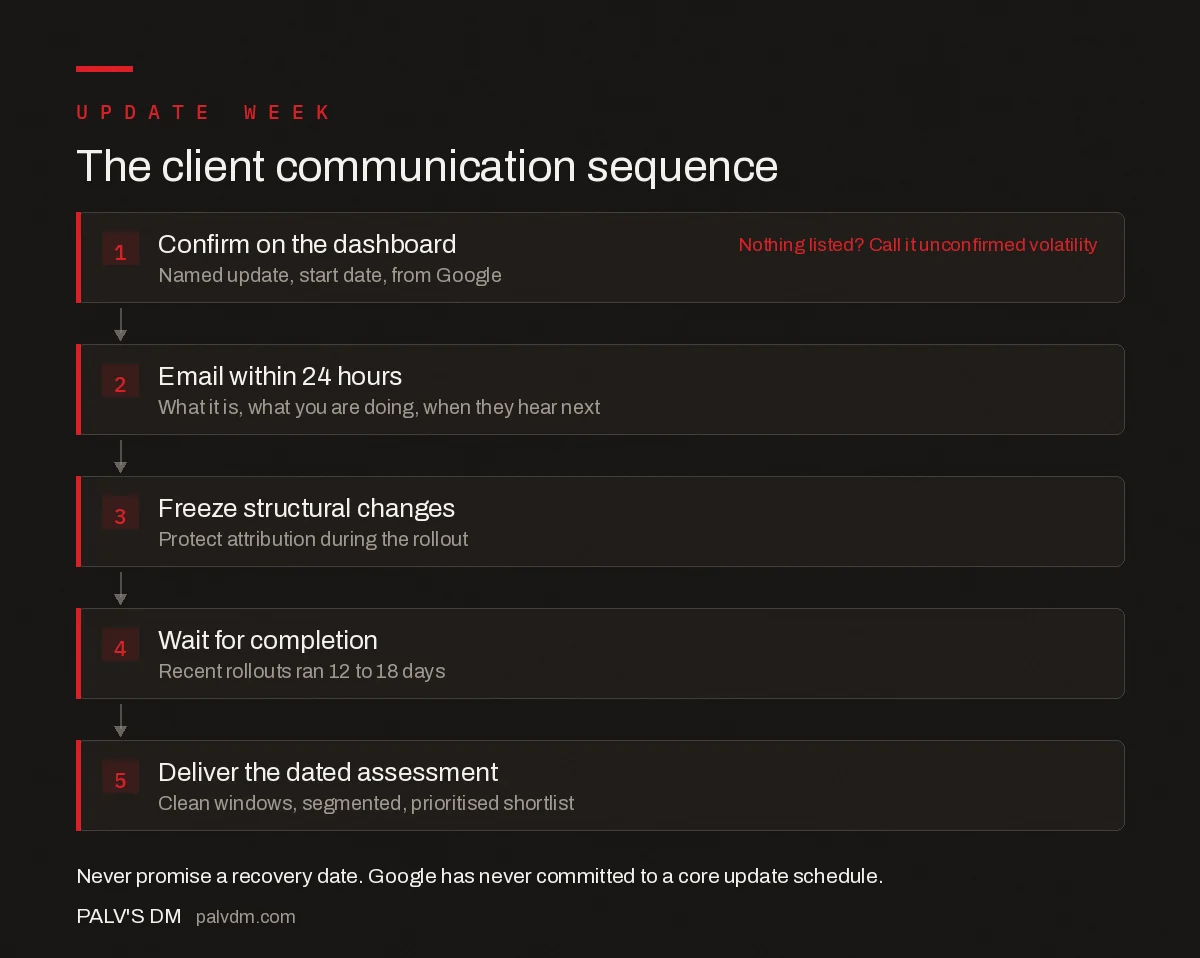
The client communication sequence
- Confirm on the dashboard. Named update, start date, from Google. Nothing listed? Call it unconfirmed volatility
- Email within 24 hours. What it is, what you are doing, when they hear next.
- Freeze structural changes. Protect attribution during the rollout.
- Wait for completion. Recent rollouts ran 12 to 18 days.
- Deliver the dated assessment. Clean windows, segmented, prioritised shortlist.
Frequently asked questions
What should you tell a client when a Google update rolls out?
Send an email within 24 hours confirming the update from Google’s Search Status Dashboard, explaining that a core update is a broad reassessment rather than a penalty, stating that you are holding structural changes until the rollout completes, and giving a specific date for a full assessment, usually about four weeks after completion.
How do you explain a core update to a non-technical client?
Use Google’s own analogy: a core update is like a best-films list refreshed a few years later. The films that slipped down did not get worse, but new films arrived and the criteria matured. Nothing was done to any individual film. That framing separates reassessment from punishment, which is the distinction clients most often get wrong.
Should you give a client a recovery date after a core update?
No. Google states there are no specific actions that guarantee recovery and that the largest changes tend to arrive with a subsequent core update, and it has never committed to a schedule for core updates. Give the rollout length and the assessment date instead, both of which are knowable, and explain why a recovery date is not.
What do you say when a client sends a volatility tracker screenshot?
Explain that trackers show search results moved while Google’s dashboard confirms Google moved them. In August 2026 roughly fourteen tools registered spikes between 1 and 6 August while Google’s dashboard showed no ranking, indexing, crawling or serving incident at all. Use the phrase unconfirmed volatility in reporting when nothing is listed.
How do you answer a client asking why a competitor's rankings went up?
Ranking is relative, so a core update reassesses the whole field and a site can lose positions without changing anything because competing pages were reassessed upward. A competitor rising is evidence about the field rather than proof they know something. Once the rollout completes, compare the specific queries where they gained and you lost.
What should the post-update client report contain?
Confirmed rollout dates from Google’s dashboard, an explicitly stated comparison method using equal-length windows outside the rollout, positions, impressions and clicks reported separately, the damage segmented by page type, query cluster, device and country, a record of what you shipped in the surrounding weeks, and a prioritised shortlist of URLs.
Sources
- Google core updates and your website — Search Central
- Google Search Status Dashboard
- Manual Actions report — Search Console Help
- August 2026 Google Webmaster Report — Search Engine Roundtable
Want this done on your site?
Every PalV’s DM engagement starts with a free audit of your actual website — a 12-point
crawl covering what is blocking indexation, on-page gaps against your primary keywords, speed
findings, and the three to five fixes worth making first. Delivered in two working days. No
payment details, and the findings are yours whether you hire us or not.