Google Discover After the 2026 Update: Locality, Clickbait and Topic Expertise
Google named three goals for the February 2026 Discover core update. What locality, clickbait and topic expertise mean in practice, and what to change now.
The February 2026 Discover core update was the first core update Google aimed exclusively at Discover, and Google published three specific goals for it: show more locally relevant content from websites based in the user’s country, reduce sensational content and clickbait, and surface more in-depth, original and timely content from sites with demonstrated expertise in a given area. It ran from 5 February to 27 February 2026 — 21 days and 17 hours — and Google released it to English-language users in the US, saying it would expand to all countries and languages in the months ahead.
That launch scope is the detail most coverage left out, and it changes who should act. If your Discover traffic comes from readers outside the US, the February update’s stated changes were not applied to your audience at launch, and Google has published no separate announcement confirming the expansion since. The direction of travel is unambiguous even so, which makes the goals worth building against now rather than after they arrive.
What did Google actually change in Discover?
Google described the February 2026 Discover core update as “a broad update to our systems that surface articles in Discover” and said its testing showed people find the Discover experience more useful and worthwhile with the update in place. Unusually for a core update, Google named what it was trying to achieve rather than leaving it at general quality language. The full account of the update covers the rollout itself; what follows is what to do about it.
Google also stated plainly that “this change may lead to fluctuations in Discover traffic. Some sites might see increases or decreases; many sites may see no change at all.” That is the standard core update caveat, and it applies here: a Discover decline in early 2026 is not automatically this update’s doing.
How does Google decide a site has expertise in a topic?
This is the most actionable thing Google published, because it gave a concrete example rather than a principle. Google said its systems identify expertise on a topic-by-topic basis, so a site with deep focus on one subject and a site with genuine expertise across several both have opportunity in Discover.
Google’s illustration: a local news site with a dedicated gardening section could have established expertise in gardening, even though it covers other topics. A movie review site that wrote a single article about gardening would likely not.
The operational reading is direct. Sustained, sectioned coverage of a defined subject counts. One opportunistic article aimed at a trending topic does not, no matter how well written it is. That is the same logic that drives genuine topical authority in Search: depth in a defined area beats breadth across whatever is currently popular.
For a publisher, that turns into three questions worth answering honestly about every section you run: does it publish consistently rather than opportunistically, does it have named writers who cover that subject repeatedly, and would a reader recognise the site as a place that covers this? Author pages that carry real credentials are how the second question becomes visible to a system rather than only to a human.
What does “locally relevant” mean if you publish outside the US?
Google’s first stated goal was showing users more locally relevant content from websites based in their country. Read the two halves separately, because they point in opposite directions for different businesses.
Publishers producing content aimed at a foreign audience — most commonly non-US sites writing for US readers to reach higher ad rates — are the exposed group. Publishers writing for readers in their own country are the intended beneficiaries. For an Indian publisher serving Indian readers, the stated direction is favourable. For an Indian publisher running a US-targeted news operation, it is not.
One third-party analysis is worth knowing about and worth treating cautiously. Newzdash examined the US top 1,000 domains after the rollout and reported that the international share declined on a normalised basis, which is directionally consistent with what Google described. That is a single analysis rather than a controlled study, so treat it as corroboration rather than proof.
What counts as clickbait in Discover, and what does not?
Google’s second stated goal was reducing sensational content and clickbait. Discover has always rewarded a curiosity gap more generously than Search does, because there is no query to satisfy — only a decision to tap a card. That produced a structural incentive toward overstatement, and this goal is Google pulling it back.
The distinction that matters is not between plain headlines and interesting ones. It is between a headline that describes what the article delivers and one that promises more than the article contains.
| Liability after the update | Still fine |
|---|---|
| A promise the article does not deliver on | A specific, surprising fact stated up front |
| Withholding the answer to force the tap | Giving the answer and explaining why it matters |
| Manufactured outrage or alarm | Genuine stakes described proportionately |
| Numbers and superlatives with no source | Numbers you can attribute in the first screen |
A useful internal test: if the headline and the first paragraph were shown to a reader who then read the whole piece, would they feel the article delivered what was advertised? Headlines that fail that test used to be an asset on this surface. They are now a stated target.
How do you measure Discover separately from Search?
Discover and Search move independently, and diagnosing a Discover decline as a Search problem sends you rewriting pages that were never affected. Search Console separates them cleanly.
- Open Search Console and go to Performance, then the Discover report. It is a separate report from Search results and appears only once a site has accumulated enough Discover impressions.
- Compare equal-length windows that both sit fully outside 5–27 February 2026 if you are assessing the update specifically. A window straddling the rollout blends two states.
- Split impressions from clicks. Discover impressions are a function of how often Google surfaced your card; clicks are a function of whether people tapped it. A clickbait correction shows up differently from a distribution change.
- Segment by article and by section. If one section held and another collapsed, the topic-expertise goal is the likely story rather than anything site-wide.
- Check the Search report for the same period. If Search held steady while Discover fell, you have isolated the surface. Confirming update impact properly covers the comparison method in full.
What if your Discover traffic fell in July or August 2026?
Then the February update is probably not your explanation, and it is worth being precise about the dates. A broad Google Discover traffic decline began in mid-July 2026, before the widely discussed August volatility window. Separately, across 1 to 6 August 2026, roughly fourteen third-party tools registered elevated movement while Google’s Search Status Dashboard showed no ranking, indexing, crawling or serving incident at all.
Two other things landed in the same weeks and are routinely mistaken for search changes: a GA4 reporting bug and Google Ad Manager disruptions. Neither is a Google Search system and neither would ever appear on the dashboard. What the August 2026 data actually shows separates the four events, and the wider publisher traffic decline puts the Discover component in context.
The practical instruction is to date your decline precisely before choosing an explanation. A drop that starts in mid-July and a drop that starts in February are not the same problem.
What should you actually do about Discover now?
- Pick the topics you intend to be known for and cover them as sections, not as posts. Google’s expertise assessment is topic-by-topic and site-level, which rewards sustained coverage over opportunistic publishing.
- Put named, credentialled writers on those sections consistently. E-E-A-T is not a Discover ranking score, but “who produced this and why should we believe them” is answerable or it is not.
- Audit your last hundred headlines against the delivery test. Fix the ones that promise more than the article contains, starting with your highest-impression cards.
- Decide honestly which country your content is for. If it is written for readers elsewhere purely for ad rates, the stated direction of Google’s update is against you.
- Keep timeliness real. Google named timely content as part of the third goal, but timely means covering things while they matter, not republishing with a new date. Genuine content freshness and date manipulation are different activities.
- Stop treating Discover as a Search side effect. Track it as its own channel with its own targets, because it now has its own core updates.
The wider signal is worth registering: Google is willing to run broad ranking reassessments on individual surfaces rather than only across Search as a whole. Every confirmed change of the year is dated in the 2026 update timeline, and what a core update actually is applies to Discover core updates exactly as it does to Search — there is no violation to undo, and no reconsideration to file.
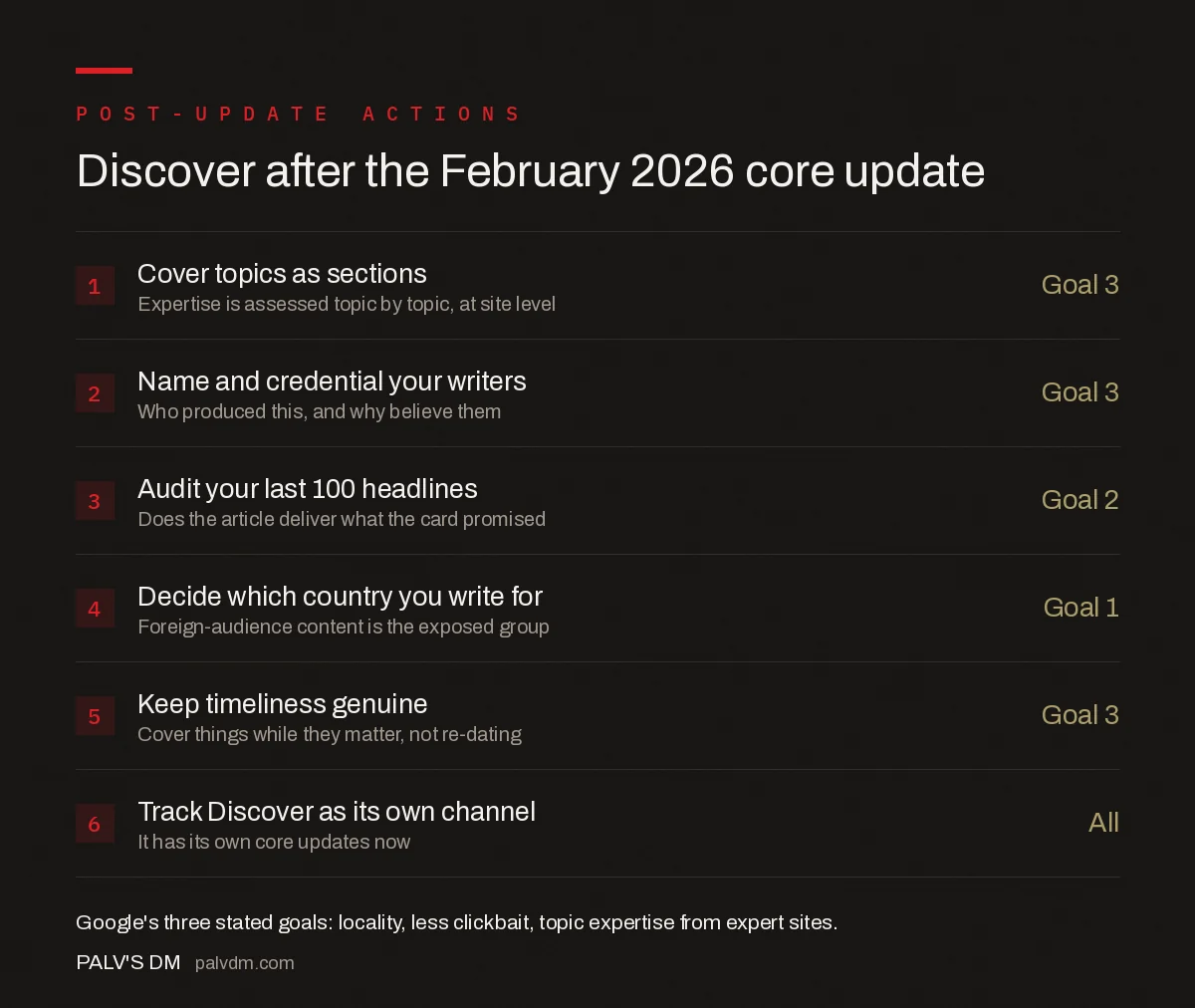
Discover after the February 2026 core update
- Cover topics as sections — Goal 3. Expertise is assessed topic by topic, at site level.
- Name and credential your writers — Goal 3. Who produced this, and why believe them.
- Audit your last 100 headlines — Goal 2. Does the article deliver what the card promised.
- Decide which country you write for — Goal 1. Foreign-audience content is the exposed group.
- Keep timeliness genuine — Goal 3. Cover things while they matter, not re-dating.
- Track Discover as its own channel — All. It has its own core updates now.
Frequently asked questions
What did the February 2026 Discover core update change?
Google published three goals: showing users more locally relevant content from websites based in their country, reducing sensational content and clickbait in Discover, and showing more in-depth, original and timely content from sites with expertise in a given area. It ran from 5 to 27 February 2026 and was the first core update Google aimed exclusively at Discover.
Did the February 2026 Discover update roll out worldwide?
Not at launch. Google released it to English-language users in the US and said it would expand to all countries and languages in the months ahead. If your Discover audience is outside the US, the stated changes were not applied to your readers at launch. Google has published no separate announcement confirming the expansion since.
How does Google assess topic expertise for Discover?
On a topic-by-topic basis, at site level. Google’s own example: a local news site with a dedicated gardening section could have established expertise in gardening even though it covers other subjects, whereas a movie review site that published one gardening article likely would not. Sustained sectioned coverage counts; opportunistic single articles do not.
How do I see Discover traffic separately from Search?
Open Google Search Console, go to Performance, and use the Discover report, which is separate from the Search results report. It appears once a site has accumulated enough Discover impressions. Compare equal-length periods, split impressions from clicks, and segment by article and section rather than reading a site-wide average.
Why did my Google Discover traffic drop in mid-2026?
Date the decline before choosing an explanation. A broad Google Discover traffic decline began in mid-July 2026, separate from the February core update and from the early-August volatility window in which around fourteen third-party tools spiked while Google confirmed no incident at all. A GA4 reporting bug and Ad Manager disruptions also landed in the same weeks.
What counts as clickbait in Google Discover now?
The distinction is between a headline that describes what the article delivers and one that promises more than it contains. Withholding the answer to force a tap, manufactured alarm, and unsourced superlatives are the exposed patterns. A specific, surprising, accurate fact stated up front is not clickbait, however compelling it is.
Sources
- Discover core update — Google Search Central blog, 5 February 2026
- Get on Google Discover — Search Central documentation
- Google Search Status Dashboard — Ranking incident history
- Google core updates and your website — Search Central
Want this done on your site?
Every PalV’s DM engagement starts with a free audit of your actual website — a 12-point
crawl covering what is blocking indexation, on-page gaps against your primary keywords, speed
findings, and the three to five fixes worth making first. Delivered in two working days. No
payment details, and the findings are yours whether you hire us or not.