February 2026 Discover Core Update: What Changed for Publishers
Google's first core update aimed only at Discover ran 22 days and named three goals. What it changed for non-US publishers, and how to respond.
The February 2026 Discover core update ran from 5 February to 27 February 2026 — 22 days — and was the first core update Google has ever aimed exclusively at Google Discover rather than Search results. Unusually for a core update, Google published three specific goals: show users more locally relevant content from websites based in their own country, reduce sensational content and clickbait, and surface more in-depth, original and timely content from sites with demonstrated expertise in a topic. The rollout ran a week past Google’s original two-week estimate.
For publishers, this was the most consequential Google change of 2026, and it is routinely conflated with the Search core updates that followed. It should not be. Discover and Search are different surfaces with different systems, and a Discover decline diagnosed as a Search problem sends you fixing the wrong thing.
Why a Discover-only core update matters
Google Discover is the feed of articles surfaced on mobile home screens and in the Google app, driven by inferred interest rather than by a query. Nobody searches for anything; Google decides what to show.
For many publishers, news sites and content-heavy blogs, Discover is not a supplementary channel. In some verticals — travel, lifestyle, technology news — it delivers more traffic than Search does. A core update aimed only at Discover therefore lands harder on those businesses than most Search updates ever do, while being nearly invisible to a typical B2B or ecommerce site.
It is also the first of its kind, which is a signal in itself: Google is now willing to run broad ranking reassessments on individual surfaces rather than only across Search as a whole.
The three stated goals, and what each one means
Google published these verbatim. Taking them one at a time is more useful than reading them as a block.
1. More locally relevant content from websites based in the user’s country
This is the one with real commercial consequences. Publishers who had built traffic by producing content aimed at a US audience from outside the US were the most exposed. Search Engine Roundtable’s reporting of the rollout noted that the change may reduce traffic for non-US websites publishing news aimed at a US audience — a reading consistent with Google’s stated goal, though not a direct Google quote.
The offsetting half of that statement matters too: Google said the same change should, over time, elevate those publishers’ content within their own local markets. For an Indian publisher writing for Indian readers, this is potentially favourable. For an Indian publisher writing US-targeted content to chase US ad rates, it is not.
Newzdash analysed the US top 1,000 domains after the rollout and reported that the international share declined on a normalised basis — directionally consistent with what Google described. That is one third-party analysis, not a controlled study, so treat it as corroborating rather than conclusive.
2. Reducing sensational content and clickbait
Discover has always rewarded a curiosity-gap headline more generously than Search does, because there is no query to satisfy — only a decision to tap. That created a strong incentive toward overstated headlines, and this goal is Google pulling that back.
The practical read: headlines that overpromise relative to what the article delivers are now a liability on the surface where they used to be an asset.
3. More in-depth, original, timely content from sites with topic expertise
Note the mechanism Google described here — “based on our systems’ understanding of a site’s content.” That is a site-level assessment of what you are known for, not a page-level judgement. It rewards consistent coverage of a defined area over opportunistic publishing across whatever is trending, which is the same logic behind building genuine topical authority.
One scope detail that is widely missed: the update launched for English-language users in the United States only. Google said at launch that it would expand to all countries and languages “in the months ahead”, and as of 17 August 2026 no later Google announcement confirms that expansion has happened. If your Discover traffic comes from outside the US, or from non-English users, this update may not yet have reached your audience at all — which makes it a poor explanation for a decline in those markets.
Google also updated its Discover documentation alongside the update, which is worth reading directly if Discover is material to your business.
How to tell whether this update affected you
The single most common error in early 2026 was reading a Discover decline as a Search decline, or vice versa. They are separated cleanly in Search Console.
- Open Search Console → Performance → Discover. This is a separate report from Search results. If you have no Discover report at all, Discover has never sent you meaningful traffic and this update is not your problem.
- Compare 10 January – 4 February against 28 February – 25 March. Equal-length windows either side of the 5–27 February rollout.
- Check whether your audience is geographically mismatched. If your Discover traffic came predominantly from a country other than where your site is based, goal one is the likely explanation.
- Do not blame the March core update. The March 2026 core update began on 27 March — the same day the Discover rollout finished — and the March 2026 spam update ran 24–25 March. Three overlapping events in five weeks make careless attribution almost inevitable.
- Isolate Discover before drawing any Search conclusion. A blended Search Console total during this period is close to uninterpretable.
What to do if Discover traffic fell
If you publish for a foreign audience, this is a strategic question rather than an SEO fix. Google has stated it wants to show users content from publishers in their own country. You can compete for your home market, where this update should help you, or you can accept structurally reduced Discover reach abroad. There is no on-page tweak that resolves it.
If your headlines lean on curiosity gaps, audit them honestly against what the article actually delivers. The test is whether a reader who taps feels the headline was accurate. Reducing sensationalism was a named goal, not an inference.
If your coverage is scattered, concentrate it. Google described its systems as forming an understanding of a site’s content and expertise. A site publishing across eight unrelated topics gives those systems little to work with.
If you depend heavily on Discover, treat this update as a warning about concentration risk. Discover traffic is volatile by design, arrives without a query, and can be reassessed by a single update with no recourse. Diversifying toward Search and toward AI-answer citation is a business decision, not just an SEO one — SEO in the age of AI search covers the second surface.
The wider point about surface-specific updates
Until February 2026, “core update” reliably meant Search. It no longer does. That changes how you should read every future announcement: the first question is now which surface, not just what changed.
It also changes your measurement hygiene permanently. If your reporting blends Search, Discover and News into one organic number, you will misdiagnose surface-specific updates every time one runs. Splitting those three in your standard report is a small piece of work that pays back the first time this happens again — and it is the same discipline that made the August 2026 volatility so widely misread, where a Discover decline that began in mid-July was folded into a supposed August algorithm update.
Every confirmed 2026 rollout, with dates, sits in the 2026 update timeline.
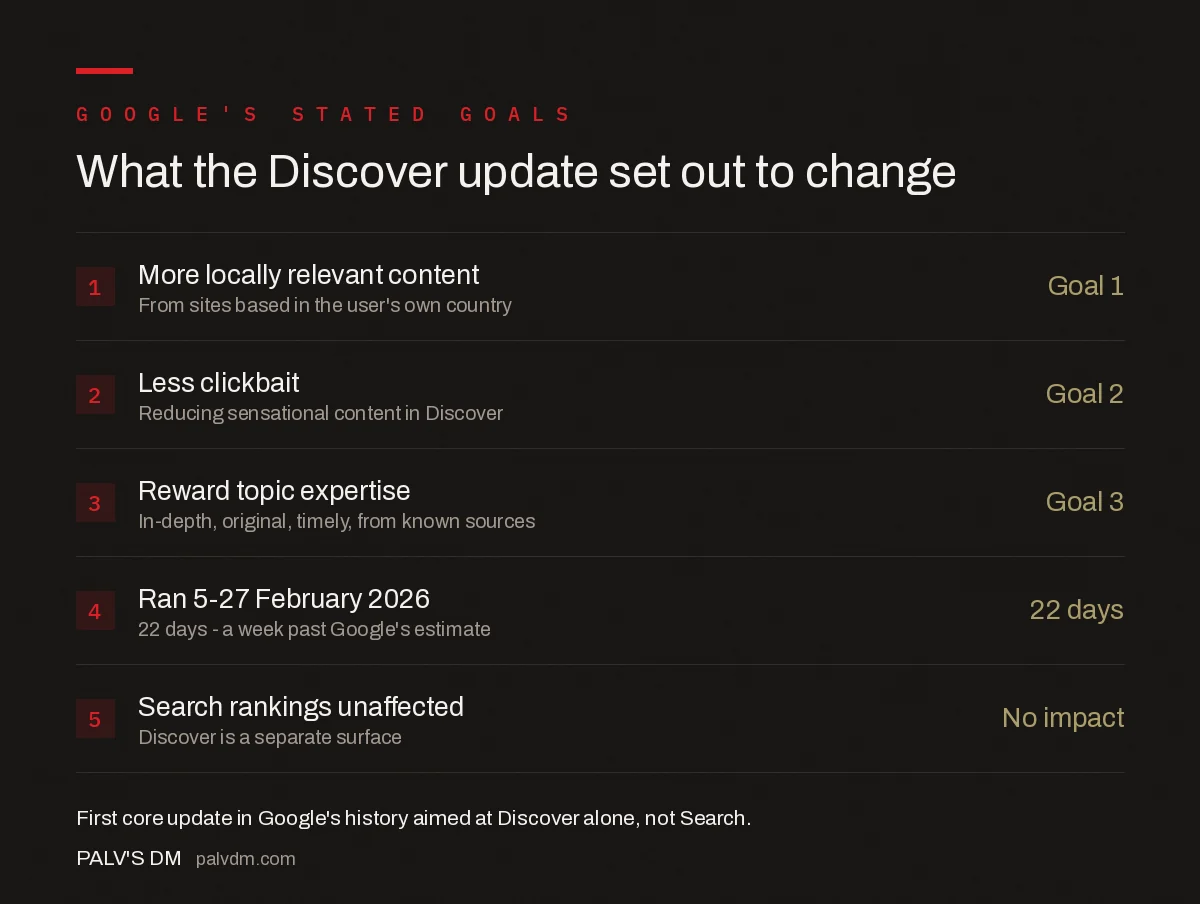
What the Discover update set out to change
- More locally relevant content — Goal 1. From sites based in the user’s own country.
- Less clickbait — Goal 2. Reducing sensational content in Discover.
- Reward topic expertise — Goal 3. In-depth, original, timely, from known sources.
- Ran 5-27 February 2026 — 22 days. 22 days – a week past Google’s estimate.
- Search rankings unaffected — No impact. Discover is a separate surface.
Frequently asked questions
What was the February 2026 Discover core update?
It was the first Google core update aimed exclusively at Google Discover rather than Search results, running from 5 February to 27 February 2026 — 22 days. Google described it as a broad update to the systems that surface articles in Discover, and published three specific goals covering local relevance, clickbait reduction, and rewarding in-depth original content from sites with topic expertise.
Why did my Discover traffic drop in February 2026?
The most likely cause is the first of Google’s three stated goals: showing users more locally relevant content from websites based in their own country. Google said directly that this may reduce traffic for non-US websites publishing news for a US audience. Check Search Console’s Discover report specifically, and compare the geographic split of your audience against where your site is based.
Does the February 2026 Discover update affect Google Search rankings?
No. It was aimed exclusively at Discover, which is a separate surface from Search with its own systems. If your Search rankings moved in that period, look instead at the March 2026 spam update (24–25 March) or the March 2026 core update (27 March to 8 April). Search Console separates Search, Discover and News, and they should be analysed separately.
How do I recover Discover traffic after this update?
It depends which goal affected you. If your audience is in a different country from your site, this is a strategic question rather than a fixable one — Google has stated it wants to favour local publishers. If sensational headlines were the issue, audit them against what your articles actually deliver. If your coverage is scattered across unrelated topics, concentrating it helps Google’s systems understand what you have expertise in.
How long did the February 2026 Discover update take to roll out?
22 days, from 5 February to 27 February 2026. Google originally estimated two weeks, so it ran roughly a week over. Google confirmed completion on its Search Status Dashboard on the morning of 27 February.
Sources
- February 2026 Google Discover Core Update Done Rolling Out — Search Engine Roundtable
- Google Discover documentation — Search Central
- Google Search Status Dashboard
Want this done on your site?
Every PalV’s DM engagement starts with a free audit of your actual website — a 12-point
crawl covering what is blocking indexation, on-page gaps against your primary keywords, speed
findings, and the three to five fixes worth making first. Delivered in two working days. No
payment details, and the findings are yours whether you hire us or not.