SEO in the Age of AI Search: What Changes and What Doesn’t
AI search changed where answers get delivered, not how pages get found. What genuinely changed, what did not, and the seven changes worth making now.
AI search changed where answers get delivered, not how documents get found. The retrieval mechanics — crawling, indexing, relevance, authority — are largely the same ones classic SEO has always worked with, and a second visibility surface has been added on top of them: being cited inside a generated answer. That surface is real, measurable and separate from ranking, but it is fed by the same index. Sites that were invisible to Google are not suddenly visible to ChatGPT. What has genuinely changed is the click economics of informational queries, and the fact that a well-structured passage can now be quoted without the reader ever reaching your page.
Two things are true at once, and most commentary picks one. AI referral traffic is growing quickly from a small base — Shopify reported in August 2026 that AI referrals to its merchants were up 197% year on year, while organic search still led total traffic outright. Adoption in India is not marginal either: ChatGPT passed 100 million weekly users in the country, OpenAI’s second-largest market, according to TechCrunch in February 2026. Growth and continued dominance of classic search are not contradictory. They describe the same transition at different points on the curve.
What actually changed?
Three shifts, in order of how much they affect an ordinary business site.
Answers moved above the results. AI Overviews and AI Mode place a generated response, with citations, above the traditional list. For queries where the user only wanted a fact, the click that used to arrive no longer does. What AI Overviews do to click-through rates covers the measured effects and their limits.
A second retrieval surface appeared. Assistants such as ChatGPT, Perplexity, Gemini and Copilot select passages, not domains. A page can be quoted for one specific paragraph while ranking nowhere near the top for the equivalent query — which is why citation and ranking have to be tracked as separate things.
Queries got longer and more conversational. People type into an assistant the way they would ask a colleague, which produces long, specific, multi-part questions rather than two-word keywords. That shifts keyword research towards the full questions buyers ask rather than the compressed two-word versions they used to type.
What has not changed?
More than the discourse suggests, and this is the part worth being blunt about.
- You still have to be crawlable and indexable. A page blocked by robots.txt, carrying a stray noindex or buried at crawl depth nine is invisible to every surface at once.
- Relevance still decides candidacy. Retrieval selects documents that match the query. Nothing about generative answers removes that step.
- Authority still shapes source selection. Engines prefer sources that other sources reference. The mechanism differs from PageRank; the direction does not.
- Technical health still gates everything. Speed, rendering, duplicate handling and site architecture continue to determine whether your content is reachable.
- Confirmed ranking factors remain confirmed. The list in what Google has actually documented about ranking factors did not shrink because a summary box appeared above it.
This is why the honest answer to “should we stop doing SEO” is no, and why the SEO is dead argument keeps failing on the data. The overlap between work that helps classic rankings and work that helps AI citation is large — where GEO and SEO overlap quantifies which tasks serve both.
What does the evidence say about getting cited?
The strongest peer-reviewed evidence is Aggarwal et al., GEO: Generative Engine Optimization, presented at KDD 2024. The study tested content modifications against generative engine responses and found that adding statistics, quotations from named sources and citations to authoritative sources raised a source’s visibility in generated answers by up to around 40%. Keyword stuffing performed worse than making no change at all.
Three practical readings follow. Specific, attributable claims travel; vague ones do not. Classic keyword manipulation is actively counterproductive on this surface. And the changes that worked were page-level content edits rather than domain-level authority building, which is why a small site can compete for citations sooner than it can compete for a competitive head term. How statistics affect AI citation covers each finding in more detail.
How is an AI citation different from a ranking?
| Property | Classic ranking | AI citation |
|---|---|---|
| Unit selected | A page, for a query | A passage, for a claim inside an answer |
| Stability | Same query, similar result | Same prompt can produce different sources |
| Position | An ordered list | Inline attribution, order less meaningful |
| Measurement | Search Console, rank trackers | Prompt test sets and referral segmentation |
| Barrier to entry | Domain authority-heavy | Page structure and specificity-heavy |
| Traffic outcome | A click, if the snippet earns it | Often visibility without a click |
The last row is the strategic problem. Citations build brand recall and can produce high-intent referrals, but they do not produce sessions at the same rate as rankings did. AI citations without clicks covers how to value them without pretending they are equivalent.
What should you actually do differently?
Seven changes, in the order they pay back. None of them require abandoning existing SEO work.
- Answer the question in the first 50 to 150 words. The opening passage is what gets extracted. Answer-first content is the single highest-yield structural change available.
- Make every section stand alone. Restate the noun instead of writing “this approach” or “these tools”. A passage lifted out of context must still make sense — the point of self-contained sections.
- Write headings as questions. Headings function as retrieval labels, not decoration.
- Add specifics with sources. Numbers, dates, named things, each attributable. A statistic without a source is not quotable.
- Use real tables for tabular content. Structured comparisons are extracted far more reliably than the same information in prose.
- Keep your entity consistent. One canonical name, address and description across the site, schema and off-site profiles, so engines resolve you to one thing. Inconsistent naming splits one organisation into several partial entities.
- Decide crawler access deliberately. AI crawlers are separate user agents with separate rules; allowing or blocking AI crawlers in robots.txt is a business decision, not a default.
How do you measure any of this?
Badly, if you expect a Search Console equivalent. There is no dashboard reporting how often an assistant cited you, and the surfaces are variable by design — the same prompt can return different sources on consecutive runs.
What works is a repeatable prompt test set: a fixed list of the questions your buyers actually ask, run across the major assistants on a stated cadence, recording whether you were cited, what was said, and who was cited instead. That is a manual baseline anyone can build in an afternoon, and it is the foundation of measuring AI visibility properly. Alongside it, segment AI referral traffic in analytics so the sessions that do arrive are attributable rather than lumped into direct.
What does this mean for budget?
For most businesses, less than the noise implies. The large majority of AI-visibility work is content and structural work that also improves classic search performance, so it belongs inside an existing programme rather than as a separate line item. A site with unresolved indexation problems should fix those first — they block both surfaces simultaneously.
At PalV’s DM the same logic sets the pricing: SEO plans run from ₹5,000 a month for the Foundation tier through ₹10,000 for Growth and ₹15,000 for Ultimate, with standalone services from ₹500, because the underlying work overlaps heavily rather than doubling. Where a dedicated AI-visibility engagement makes sense is when a brand is being described wrongly by assistants, or when citation share in a category is commercially significant on its own terms.
What is genuinely at risk?
Purely informational, top-of-funnel content answering questions with a single factual answer. That is the traffic AI Overviews absorb most efficiently, and no amount of optimisation restores a click the user no longer needs to make.
What holds up better: commercial and transactional queries where the user needs to compare, buy or contact somebody; content requiring judgement rather than a fact; and anything grounded in proprietary data or first-hand experience, because it cannot be synthesised from the consensus web. The strategic response is to shift the content mix in that direction rather than to publish more of what a generated summary already handles. Building a content moat for AI search is the longer version of that argument, and getting cited by ChatGPT covers the per-engine mechanics.
One caution on sequencing. Businesses regularly arrive asking for an AI-visibility project while their site has pages excluded from the index, a broken canonical setup or content that nobody would cite in any medium. Fixing those is not a prerequisite in a bureaucratic sense — it is the same work, done in the order that makes the later work possible. An assistant cannot quote a page it never retrieved, and no amount of passage-level structuring compensates for a document that is not in the index.
The summary worth keeping: nothing about AI search rewards a site that was invisible before. It rewards sites that are already retrievable and then write in a way that can be quoted — specifically, with sources, in sections that stand on their own.
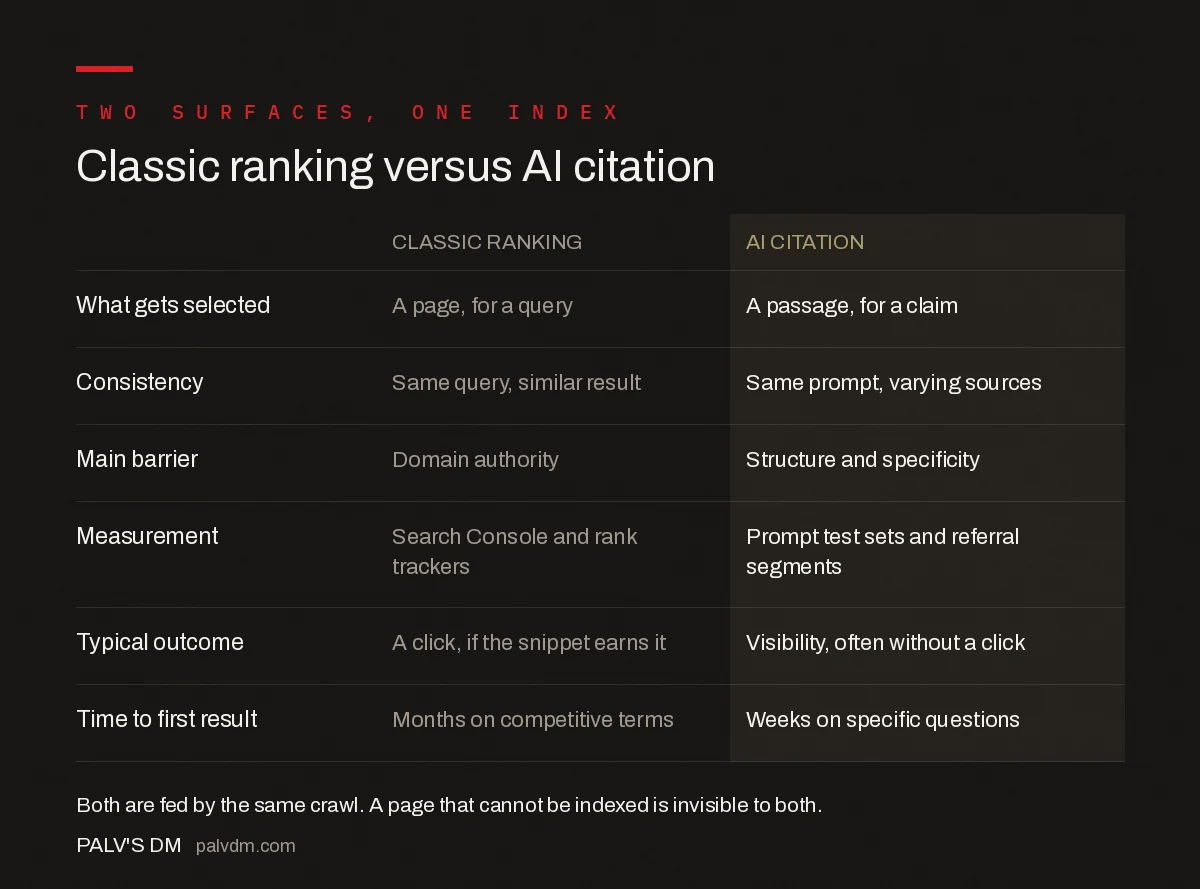
Classic ranking versus AI citation
| Classic ranking | AI citation | |
|---|---|---|
| What gets selected | A page, for a query | A passage, for a claim |
| Consistency | Same query, similar result | Same prompt, varying sources |
| Main barrier | Domain authority | Structure and specificity |
| Measurement | Search Console and rank trackers | Prompt test sets and referral segments |
| Typical outcome | A click, if the snippet earns it | Visibility, often without a click |
| Time to first result | Months on competitive terms | Weeks on specific questions |
Frequently asked questions
Is SEO still relevant with AI search?
Yes. AI assistants retrieve from indexes built by crawling the same web, so a page that cannot be crawled or indexed is invisible to both surfaces. Relevance, authority and technical health still determine whether a document is a candidate. What changed is that a growing share of informational queries resolve without a click, and citation inside an answer is now a second visibility surface.
What is the difference between an AI citation and a ranking?
A ranking selects a page for a query and places it in an ordered list. A citation selects a passage to support a specific claim inside a generated answer, is attributed inline rather than ranked, and varies between runs of the same prompt. Citations depend more on page structure and specificity, and less on domain authority, than competitive rankings do.
What does the research say about getting cited by AI engines?
The peer-reviewed GEO study presented at KDD 2024 found that adding statistics, quotations from named sources and citations to authoritative sources raised a source’s visibility in generative engine responses by up to around 40%, while keyword stuffing performed worse than making no change at all. The effective changes were page-level content edits rather than domain-level authority building.
How do you measure AI search visibility?
Build a fixed prompt test set — the questions your buyers actually ask — and run it across the major assistants on a stated cadence, recording whether you were cited, what was said and who was cited instead. Alongside that, segment AI referral traffic in analytics so arriving sessions are attributable. No equivalent of Search Console exists for these surfaces.
Should I block AI crawlers from my site?
It is a business decision rather than a default. Blocking AI crawlers removes your content from the training and retrieval pipelines that produce citations, which for most service businesses costs more visibility than it protects. Publishers whose revenue depends on the click may weigh it differently. AI crawlers use separate user agents, so the choice can be made per engine.
Which content is most at risk from AI Overviews?
Purely informational, top-of-funnel content that answers a question with a single fact — the traffic a generated summary absorbs most efficiently. Content holds up better where the user must compare, buy or contact someone, where judgement rather than a fact is required, or where the material rests on proprietary data and first-hand experience that cannot be synthesised.
Sources
- GEO: Generative Engine Optimization (Aggarwal et al., KDD 2024) — peer-reviewed source of the ~40% visibility finding
- Shopify: AI referrals up 197%, but organic search still leads traffic — Search Engine Land — 13 August 2026
- AI features and your website — Google Search Central
- Creating helpful, reliable, people-first content — Google Search Central
Want this done on your site?
Every PalV’s DM engagement starts with a free audit of your actual website — a 12-point
crawl covering what is blocking indexation, on-page gaps against your primary keywords, speed
findings, and the three to five fixes worth making first. Delivered in two working days. No
payment details, and the findings are yours whether you hire us or not.