Is SEO Dead? What the Data Says in 2026
SEO is not dead, but the click economics changed. Here is what the 2026 data shows about AI Overviews, zero-click search and where organic traffic went.
SEO is not dead. What died is the assumption that a ranking automatically converts into a click. Google still handles the overwhelming majority of search demand, and organic search still delivers more traffic than any AI referral source — Shopify reported in August 2026 that AI referrals to its merchants had grown 197% year on year while organic search still led total traffic outright. Both things are true at once: AI referrals are growing fast from a small base, and organic search remains the larger channel. The job changed. The channel did not disappear.
The “SEO is dead” claim has been made roughly annually since 2009. What makes the 2026 version worth taking seriously is that, for the first time, the mechanism people point to is real: AI Overviews and AI Mode genuinely do answer some queries without sending a click. Dismissing that would be as lazy as accepting the headline.
Why do people keep saying SEO is dead in 2026?
Three genuine changes are behind the claim, and it is worth separating them because they have different fixes.
AI Overviews absorb informational clicks. When Google answers a definitional or simple factual query directly, the traditional blue-link click for that query often does not happen. This is a real loss, and it lands hardest on sites whose traffic was built on top-of-funnel definition posts.
Reported impressions became harder to read. In September 2025 Google removed support for the &num=100 parameter, which rank trackers had used to pull 100 results in a single request. Overnight, a large volume of tracker-generated impressions disappeared from Search Console. Many site owners saw impression counts fall off a cliff and interpreted it as a traffic collapse. It was largely a measurement artefact, not a loss of human visitors. If your impressions dropped sharply in that window while clicks held steady, that is the likely explanation.
Core updates got sharper about quality. The 2026 core updates — March and May — both moved rankings substantially, and both hit sites publishing high volumes of undifferentiated content hardest. For a site built on that model, it genuinely feels like SEO stopped working. It did not. That specific approach stopped working.
What does the 2026 data actually show?
Set the narrative aside and look at what is measurable.
| Claim | What the evidence shows |
|---|---|
| “Nobody clicks through any more” | Zero-click behaviour has risen for informational queries. Commercial and transactional queries still generate clicks, because a user comparing services or ready to buy needs to reach a page to act. |
| “AI has replaced search” | AI referrals are growing quickly — Shopify measured 197% year-on-year growth in August 2026 — but organic search still led its merchants’ traffic. Growth rate and absolute volume are different things. |
| “My impressions collapsed, so search is dying” | Check whether the drop coincides with September 2025. The removal of the &num=100 parameter stripped out tracker impressions that were never human visits. |
| “Google sends less traffic than it used to” | Directionally true for many informational sites. This is a real change in click economics, and the correct response is to shift where you compete, not to abandon the channel. |
Which SEO work stopped paying, and which still does?
This is the useful question, and the answer is unusually clear in 2026.
Work that has genuinely stopped paying
- Thin definitional posts targeting high-volume informational keywords. “What is a CRM” is exactly the query an AI Overview answers completely. Writing the 400-word version of it in 2026 is buying a lottery ticket for a draw that no longer runs.
- Publishing volume as a strategy. Google’s helpful content assessment operates partly at site level. Fifty weak posts do not just fail on their own; they can drag on the strong ones.
- Anything optimised for a metric Google does not read. Keyword density targets, third-party domain authority scores, directory submissions.
Work that pays more than it used to
- Bottom-of-funnel and commercial pages. Someone searching “seo agency pricing india” or “best crm for field sales teams” is closer to a decision and still needs to land somewhere to act. These queries are less exposed to zero-click loss and convert far better than the informational terms people obsess over.
- Content with something genuinely new in it. Original data, a documented test, a real client example with numbers, a named expert’s view. This is the one thing an AI summary cannot synthesise from the existing corpus, because it is not in the corpus yet.
- Being citable, not just rankable. Ranking makes you eligible for AI citation. It does not make you selected. Generative engines extract passages, and the peer-reviewed GEO study (Aggarwal et al., KDD 2024) found that adding statistics, named quotations and citations to authoritative sources lifted visibility in AI answers by up to around 40%, while keyword stuffing performed worse than doing nothing.
- Technical fundamentals. Unchanged and unglamorous. A page that cannot be crawled cannot rank or be cited on any surface.
How do you tell whether SEO is failing, or just your SEO?
Before concluding the channel is finished, work through this in order. Most “SEO is dead” diagnoses collapse at step two or three.
- Split impressions from clicks from positions in Search Console. These three tell different stories and averaging them hides the answer. A position drop with steady impressions is a ranking problem. An impression drop with steady clicks is usually a measurement change.
- Check the September 2025 boundary. If your impression graph has a cliff there, you are looking at the
&num=100removal, not lost customers. - Isolate Discover and News from Search. They move independently. A Discover decline dressed up as a search collapse is a common misread, and Discover had its own dedicated core update in February 2026.
- Segment by query type. If your informational terms lost clicks while commercial terms held, that is the zero-click shift, and it argues for changing your target mix rather than leaving the channel.
- Check whether a core update landed in the window. Google’s Search Status Dashboard is the only confirmation that matters. Third-party volatility trackers show movement, not causation.
- Rule out your own deployments. A theme change, a migration, a plugin, a robots.txt edit. In practice this is the single most common cause of a traffic drop that gets blamed on Google.
What does a sensible 2026 search strategy look like?
Stop treating rankings as the goal and start treating them as one of three outputs.
Compete where clicks still exist. Weight your keyword mix towards commercial-investigation and transactional intent. If an AI Overview can fully answer a query in two sentences, that query was never going to fund your business.
Build the things AI cannot summarise from elsewhere. Proprietary data, first-hand testing, transparent methodology, named expertise. This is also, not coincidentally, what Google’s helpful content guidance has asked for since 2022.
Measure three layers, not one. Classic rankings and SERP features. AI citations, tested manually across ChatGPT, Perplexity and AI Overviews and logged over time. And referral traffic from AI sources, segmented in GA4. A brand that gets cited constantly but receives few clicks is not failing — it is being measured with the wrong instrument.
There is a genuine early-mover advantage here, particularly for newer brands. Established competitors carry years of legacy content built for the old click economics. A site starting now carries none of that, and the AI-answer surface is far less crowded than page one of Google. In India specifically, where weekly ChatGPT usage passed 100 million and made it OpenAI’s second-largest market (TechCrunch, February 2026), that surface is not a niche experiment.
So, is SEO dead?
No. The work that was already lazy is dead, and it died louder than usual this time because AI made the failure obvious. The work that was always defensible — being the most useful, most specific, most clearly authored page on your topic, on a site Google can crawl — now pays on two surfaces instead of one. If your SEO stopped working in 2026, the honest first question is not whether the channel died. It is whether your content could survive being read by someone who already knows the topic. If rankings have genuinely stalled, work through what to do when SEO is not working after six months.
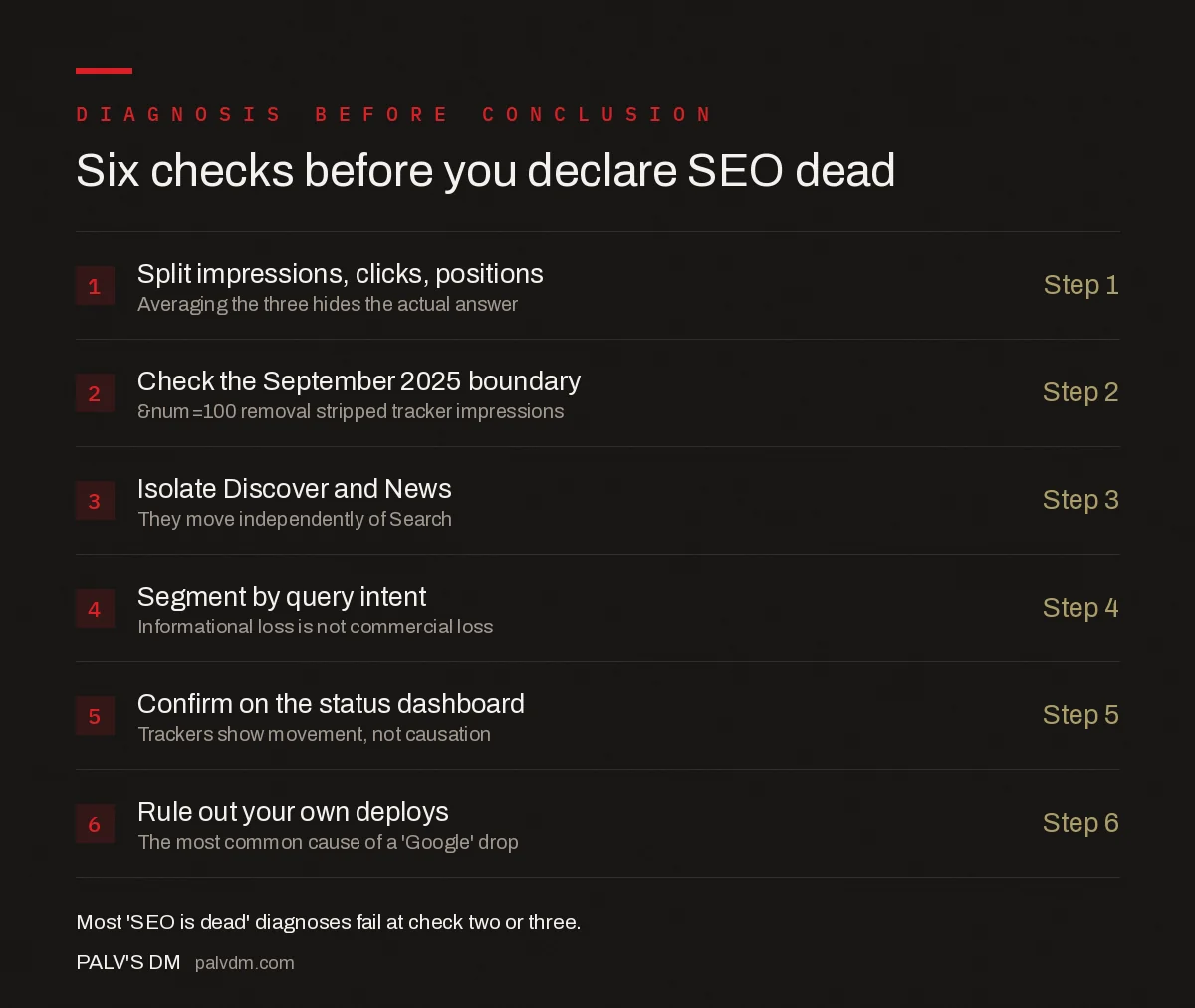
Six checks before you declare SEO dead
- Split impressions, clicks, positions — Step 1. Averaging the three hides the actual answer.
- Check the September 2025 boundary — Step 2. &num=100 removal stripped tracker impressions.
- Isolate Discover and News — Step 3. They move independently of Search.
- Segment by query intent — Step 4. Informational loss is not commercial loss.
- Confirm on the status dashboard — Step 5. Trackers show movement, not causation.
- Rule out your own deploys — Step 6. The most common cause of a ‘Google’ drop.
Frequently asked questions
Is SEO still worth it in 2026?
Yes, particularly for commercial and transactional queries where users still need to reach a page to act. Organic search remains the largest traffic channel for most businesses, and Shopify reported in August 2026 that organic search still led its merchants’ traffic even as AI referrals grew 197% year on year. What has weakened is thin informational content, which AI answers now absorb.
Will AI replace Google search?
Not on current evidence. AI referral traffic is growing quickly but from a small base, while organic search still accounts for far more visits. The more accurate framing is that there are now two surfaces to win rather than one: classic rankings and AI-answer citations. Brands that treat them as a single job tend to underinvest in the second.
Why did my Google impressions drop suddenly in late 2025?
Most likely the removal of the &num=100 URL parameter in September 2025. Rank-tracking tools had used it to request 100 results at once, and each request generated impressions in Search Console. When Google removed support, those non-human impressions disappeared. If your impressions fell sharply while clicks stayed roughly flat, this is almost certainly the cause rather than lost customers.
Should I stop writing blog posts because of AI Overviews?
No, but change what you write. Short definitional posts aimed at simple informational queries are the most exposed, because those are exactly the queries AI Overviews answer completely. Content built on original data, first-hand testing, real examples with numbers or named expertise is far harder to replace, and is the type most likely to be cited by AI engines rather than replaced by them.
What is the difference between ranking and being cited by AI?
Ranking makes a page eligible for AI citation, but does not guarantee selection. Generative engines extract individual passages rather than whole pages, and select on partly different signals. Research published at KDD 2024 found that adding statistics, quotations from named sources and citations to authoritative sources raised visibility in generative answers by up to around 40%, while keyword stuffing performed worse than making no change at all.
Sources
- Shopify: AI referrals up 197%, but organic search still leads traffic — Search Engine Land — 13 August 2026
- GEO: Generative Engine Optimization (Aggarwal et al., KDD 2024)
- Google Search Status Dashboard — the only confirmation of a live update
Want this done on your site?
Every PalV’s DM engagement starts with a free audit of your actual website — a 12-point
crawl covering what is blocking indexation, on-page gaps against your primary keywords, speed
findings, and the three to five fixes worth making first. Delivered in two working days. No
payment details, and the findings are yours whether you hire us or not.