What a Core Update Actually Is (And What It Is Not)
A Google core update is a broad change to ranking systems, not a penalty. Here is what it does, what it does not, and the 2026 rollout record.

A Google core update is a broad, site-agnostic change to how Google’s ranking systems assess and order content. It is not a penalty, it does not target individual sites, and it does not mean you have broken a rule. Google reassesses which pages best satisfy each query, and positions shift as a result. A site can drop several places without having done anything wrong, simply because Google’s assessment of what deserves to rank for that query changed. Core updates roll out over one to three weeks and are announced on Google’s Search Status Dashboard, which is the only authoritative confirmation that one is running.
That distinction between a reassessment and a punishment is not pedantry. It determines the correct response. If you believe you were penalised, you go looking for a violation to undo. If you understand it as a reassessment, you go looking for the gap between your page and the pages that gained.
What does a core update actually change?
Google describes core updates in consistent language each time: “a regular update designed to better surface relevant, satisfying content for searchers from all types of sites.” It used exactly that phrasing for both the March 2026 and May 2026 core updates.
Underneath that, a core update adjusts the systems that evaluate relevance and quality across the whole index. Nothing is aimed at your domain. Google’s standard analogy is a top-films list refreshed a few years later: films that dropped down the list did not get worse, but new films arrived and the ranking criteria matured.
Three things follow from this that people routinely get wrong:
- There is no violation to fix. Core updates are not enforcement. Nothing was flagged against your site.
- Movement is relative. You can lose position without changing anything, because competitors were reassessed upward.
- Fast fixes do not produce fast recovery. Google states plainly that recovery tends to arrive with a subsequent core update rather than between them.
How is a core update different from a spam update or a manual action?
These three get used interchangeably and they are entirely different mechanisms with entirely different responses. The full comparison goes deeper than the table below.
| Core update | Spam update | Manual action | |
|---|---|---|---|
| What it is | Broad reassessment of ranking systems | Enforcement of spam policies, applied algorithmically | A human reviewer at Google penalising a specific site |
| Is it a penalty? | No | Yes, against policy violations | Yes, explicitly |
| Are you told? | Announced globally, never site-specific | Announced globally, never site-specific | Yes — a notice appears in Search Console |
| Typical duration | 1–3 weeks to roll out | Hours to weeks | Until you fix it and pass reconsideration |
| Correct response | Improve the site substantially, wait for the next core update | Remove the violating practice | Fix the violation, then file a reconsideration request |
The single fastest diagnostic: open Search Console and look under Security & Manual Actions. If there is no notice there, you do not have a manual action, full stop. That takes thirty seconds and eliminates the most feared possibility.
How long does a core update take to roll out?
Google usually estimates up to two weeks, and the actual record varies more than that estimate suggests. Recent confirmed rollouts:
| Update | Started | Completed | Duration |
|---|---|---|---|
| March 2025 core update | 13 Mar 2025 | 27 Mar 2025 | 14 days |
| June 2025 core update | 30 Jun 2025 | 17 Jul 2025 | ~17 days |
| December 2025 core update | 11 Dec 2025 | 29 Dec 2025 | 18 days |
| March 2026 core update | 27 Mar 2026 | 8 Apr 2026 | 12 days, 4 hours |
| May 2026 core update | 21 May 2026 | 2 Jun 2026 | ~12 days |
Two things are worth noting. The 2025 rollouts lengthened steadily (14, then roughly 17, then 18 days) and the 2026 rollouts came in shorter, at 12 days each. Google has never explained why rollout length varies, and anyone telling you what it signifies is speculating.
The practical implication matters more than the pattern: do not draw conclusions mid-rollout. Rankings genuinely swing during a rollout and frequently land somewhere different from where they sat on day four. The May 2026 update produced large movements on 23 May, again on 30 May, and more volatility in the final twenty-four hours before Google marked it complete. A site owner who panicked on 24 May and started rewriting pages would have been reacting to a state that no longer existed a week later.
How do you confirm a core update actually affected your site?
Work in this order. Most self-diagnosed core update hits turn out to be something else.
- Confirm an update was running. Check the 2026 update timeline and Google’s Search Status Dashboard for the dates. Third-party volatility trackers show that results moved; only Google confirms that Google moved them.
- Check for a manual action. Search Console → Security & Manual Actions. Thirty seconds, and it rules out the worst case.
- Compare the right windows. Use Search Console’s comparison mode with equal-length periods that both sit fully outside the rollout — not one window straddling it. Comparing a period that includes the rollout to one that does not produces a meaningless blend.
- Separate positions, impressions and clicks. A position drop is a ranking change. An impression drop with flat clicks is often a measurement artefact. Averaging the three hides the answer.
- Isolate Discover and News. They move independently of Search, and Discover had a dedicated core update of its own in February 2026 — which ran 22 days, from 5 to 27 February, and was the first core update aimed exclusively at Discover rather than Search.
- Rule out yourself. Deployments, theme changes, plugin updates, robots.txt edits, migrations. Work through whether it was an update or you. In practice this is the most common cause of a drop that gets blamed on Google.
What should you do if a core update hit you?
Google’s published guidance is unusually direct, and unusually unpopular, because it offers no quick lever.
There are no specific actions that guarantee recovery. A drop does not necessarily mean anything is wrong with your pages. You may see partial recovery between core updates, but the largest changes tend to follow a subsequent one. Google points site owners to its self-assessment questions, built around three axes: who produced the content, how it was produced, and why it exists.
Those questions are more useful than they look. Content published under no byline cannot answer “who”. Content generated at volume to fill a keyword gap struggles to answer “why” honestly. If your pages cannot answer all three convincingly, you have found your work.
Practically, that means: identify which specific URLs and query clusters lost, compare them honestly against the pages that gained, and ask what those pages offer that yours does not. Usually the answer is specificity — real numbers, first-hand experience, a named author with relevant credentials, or genuine information gain rather than a competent rewrite of the existing top ten.
What not to do
- Do not make sweeping changes mid-rollout. The 30-day recovery plan sets a safer sequence. You will be optimising against a moving target and you will lose the ability to attribute cause afterwards.
- Do not delete pages in a panic. Pruning genuinely weak content is legitimate; deleting pages that dropped three positions is not.
- Do not file a reconsideration request. They only apply to manual actions. Filing one for a core update accomplishes nothing.
- Do not buy links to compensate. This converts a reassessment into an actual policy problem.
- Do not trust a tracker over the dashboard. Volatility tools registered spikes across 1–6 August 2026 while Google’s dashboard showed no ranking, indexing, crawling or serving incident at all in that window. Several unrelated issues — a GA4 reporting bug, Ad Manager disruptions, and a Discover decline that had begun in mid-July — landed close together and were widely misread as a single algorithm update.
The useful mental model is this: a core update is Google marking the whole class again with a slightly revised rubric. You were not singled out, there is no appeal, and the only route to a better grade is to be substantially better work by the time the next paper is marked.
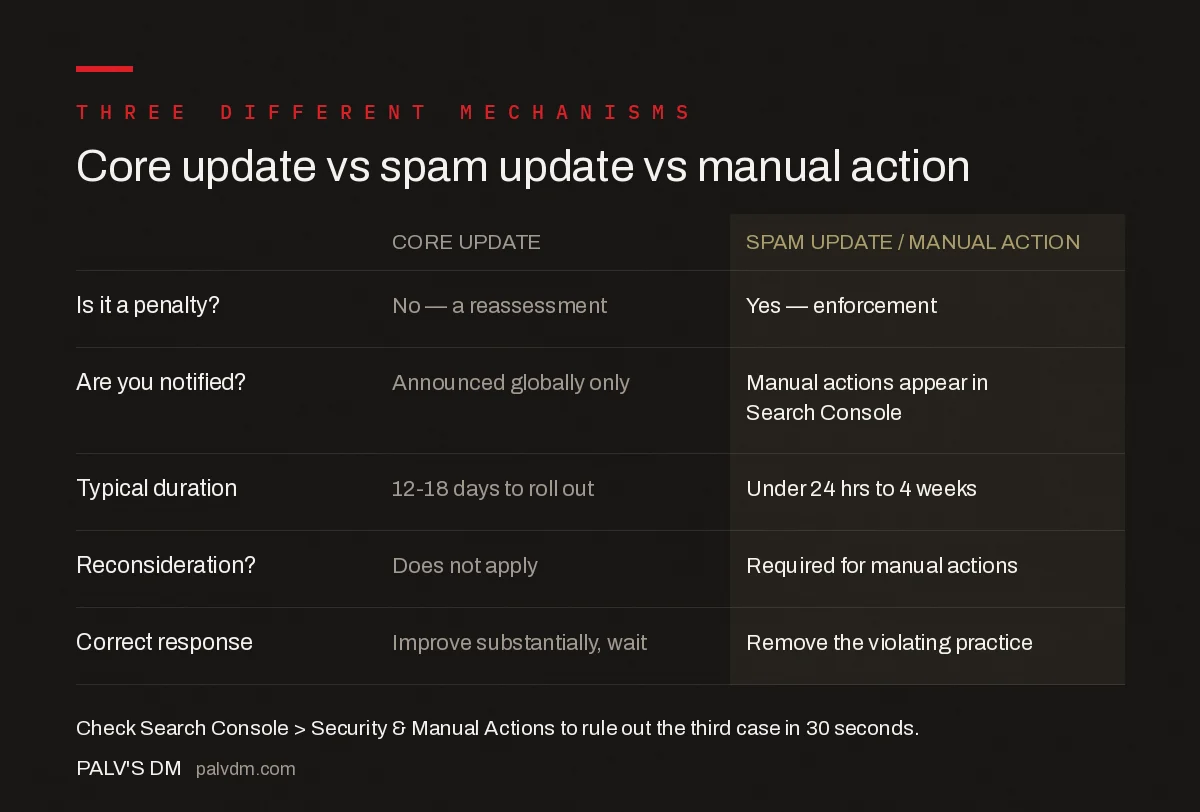
Core update vs spam update vs manual action
| Core update | Spam update / manual action | |
|---|---|---|
| Is it a penalty? | No — a reassessment | Yes — enforcement |
| Are you notified? | Announced globally only | Manual actions appear in Search Console |
| Typical duration | 12-18 days to roll out | Under 24 hrs to 4 weeks |
| Reconsideration? | Does not apply | Required for manual actions |
| Correct response | Improve substantially, wait | Remove the violating practice |
Frequently asked questions
What is a Google core update?
A Google core update is a broad change to Google’s ranking systems that reassesses how content across the entire index is evaluated and ordered. Google describes it as a regular update designed to better surface relevant, satisfying content from all types of sites. It is not aimed at individual websites and is not a penalty, though it can move a site’s rankings substantially in either direction.
Is a core update a penalty?
No. Core updates are a reassessment of ranking systems, not enforcement against a violation. Nothing has been flagged against your site, and there is no reconsideration process. Penalties come in two forms: manual actions, which are applied by a human reviewer and always appear as a notice in Search Console, and algorithmic spam enforcement, which acts on specific policy violations.
How long does a Google core update take to roll out?
Google typically estimates up to two weeks. In practice recent rollouts have ranged from 12 to 18 days: the March 2026 core update took 12 days and 4 hours, the May 2026 update roughly 12 days, and the December 2025 update 18 days. Rankings frequently swing during the rollout, so it is worth waiting until Google marks the update complete before drawing conclusions.
How do I know if a core update affected my site?
Check Google’s Search Status Dashboard to confirm an update was actually running on those dates, then check Search Console for a manual action notice. Compare equal-length periods that both sit fully outside the rollout window, and look at positions, impressions and clicks separately rather than as an average. Finally, rule out your own deployments, which cause more traffic drops than updates do.
How do you recover from a Google core update?
Google states there are no specific actions that guarantee recovery, and that the largest changes tend to arrive with a subsequent core update rather than between them. The practical approach is to identify which URLs and query clusters lost, compare them honestly against pages that gained, and address the gap. Google’s own self-assessment questions focus on who produced the content, how it was produced, and why it exists.
What is the difference between a core update and a spam update?
A core update broadly reassesses how all content is ranked and is not a penalty. A spam update algorithmically enforces Google’s spam policies against specific violating practices, and is a penalty in effect. Spam updates also tend to roll out much faster: the March 2026 spam update completed in under 24 hours and the June 2026 spam update in about two days, against 12 days for each 2026 core update.
Sources
- Google core updates and your website — Search Central
- Google Search Status Dashboard
- Google March 2026 core update rollout is now complete — Search Engine Land
- Google May 2026 core update rollout is now complete — Search Engine Land
Want this done on your site?
Every PalV’s DM engagement starts with a free audit of your actual website — a 12-point
crawl covering what is blocking indexation, on-page gaps against your primary keywords, speed
findings, and the three to five fixes worth making first. Delivered in two working days. No
payment details, and the findings are yours whether you hire us or not.