The 2026 Google Update Timeline: Every Confirmed Change
Every Google algorithm update confirmed in 2026, with exact start and end dates from Google's Search Status Dashboard, plus what each one targeted.
Google has confirmed five algorithm updates in 2026 as of 17 August: the February Discover core update, the March spam update, the March core update, the May core update, and the June spam update. No update has been confirmed since 26 June 2026. The widely discussed ranking volatility in early August 2026 was not a confirmed update — Google’s Search Status Dashboard recorded no ranking, indexing, crawling or serving incident between 1 and 6 August. This page lists every confirmed change with its exact start and end dates, and is updated as Google announces new ones.
For the mechanics of what a core update actually does, start with the plain definition. Every date below comes from Google’s Search Status Dashboard or from reporting of the dashboard entry. Third-party volatility trackers are useful for noticing that something moved; they are not confirmation that Google moved it.
Every confirmed Google update in 2026
| Update | Type | Started | Completed | Duration |
|---|---|---|---|---|
| February 2026 Discover core update | Core (Discover only) | 5 Feb 2026 | 27 Feb 2026 | 22 days |
| March 2026 spam update | Spam | 24 Mar 2026 | 25 Mar 2026 | Under 24 hours |
| March 2026 core update | Core | 27 Mar 2026 | 8 Apr 2026 | 12 days, 4 hours |
| May 2026 core update | Core | 21 May 2026 | 2 Jun 2026 | ~12 days |
| June 2026 spam update | Spam | 24 Jun 2026 | 26 Jun 2026 | ~2 days |
February 2026 Discover core update
5–27 February 2026, 22 days. This was the first core update Google has ever run exclusively against Google Discover rather than Search results — a genuinely new category of update, and the reason it deserves separate attention from publishers.
Google described it as “a broad update to our systems that surface articles in Discover” and, unusually, published three specific goals:
- Showing users more locally relevant content from websites based in their country
- Reducing sensational content and clickbait in Discover
- Showing more in-depth, original and timely content from websites with expertise in a given area, based on Google’s systems’ understanding of a site’s content
The first goal has the sharpest commercial edge, and reshaped how Discover treats publishers. Publishers outside the United States who had built traffic by publishing for a US audience were the most exposed, while the same change should elevate their content within their own markets over time. Newzdash analysed the US top 1,000 domains after the rollout and reported the international share declined on a normalised basis — directionally consistent with what Google said it was doing.
Google also updated its Discover documentation alongside the update. The rollout ran a week past Google’s original two-week estimate.
March 2026 spam update
24–25 March 2026, under 24 hours. The fastest spam rollout on record. Google announced no new spam policies alongside it, which indicates enforcement of existing policies rather than a change in what counts as spam.
For scale, the August 2025 spam update ran nearly four weeks. A sub-24-hour rollout is a striking outlier, though Google has never explained what determines spam update duration.
March 2026 core update
27 March – 8 April 2026, 12 days and 4 hours. The first broad core update of 2026, and the third confirmed update inside roughly five weeks.
Google used its standard framing: “a regular update designed to better surface relevant, satisfying content for searchers from all types of sites.” It published no companion blog post, announced no specific goals, and issued no new guidance with either the launch or the completion notice.
That last point matters, because a good deal of commentary has attached specific mechanisms to this update — most commonly that it made “information gain” the dominant ranking signal. Google said nothing of the kind. Information gain is a real concept and Google does hold a patent referencing it, but no Google statement connects it to this or any 2026 update, and the percentage figures circulating in SEO write-ups are vendor estimates without published methodology. Treat them as interpretation, not fact.
May 2026 core update
21 May – 2 June 2026, roughly 12 days. The second core update of 2026, and by practitioner consensus a heavier one than March.
Google’s dashboard entry and LinkedIn post again used the standard “regular update” language and the two-week estimate. The rollout was notably front-loaded: announced on a Thursday afternoon, with large ranking movements already visible by Saturday 23 May, further significant movement on Saturday 30 May, and more volatility in the final twenty-four hours before Google marked it complete.
The practical lesson from that shape is that mid-rollout readings are unreliable. A site owner assessing damage on 24 May would have been looking at a position that changed twice more before the update finished.
June 2026 spam update
24–26 June 2026, roughly 2 days. The second spam update of 2026. Again, no new spam policies were announced. As of 17 August 2026, this is the most recent confirmed Google update.
What about the August 2026 volatility?
This is covered in full in the August 2026 volatility breakdown, but it is worth stating plainly here: there is no confirmed August 2026 Google update.
Google announced nothing, and its Search Status Dashboard showed no ranking, indexing, crawling or serving incident between 1 and 6 August 2026. Third-party trackers did register elevated movement — around fourteen tools showed spikes across 1–3 August and again on 5–6 August, following earlier spikes on 11, 18 and 24 July.
What makes the August window genuinely confusing is that several unrelated problems landed close together, and they do not share a cause:
- A GA4 reporting bug, which corrupted the analytics many site owners were using to assess the damage
- Google Ad Manager disruptions
- A Google Discover traffic decline that had actually begun in mid-July, before the August window opened
Attributing all of that to a single secret algorithm update is the kind of tidy story that produces bad decisions. If your traffic moved in early August, separate Search from Discover from News, verify GA4 against a second data source, and rule out your own deployments before concluding anything about Google’s ranking systems.
What pattern do the 2026 updates share?
Three observations that are supportable from the record, rather than from speculation. The underlying pattern is consistent: evidence over volume.
Core rollouts got shorter. The 2025 core updates lengthened steadily — 14 days in March, roughly 17 in June, 18 in December. Both 2026 core updates completed in about 12 days. Google has never explained rollout duration, so note the pattern and resist explaining it.
Spam rollouts got dramatically faster. Nearly four weeks in August 2025, under 24 hours in March 2026, about two days in June 2026.
Google published less guidance, not more. Neither 2026 core update came with new advice. Google’s position is that its existing helpful content guidance already covers what creators should do, and that there is nothing new or special to do for any individual update.
How to use this timeline
The most valuable thing you can do with a list of update dates is annotate your own reporting with them. When traffic moves six months from now, the question “was there an update running that week?” should take five seconds to answer, not an afternoon of forum searching.
- Add these dates as annotations in GA4 and in whatever rank tracker you use.
- Keep a change log of your own deployments alongside them. Causation is impossible to establish later without it, and your own releases are the more common culprit.
- Compare equal-length windows that both sit fully outside a rollout. A comparison window straddling a rollout produces a blended, meaningless number.
- Treat the dashboard as the source of truth. If Google has not confirmed it, write “unconfirmed volatility” in your report, not “algorithm update”.
This page is reviewed monthly and updated whenever Google confirms a new rollout. Last verified against Google’s Search Status Dashboard on 17 August 2026.
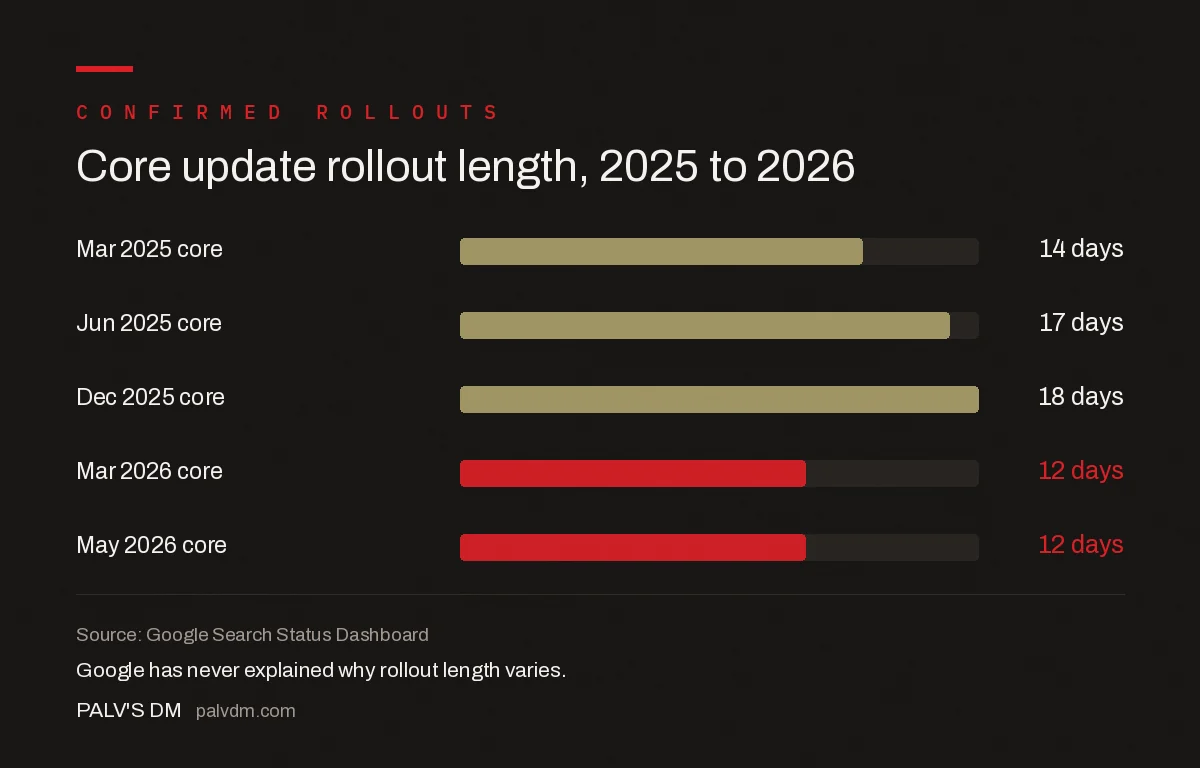
Core update rollout length, 2025 to 2026
| Metric | Value |
|---|---|
| Mar 2025 core | 14 days |
| Jun 2025 core | 17 days |
| Dec 2025 core | 18 days |
| Mar 2026 core | 12 days |
| May 2026 core | 12 days |
Source: Google Search Status Dashboard
Frequently asked questions
How many Google updates have there been in 2026?
Five confirmed updates as of 17 August 2026: the February Discover core update (5–27 February), the March spam update (24–25 March), the March core update (27 March – 8 April), the May core update (21 May – 2 June), and the June spam update (24–26 June). No further update has been confirmed since 26 June 2026.
Was there a Google algorithm update in August 2026?
No confirmed update. Google announced nothing, and its Search Status Dashboard showed no ranking, indexing, crawling or serving incident between 1 and 6 August 2026. Third-party trackers did register volatility on 1–3 and 5–6 August, but several unrelated issues landed in the same window: a GA4 reporting bug, Google Ad Manager disruptions, and a Discover traffic decline that started in mid-July.
What was the February 2026 Discover core update?
It was the first Google core update aimed exclusively at Google Discover rather than Search, running 5 to 27 February 2026. Google published three goals: showing users more locally relevant content from websites based in their own country, reducing sensational content and clickbait, and surfacing more in-depth, original and timely content from sites with demonstrated expertise in a topic.
How long did the March 2026 core update take?
12 days and 4 hours. It began on 27 March 2026 and Google confirmed completion at 06:12 PDT on 8 April 2026. That was inside Google’s original two-week estimate and notably faster than the December 2025 core update, which ran 18 days.
Did the March 2026 core update target information gain?
Google never said so. It described the update in its standard terms as a regular update to better surface relevant, satisfying content, published no companion blog post, and issued no new guidance. Claims that the update made information gain the dominant ranking signal, along with the percentage figures attached to them, are industry interpretation rather than confirmed fact.
Where can I confirm whether a Google update is running?
Google’s Search Status Dashboard at status.search.google.com is the only authoritative source. It lists each ranking update with start and completion timestamps. Third-party volatility trackers are useful for noticing that search results moved, but they cannot distinguish an algorithm update from an infrastructure bug, a seasonal shift or your own site changes.
Sources
- Google Search Status Dashboard — primary source for every date on this page
- Google March 2026 core update rollout is now complete — Search Engine Land
- Google May 2026 core update rollout is now complete — Search Engine Land
- February 2026 Google Discover Core Update Done Rolling Out — Search Engine Roundtable
- Google June 2026 spam update done rolling out — Search Engine Land
Want this done on your site?
Every PalV’s DM engagement starts with a free audit of your actual website — a 12-point
crawl covering what is blocking indexation, on-page gaps against your primary keywords, speed
findings, and the three to five fixes worth making first. Delivered in two working days. No
payment details, and the findings are yours whether you hire us or not.