June 2026 Spam Update: What Google Targeted
Google ran the June 2026 spam update from 24 to 26 June with no new policies announced. What it enforced, how to tell if it hit you, and what recovery takes.
Google released the June 2026 spam update on 24 June 2026 and marked the rollout complete on 26 June — 2 days and 1 hour. Google announced no new spam policies alongside it, which means it enforced the practices already published in Google’s spam policies rather than introducing new ones. The dashboard notice said only that the update “applies globally and to all languages” and that the rollout “may take a few days to complete”.
That is genuinely everything Google confirmed. Google has never named which sites or which specific practices a given spam update hit, and it did not here. Any list you read of “what the June 2026 spam update targeted” describes movement in somebody’s tracked keyword set, not a Google statement about intent.
What did Google confirm about the June 2026 spam update?
| Detail | Confirmed |
|---|---|
| Announced | 24 June 2026, Google Search Status Dashboard |
| Completed | 26 June 2026 |
| Duration | 2 days, 1 hour |
| Scope | Applies globally and to all languages |
| New policies | None announced |
| Category | Filed under Ranking, as service information |
Google’s notice linked to its spam updates documentation rather than to any new guidance, which is the tell that nothing about the policy surface changed. The Search Status Dashboard is the record of reference for all of this, and it was the second spam update of 2026 after the March 2026 spam update.
What is a spam update, in Google’s own words?
Google’s documentation defines it directly: “While Google’s automated systems to detect search spam are constantly operating, we occasionally make notable improvements to how they work. When we do, we refer to this as a spam update.”
Google names SpamBrain, its AI-based spam-prevention system, as an example: “From time-to-time, we improve that system to make it better at spotting spam and to help ensure it catches new types of spam.”
Two things follow from that definition and both are often missed. A spam update is an improvement to detection, not a change to what counts as spam — the rules were already published. And it is enforcement, which makes it categorically different from a core update. Core updates, spam updates and manual actions are three mechanisms with three different correct responses.
So what did the June 2026 spam update target?
Google’s published spam policies, which is the only defensible answer. With no new policies announced, the enforceable surface on 24 June 2026 was the same list that existed the week before. That list currently covers:
- Content practices: scaled content abuse, thin affiliation, scraping, keyword stuffing, hidden text and link abuse, doorway abuse.
- Link practices: link spam, covering buying and selling links for ranking purposes and other schemes.
- Deception practices: cloaking, sneaky redirects, misleading functionality, malicious practices, machine-generated traffic, hacked content.
- Third-party and domain practices: site reputation abuse and expired domain abuse, both of which became policies in March 2024.
- User-generated spam: spam posted by third parties on your own site, which remains your responsibility.
Google directs affected sites to exactly this list: “Sites that see a change after a spam update should review our spam policies to ensure they are complying with those.”
How do you tell whether the June 2026 spam update hit you?
The June window is unusually clean, which makes attribution easier here than for most updates. Google confirmed nothing else in that period — the May 2026 core update had completed on 2 June, three weeks earlier — so a sharp change on 24 to 26 June has fewer competing explanations than a change in late March did.
- Check the dates against the dashboard. Movement starting 24 June and settling by 26 June is consistent with the rollout. Movement starting on 18 June is not.
- Check Search Console for a manual action. Security & Manual Actions. A spam update is algorithmic and produces no notice, so a notice there means a manual action rather than the update.
- Look at the shape of the loss. Algorithmic spam enforcement tends to be sharper and more concentrated — specific pages or the whole site — than the graded, pattern-based movement typical of a core update.
- Audit honestly against the policy list. Bought links, pages generated at volume to fill keyword gaps, a subfolder rented to a third party, doorway pages for locations you do not serve. If you match a policy, that is your answer regardless of what any tracker showed.
- Rule out your own deployments. A release on 23 June explains more drops than a spam update does. Volatility trackers are not confirmation of anything about your site.
What do you do if you match a spam policy?
Remove the practice, and calibrate your expectations to Google’s stated timeframe rather than the rollout length. Google’s wording is precise: “Making changes may help a site improve if our automated systems learn over a period of months that the site complies with our spam policies.”
Months, not days. A two-day rollout does not imply a two-day recovery, and there is no reconsideration request for algorithmic enforcement — that process exists only for manual actions. Working out whether you actually have a penalty is the first step before any of this.
One exception is worth knowing because it changes the calculation entirely. For link spam specifically, Google states that making changes might not generate an improvement at all: when its systems remove the effect spammy links had, the ranking benefit those links previously generated is lost and cannot be regained. Removing bought links stops the liability. It does not restore what the links were doing.
What if you audit honestly and find no policy match?
Then the June 2026 spam update is probably not your explanation, and continuing to look for one wastes the week. This is the most common outcome, because spam enforcement is narrow by design: it acts on specific published practices, and most sites that lose traffic in a given month are not running any of them.
Three alternatives account for the large majority of drops that get blamed on a spam update. The first is a core update, which reassesses ranking broadly and is not enforcement — if your losses are graded across a content type or query cluster rather than concentrated on specific pages, that pattern fits a core update far better. The second is your own deployment: a release, a template change, a robots.txt edit or a migration in the same fortnight. Establishing whether it was an update or you resolves more cases than any external analysis.
The third is measurement. An impressions drop with clicks holding steady is usually a reporting or SERP-layout story rather than a ranking one, and Discover and News move independently of Search. Splitting positions, impressions and clicks, and splitting surfaces, will often dissolve a “spam update” entirely. Confirming update impact properly sets out the comparison method that makes the difference visible.
What the June 2026 spam update was not
- Not a core update. Core updates reassess how all content is ranked and are not enforcement. What a core update actually is covers the difference in mechanism.
- Not a new set of rules. No new spam policies were announced, so nothing became a violation on 24 June that was permitted on 23 June.
- Not a manual action. Nobody at Google reviewed your site, and nothing appears in Search Console.
- Not evidence of anything a tracker claimed. Third-party tools measure movement in their own keyword samples. Only the dashboard confirms that Google shipped something.
Where the June 2026 update sits in the year
It was the fifth confirmed Google update of 2026, after the February Discover core update, the March spam update, the March core update and the May core update. Both 2026 spam updates ran fast — 19 hours 30 minutes in March and 2 days 1 hour in June — against 26 days and 15 hours for the August 2025 spam update. Google has never explained why spam rollout durations vary, and the full rollout-duration record shows no relationship between how long a rollout takes and how much it moves.
The consistent thread across both 2026 spam updates is what Google did not do: it announced no new policies with either. Enforcement improved; the rules stayed put. Every confirmed date of the year is listed in the 2026 update timeline.
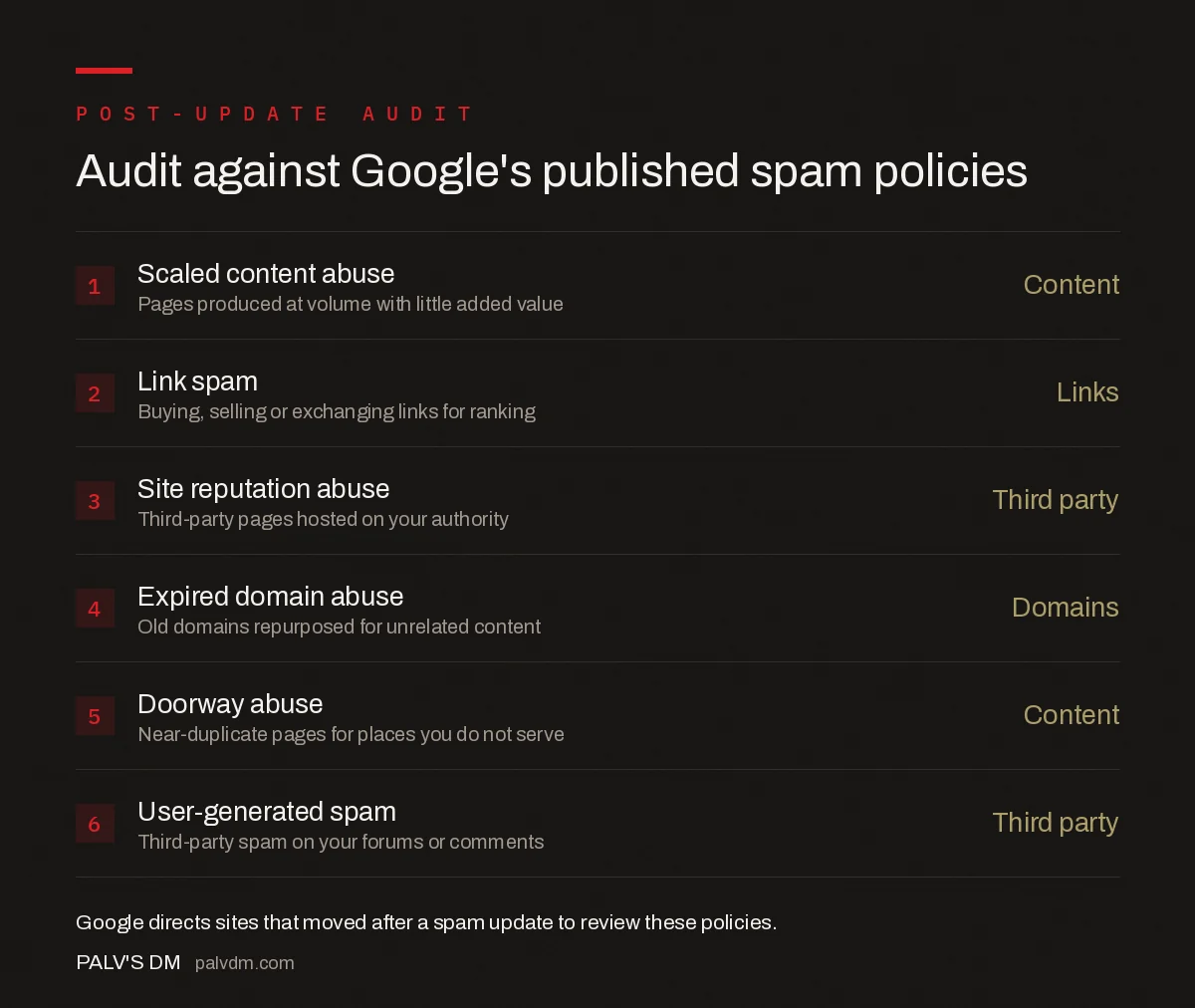
Audit against Google’s published spam policies
- Scaled content abuse — Content. Pages produced at volume with little added value.
- Link spam — Links. Buying, selling or exchanging links for ranking.
- Site reputation abuse — Third party. Third-party pages hosted on your authority.
- Expired domain abuse — Domains. Old domains repurposed for unrelated content.
- Doorway abuse — Content. Near-duplicate pages for places you do not serve.
- User-generated spam — Third party. Third-party spam on your forums or comments.
Frequently asked questions
When was the June 2026 spam update?
Google released the June 2026 spam update on 24 June 2026 and marked the rollout complete on 26 June 2026, a total of 2 days and 1 hour. It was filed on the Google Search Status Dashboard under Ranking. Google stated that the update applies globally and to all languages, and announced no new spam policies alongside it.
What did the June 2026 spam update target?
Google’s already-published spam policies. No new policies were announced, so the enforceable surface was unchanged: scaled content abuse, link spam, cloaking, doorway abuse, scraping, thin affiliation, site reputation abuse, expired domain abuse, hacked content, user-generated spam and the rest of the list. Google has never named which sites or practices a specific spam update affected.
What is a Google spam update?
Google defines it as a notable improvement to the automated systems that detect search spam. Its documentation names SpamBrain, an AI-based spam-prevention system, as an example of a system that gets improved periodically. A spam update enforces existing published policies more effectively; it does not usually change what counts as spam.
How do I recover from a spam update?
Remove the violating practice, then wait. Google states that making changes may help a site improve if its automated systems learn over a period of months that the site complies with the spam policies. There is no reconsideration request for algorithmic spam enforcement, because that process applies only to manual actions.
Will removing bad links restore my rankings after a spam update?
Not necessarily. Google states directly that for link spam updates, making changes might not generate an improvement, because when its systems remove the effect spammy links had, any ranking benefit those links previously generated is lost and cannot be regained. Removing bought links ends the liability rather than restoring past positions.
Was the June 2026 spam update a penalty?
In effect, yes, but not a manual action. Spam updates are algorithmic enforcement of Google’s published spam policies, so a site that lost ground matched a policy. No notice appears in Search Console, because Search Console notices are reserved for manual actions applied by a human reviewer at Google.
Sources
- Google Search spam updates and your site — Search Central
- Google Search spam policies
- Google Search Status Dashboard — Ranking incident history
- Manual Actions report — Search Console Help
Want this done on your site?
Every PalV’s DM engagement starts with a free audit of your actual website — a 12-point
crawl covering what is blocking indexation, on-page gaps against your primary keywords, speed
findings, and the three to five fixes worth making first. Delivered in two working days. No
payment details, and the findings are yours whether you hire us or not.