Site Reputation Abuse: The Parasite SEO Crackdown
Google's site reputation abuse policy explained: what it covers, what changed in November 2024, and what publishers renting subfolders should do now.
Site reputation abuse is Google’s spam policy against publishing third-party content on an established site mainly to exploit that site’s ranking signals, when the content offers little value to the host site’s own visitors. Google announced the policy on 5 March 2024 alongside the March 2024 core update, gave publishers two months’ notice, and brought it into force on 5 May 2024. In November 2024 Google tightened it further, clarifying that the policy applies regardless of whether the third-party content is produced with first-party involvement or oversight.
The industry calls the practice parasite SEO. Google does not use that term anywhere in its documentation, and the difference is not cosmetic: Google’s policy is written around the purpose of the arrangement and the value to the host’s readers, not around who owns the content or who signed the contract.
What does Google’s site reputation abuse policy actually say?
The policy targets a specific arrangement. A site with genuine standing — a national newspaper, a university, a long-established retailer — hosts pages produced by or for a third party, and those pages rank primarily because of the host domain rather than because of anything they offer. Google’s own examples include third-party coupon pages published on an educational site, payday loan reviews on a medical site, and third-party “best products” pages placed on a news site.
The test Google applies is about intent and audience: was the content published mainly to take advantage of the host’s ranking signals, and does it serve the host site’s own users? A university publishing loan comparison pages fails both halves of that question, however competently the pages are written.
Site reputation abuse arrived in the same announcement as scaled content abuse and expired domain abuse. All three describe the same underlying behaviour from different angles: borrowing accumulated reputation rather than earning it.
What changed in November 2024?
The original policy left publishers a defence: if the host was closely involved in producing the content, the arrangement looked legitimate. A market in editorial oversight promptly appeared, with agreements written to demonstrate involvement rather than to produce useful pages.
On 19 November 2024 Google published an update to the site reputation abuse policy stating that it applies regardless of whether the third-party content is produced with first-party involvement or oversight. Involvement stopped being a defence. What matters is whether the content exists mainly to exploit the host’s ranking signals and whether it serves the host’s audience.
For anyone running a licensing or subfolder deal, that is the clause to read first. Contractual editorial sign-off does not change how the arrangement is assessed.
What is not site reputation abuse?
Google is explicit that hosting third-party content is not itself a violation. Publishers have always carried syndicated material, and the policy is not an attack on that.
| Arrangement | Where it usually sits |
|---|---|
| Wire service and press release content | Not site reputation abuse |
| User-generated content such as forum posts and reviews | Not site reputation abuse |
| A section the publisher runs for its own readers, on its own subject matter | Not site reputation abuse |
| A subfolder rented to an affiliate operator in an unrelated category | The core case the policy describes |
| Third-party commercial pages on a site whose audience has no interest in them | The core case the policy describes |
The question that separates the rows is whether the host’s own audience is served. A gardening magazine publishing gardening tool reviews from a contributor is doing publishing. The same magazine publishing casino comparison pages in a subfolder is doing something else, and no amount of oversight documentation changes which row it lands in.
How is site reputation abuse enforced, and how would you know?
Site reputation abuse appears as an action type in Search Console’s Manual Actions report, so an affected site is told directly. Open Search Console, go to Security & Manual Actions, and any notice will name the violation and state whether it applies to the whole site or to specific URLs.
That direct notification is unusual and worth understanding, because it separates this policy from most of what site owners worry about. A manual action gives you a named problem and a reconsideration process; algorithmic demotion gives you neither. Manual action versus algorithmic suppression sets out the two paths, and how to tell if you actually have a Google penalty covers the diagnosis order.
One consequence gets missed constantly: the manual action lands on the host, not on the brand that paid for the placement. The publisher carries the risk, the visibility and the cleanup.
What should a publisher do about an existing arrangement?
- Inventory every third-party section. Subfolders, subdomains, licensed verticals, affiliate hubs, sponsored content archives. Include anything a partner uploads to, even where you never thought of it as a partnership.
- Ask the audience question honestly for each one. Would your own readers, arriving from your homepage, have any use for these pages? If the honest answer is that the section exists because the domain ranks, you have your finding.
- Decide per section: own it, block it, or remove it. Bring it under genuine editorial ownership so it serves your readers, keep it out of Search entirely, or take it down. Half-measures leave the risk intact.
- Check where it sits. Whether content lives on a subdomain or a subfolder changes how strongly it inherits host signals, and therefore how the arrangement looks.
- Handle the leftovers deliberately. Removed sections need the right status codes and redirect decisions rather than a silent deletion — the same discipline as any content pruning exercise.
- Document what you did. If a manual action exists, the reconsideration request needs a plain account of what was wrong, what changed, and what prevents it recurring.
Why does Google care about this at all?
Ranking systems lean on signals accumulated at site level. That is what makes an established domain useful to rent: a new page on a decades-old newspaper starts from a position no standalone site can buy. Site reputation abuse is the arbitrage of that gap, and it degrades results for the searcher, who clicks a trusted masthead and lands on content the masthead had nothing to do with.
It also sits directly against everything Google’s quality guidance asks for. The self-assessment questions behind the helpful content guidance ask who produced the content, how, and why it exists. Rented commercial pages answer all three badly. The experience, expertise, authoritativeness and trust framing runs the same way: a host site’s authority on one subject is not transferable evidence of expertise on another.
Treated as a pure spam risk, the policy reads as an enforcement threat. Treated as guidance, it says something simpler and more durable: reputation is assessed against the subject you actually cover, and lending your domain to a category you know nothing about was always a loan against your own credibility. The history of Google’s algorithm updates is largely a record of that same principle being enforced in new places.
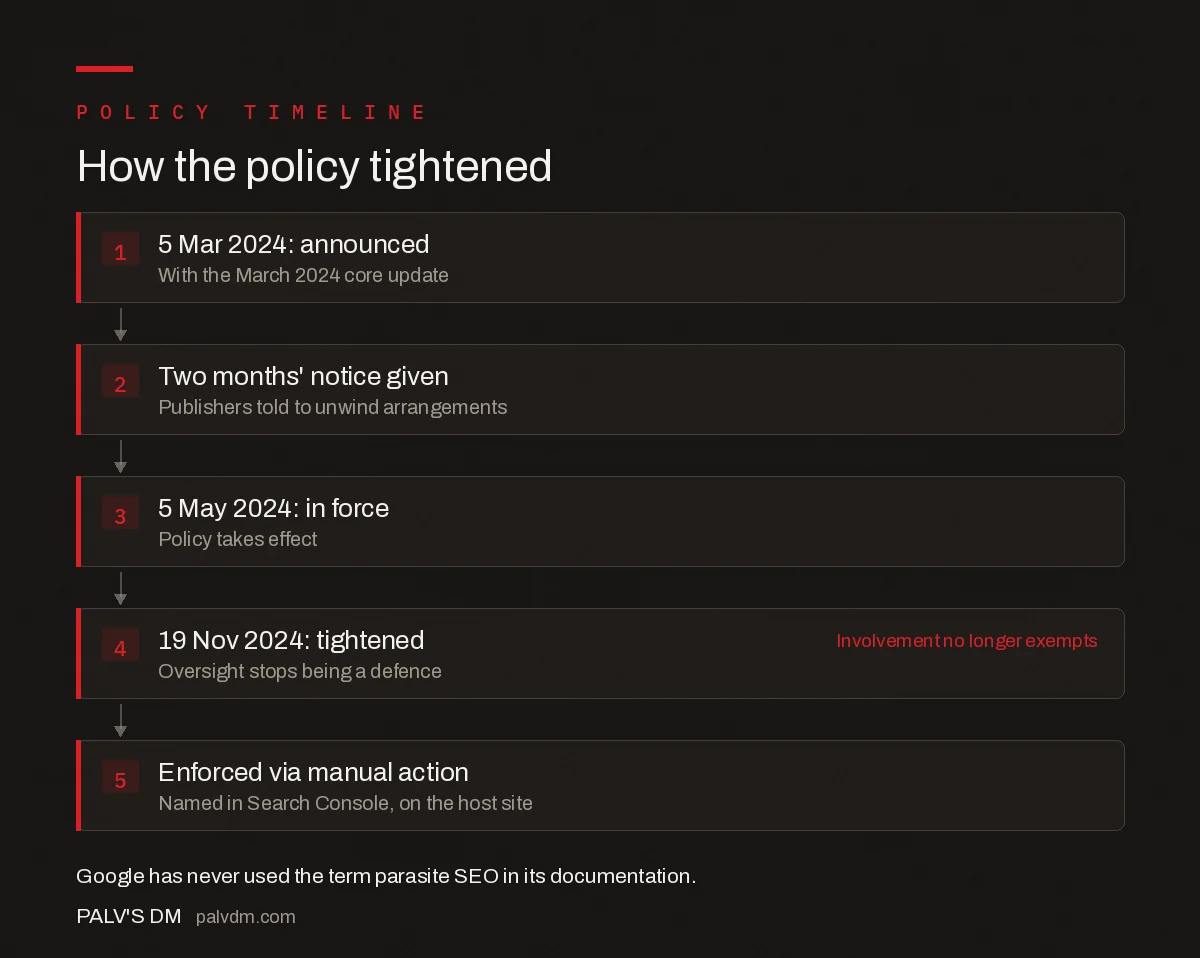
How the policy tightened
- 5 Mar 2024: announced. With the March 2024 core update.
- Two months’ notice given. Publishers told to unwind arrangements.
- 5 May 2024: in force. Policy takes effect.
- 19 Nov 2024: tightened. Oversight stops being a defence. Involvement no longer exempts
- Enforced via manual action. Named in Search Console, on the host site.
Frequently asked questions
What is site reputation abuse?
Site reputation abuse is Google’s spam policy covering third-party content published on an established site mainly to exploit that site’s ranking signals, where the content offers little value to the host site’s own visitors. Typical examples in Google’s documentation include third-party coupon pages on an educational site and payday loan reviews on a medical site.
When did Google's site reputation abuse policy take effect?
Google announced the policy on 5 March 2024 alongside the March 2024 core update and gave publishers two months’ notice, bringing it into force on 5 May 2024. On 19 November 2024 Google published an update clarifying that the policy applies regardless of whether the third-party content is produced with first-party involvement or oversight.
Is parasite SEO the same as site reputation abuse?
Parasite SEO is the industry’s name for the practice; site reputation abuse is Google’s. Google does not use the term parasite SEO in its documentation. The distinction matters because Google’s policy is written around the purpose of the arrangement and the value to the host site’s readers, not around who owns the content or how the deal was structured.
How is site reputation abuse enforced?
Site reputation abuse appears as an action type in Search Console’s Manual Actions report, so an affected site receives a direct notice naming the violation and its scope. The manual action lands on the host site rather than on the brand that paid for the placement, which means the publisher carries the risk and the cleanup work.
Is all third-party content on my site a risk?
No. Google is explicit that hosting third-party content is not itself a violation. Wire service and press release content, user-generated content such as forum posts and reviews, and sections a publisher runs for its own readers on its own subject matter are not the target. The policy describes content published mainly to exploit host ranking signals in categories the audience has no interest in.
How do I fix a site reputation abuse problem?
Inventory every third-party section, then decide for each one whether to bring it under genuine editorial ownership so it serves your readers, keep it out of Google Search entirely, or remove it. Half-measures leave the risk in place. If a manual action exists, fix the named problem first and then file a reconsideration request describing what changed.
Sources
- What web creators should know about our March 2024 core update and new spam policies
- Updating our site reputation abuse policy — Search Central Blog
- Spam policies for Google web search
- Manual Actions report — Search Console Help
Want this done on your site?
Every PalV’s DM engagement starts with a free audit of your actual website — a 12-point
crawl covering what is blocking indexation, on-page gaps against your primary keywords, speed
findings, and the three to five fixes worth making first. Delivered in two working days. No
payment details, and the findings are yours whether you hire us or not.