Google Algorithm Updates: The Complete History and What Each One Changed
Every confirmed Google algorithm update from Panda in 2011 to the 2026 core updates, what each one targeted, and which parts of the history still matter.
Google’s confirmed ranking updates fall into two families. Named systems — Panda in 2011, Penguin in 2012, Hummingbird in 2013, RankBrain in 2015, BERT in 2019 — each targeted one specific problem and were later folded into Google’s core ranking systems. Broad core updates, which have arrived three or four times a year since 2024, reassess the whole index at once and carry no name beyond the month they launched in. The shift between the two families is the most useful thing in this history: since roughly 2019, Google has largely stopped shipping separately named systems and started shipping broad reassessments instead.
That shift changes what recovery means. There is no Panda filter to lift and no Penguin penalty to appeal, because both were absorbed into Google’s core ranking systems years ago — Penguin in September 2016, Panda earlier still. Every modern update, whatever the SEO industry nicknames it, runs through the same route back: be substantially better by the time the next core update runs.
What counts as a Google algorithm update?
Google makes thousands of changes to Search every year and announces only a small fraction of them. An update is confirmed when Google publishes it — normally on the Search Status Dashboard, occasionally on the Search Central blog or a Google account on social media. Everything else is inference, however confident the inference sounds.
Three different mechanisms get called “an algorithm update”, and only two of them are:
- Core update. A broad reassessment of how ranking systems judge relevance and quality across the entire index. Not a penalty, not aimed at any site. What a core update actually is covers the mechanics.
- Spam update. Algorithmic enforcement of Google’s published spam policies against specific violating practices. This one is a penalty in effect.
- Manual action. Not an algorithm update at all — a human reviewer at Google penalising one specific site, and the only one of the three that appears as a notice in Search Console. The three-way comparison sets out which response belongs to which.
A fourth category exists and is routinely mistaken for the others: unconfirmed volatility, where third-party trackers register movement and Google confirms nothing. Reading the volatility trackers honestly is a skill in itself, because the trackers are measuring the output of the system, not statements about it.
Which named updates changed the rules, and when?
These are the confirmed systems that materially changed what ranked. Each was announced by Google, each targeted a defined problem, and each is now part of the core ranking systems rather than a separate switch.
| Update | Launched | What it targeted |
|---|---|---|
| Panda | February 2011 | Thin, low-value and duplicated content published at scale |
| Penguin | April 2012 | Manipulative link building and link schemes |
| Hummingbird | September 2013 | Query meaning, replacing strict keyword matching |
| Mobile-friendly update | April 2015 | Pages that were not mobile-friendly, on mobile results |
| RankBrain | 2015 | Interpreting queries Google had never seen before |
| BERT | October 2019 | Natural-language understanding of queries and passages |
| Page experience | 2021 | Core Web Vitals and usability as ranking signals |
| Helpful content system | August 2022 | Site-wide signal against search-engine-first content |
Two distinct jobs run through that list. Panda and Penguin were removal problems: strip out content that added nothing and links that were bought. Hummingbird, RankBrain and BERT were comprehension problems — they changed how Google reads a query, not how it judges a site, which is why no site “recovered from BERT”. Page experience and the helpful content system returned to judgement, this time weighted at site level rather than page level.
Why did Google stop naming updates?
Because the named systems stopped being separate. Google folded Panda into its core ranking signals, made Penguin real-time and part of the core algorithm in September 2016, absorbed the product reviews system into core ranking in 2023 and stopped announcing reviews updates separately, and retired the standalone helpful content system by integrating it into core ranking systems with the March 2024 core update.
The March 2024 core update is the clearest marker of the new era. It ran from 5 March to 19 April 2024 — about 45 days, the longest core rollout on record — and Google published three new spam policies alongside it: scaled content abuse, expired domain abuse and site reputation abuse. One announcement, one broad reassessment, several enforcement policies, no new named system.
The practical consequence is that diagnosis by nickname no longer works. When somebody tells you a site “got hit by Panda” in 2026, they are describing a symptom — thin content losing ground — using the name of a system that has not existed independently for a decade.
How long have recent core updates taken to roll out?
Google usually estimates up to two weeks and the record varies considerably around that estimate. Every duration below comes from Google’s own start and completion notices.
| Core update | Started | Completed | Duration |
|---|---|---|---|
| March 2024 | 5 Mar 2024 | 19 Apr 2024 | ~45 days |
| August 2024 | 15 Aug 2024 | 3 Sep 2024 | ~19 days |
| November 2024 | 11 Nov 2024 | 5 Dec 2024 | ~24 days |
| December 2024 | 12 Dec 2024 | 18 Dec 2024 | ~6 days |
| March 2025 | 13 Mar 2025 | 27 Mar 2025 | 14 days |
| June 2025 | 30 Jun 2025 | 17 Jul 2025 | ~17 days |
| December 2025 | 11 Dec 2025 | 29 Dec 2025 | 18 days |
| March 2026 | 27 Mar 2026 | 8 Apr 2026 | 12 days |
| May 2026 | 21 May 2026 | 2 Jun 2026 | ~12 days |
The 2025 rollouts lengthened steadily and the 2026 rollouts came in shorter and identical at 12 days each. Google has never explained why rollout length varies, so anyone telling you what a short rollout signifies is speculating. The full rollout-duration record goes through what can and cannot be read from it.
Which parts of this history still change how you work?
Most of the trivia is dead weight. Four things from the record are still load-bearing:
- Link manipulation is treated as enforcement, not as a ranking dial. That has been true since Penguin in 2012 and it is why buying links to recover from a core update converts a reassessment into an actual policy problem.
- Content published at scale without added value has been a target since 2011. Panda, the helpful content system and the 2024 scaled content abuse policy are three attempts at the same problem across thirteen years. Generative tooling changed the volume, not the principle.
- Google reads meaning, not strings. Hummingbird, RankBrain and BERT together retired keyword-matching as a content strategy. Writing for a phrase rather than a question has been the wrong instinct for over a decade.
- Quality assessment operates partly at site level. The helpful content system made this explicit before being absorbed into core ranking, which is why a strong page on a weak site can underperform a weaker page on a stronger one.
How do you tell whether an update affected your site?
Work in this order. Most self-diagnosed update damage turns out to be something else entirely.
- Confirm an update was actually running. Check Google’s dashboard for the dates, and check the 2026 update timeline for the confirmed list. A tracker spike is not confirmation.
- Check Search Console for a manual action. Security & Manual Actions. Thirty seconds, and it removes the worst case from consideration.
- Compare equal-length windows that both sit fully outside the rollout. A window straddling the rollout blends two states and tells you nothing.
- Separate positions, impressions and clicks. A position drop is a ranking change; an impressions drop with flat clicks is often a measurement artefact.
- Rule out your own deployments. Migrations, theme changes, robots.txt edits and plugin updates cause more traffic drops than Google does.
If an update genuinely moved you, the work is the same work it has been since 2011: find the specific URLs and query clusters that lost, compare them honestly against the pages that gained, and close the gap in substance rather than in formatting. The 30-day recovery plan sequences it, and the payoff normally arrives with the next core update rather than between them.
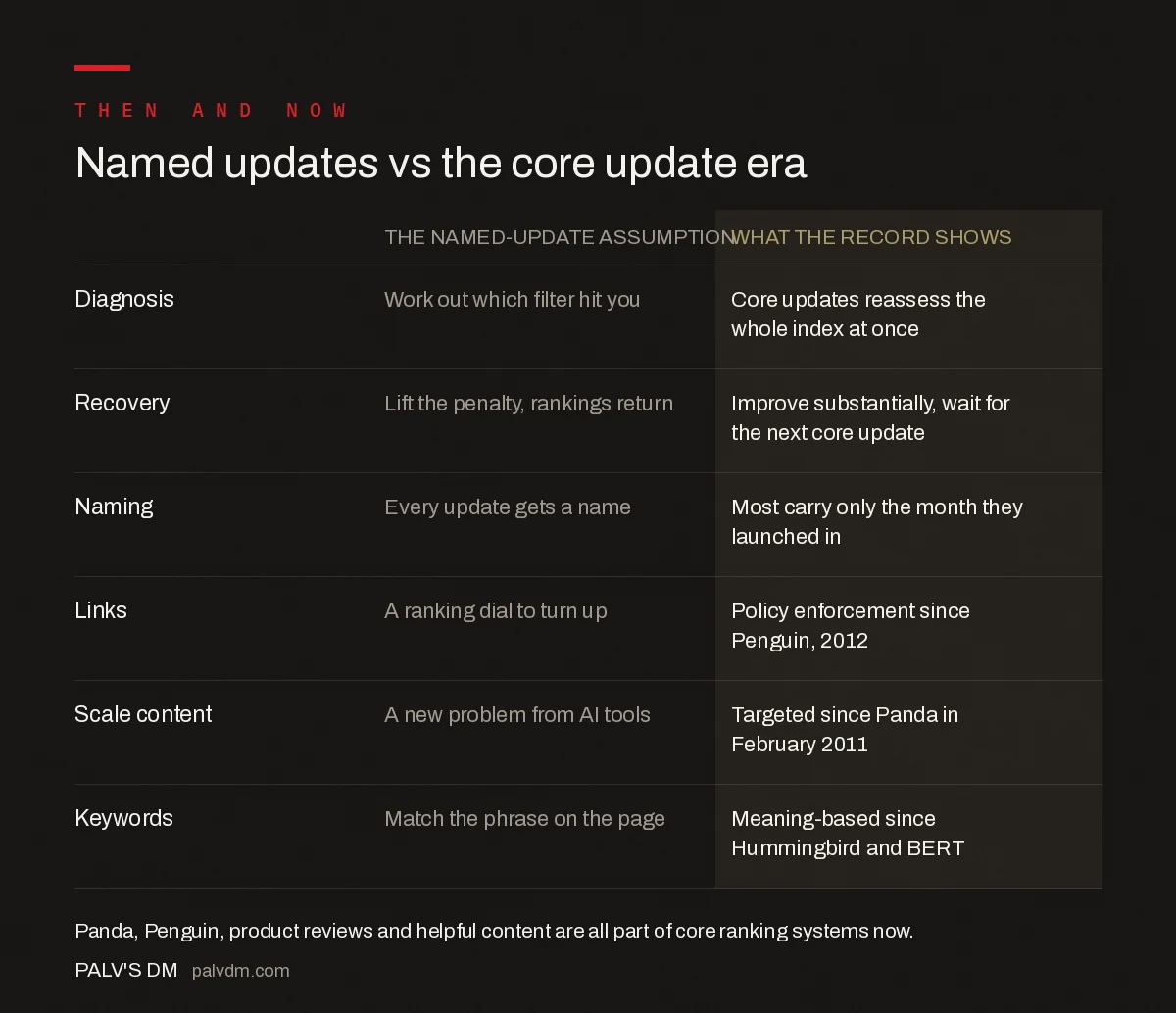
Named updates vs the core update era
| The named-update assumption | What the record shows | |
|---|---|---|
| Diagnosis | Work out which filter hit you | Core updates reassess the whole index at once |
| Recovery | Lift the penalty, rankings return | Improve substantially, wait for the next core update |
| Naming | Every update gets a name | Most carry only the month they launched in |
| Links | A ranking dial to turn up | Policy enforcement since Penguin, 2012 |
| Scale content | A new problem from AI tools | Targeted since Panda in February 2011 |
| Keywords | Match the phrase on the page | Meaning-based since Hummingbird and BERT |
Frequently asked questions
What are Google algorithm updates?
Google algorithm updates are changes to the systems that decide which pages rank and in what order. Google makes thousands of changes each year and confirms only a small number of them, publishing the confirmed ones on its Search Status Dashboard. Confirmed updates come in two forms: broad core updates that reassess the whole index, and spam updates that enforce published spam policies.
What was the first major Google algorithm update?
Panda, launched in February 2011, was the first widely recognised major update. It targeted thin, low-value and duplicated content published at scale, and it reshaped how the SEO industry thought about content quality. Penguin followed in April 2012, targeting manipulative link building. Both were eventually folded into Google’s core ranking systems rather than remaining separate filters.
Does Google still name its algorithm updates?
Rarely. Since about 2019, Google has mostly shipped broad core updates identified only by the month they launched, such as the March 2026 core update. Named systems including Panda, Penguin, the product reviews system and the helpful content system were absorbed into core ranking systems, so there is no longer a separate named filter to diagnose or recover from.
How many core updates does Google release each year?
Three or four in recent years. Google confirmed four core updates in 2024, three in 2025, and by August 2026 had confirmed a Discover-only core update in February plus broad core updates in March and May. Google does not publish a schedule, so the cadence is an observation from the record rather than a commitment.
How long does a Google core update take to roll out?
Google usually estimates up to two weeks, and actual rollouts have ranged from about six days to about 45. The March 2024 core update was the longest on record at roughly 45 days. The March 2026 and May 2026 core updates both ran about 12 days. Rankings often swing mid-rollout, so wait for Google’s completion notice before drawing conclusions.
Which old Google updates still matter in 2026?
The principles do, the names do not. Link manipulation has been treated as policy enforcement since Penguin in 2012. Content published at scale without added value has been targeted since Panda in 2011. Hummingbird, RankBrain and BERT retired keyword matching in favour of meaning. All of these are now part of Google’s core ranking systems.
Sources
- Google core updates and your website — Search Central
- What web creators should know about our March 2024 core update and new spam policies
- Penguin is now part of our core algorithm — Search Central blog
- Google Search Status Dashboard
Want this done on your site?
Every PalV’s DM engagement starts with a free audit of your actual website — a 12-point
crawl covering what is blocking indexation, on-page gaps against your primary keywords, speed
findings, and the three to five fixes worth making first. Delivered in two working days. No
payment details, and the findings are yours whether you hire us or not.