Scaled Content Abuse: Where Google Draws the Line
Google's scaled content abuse policy judges intent and usefulness, not how a page was produced. Here is what separates legitimate programmatic SEO from a manual action.
Google’s scaled content abuse policy targets pages created primarily to manipulate search rankings rather than to help a person, and it judges that by intent and usefulness, not by the method of production. AI writing, automation, human writers, and templated data pages are all treated the same way: the question is whether each individual page adds real, distinct value, not how fast it was made.
That distinction matters because it changes what “safe” means for anyone running programmatic content. Publishing a thousand pages isn’t the violation. Publishing a thousand pages that are functionally the same page with a city name swapped, offering nothing a searcher couldn’t get from any of the other 999, is.
What exactly is scaled content abuse?
Scaled content abuse is one of Google’s spam policies, formalized in the March 2024 core and spam update, covering “many pages… generated for the primary purpose of manipulating search rankings and not helping users.” The policy folds in several older, narrower issues — thin affiliate content, auto-generated gibberish, scraped and lightly reworded content — under one umbrella that’s explicitly agnostic about production method. Whether the content came from a script scraping competitor pages, a large language model with no editorial review, or a team of freelance writers working from an identical brief at high volume, the evaluation is the same: does each page serve users, or does it exist to occupy a search results position.
How does Google actually decide “primary purpose”?
Google evaluates this at a pattern level, not page by page. A site with a handful of thin pages mixed into an otherwise substantive catalog looks different from a site where scaling is the entire content strategy and depth is the exception. Signals that point toward manipulative intent include content that’s interchangeable across pages with only a data point swapped, no original analysis or reporting distinguishing one page from its siblings, and publishing volume that scales far faster than any editorial or quality process could plausibly support.
What separates legitimate programmatic SEO from scaled abuse?
Programmatic SEO — building page templates driven by structured data — isn’t the violation. Real estate listing sites, job boards, and product comparison engines have run programmatic pages for years without issue, because each page’s underlying data is genuinely different and useful on its own. The test is whether the template is a vessel for unique value or a vessel for keyword coverage.
| Characteristic | Legitimate programmatic SEO | Scaled content abuse |
|---|---|---|
| Underlying data | Unique per page (real listings, real specs, real local data) | Templated text with minor variable swaps |
| Editorial review | Present, at least at the template and sample level | Absent or nominal |
| Value if it were the only page online | Still useful on its own | Not distinguishable from near-duplicates |
| Publishing volume vs quality process | Scaled to match a real data pipeline | Scaled far beyond what review can support |
| User intent match | Answers a specific, real query precisely | Broadly targets many keyword variants with generic content |
What are the concrete examples Google calls out?
- Generative AI content at volume with no value add. Using an LLM to produce large numbers of pages without adding anything a person couldn’t get faster elsewhere — no original data, no synthesis, no verification.
- Scraping and obfuscating. Pulling feeds, search results, or existing articles, then running them through synonym-swapping, translation-and-back-translation, or light rewording to present them as original.
- Combining content from multiple pages without adding value. Stitching together paragraphs from several sources into a “comprehensive” page that’s really just aggregation dressed up as original coverage.
- Templated pages targeting keyword variants with no substantive difference. “Best X in [city]” pages repeated for hundreds of cities with identical body copy and a swapped city name.
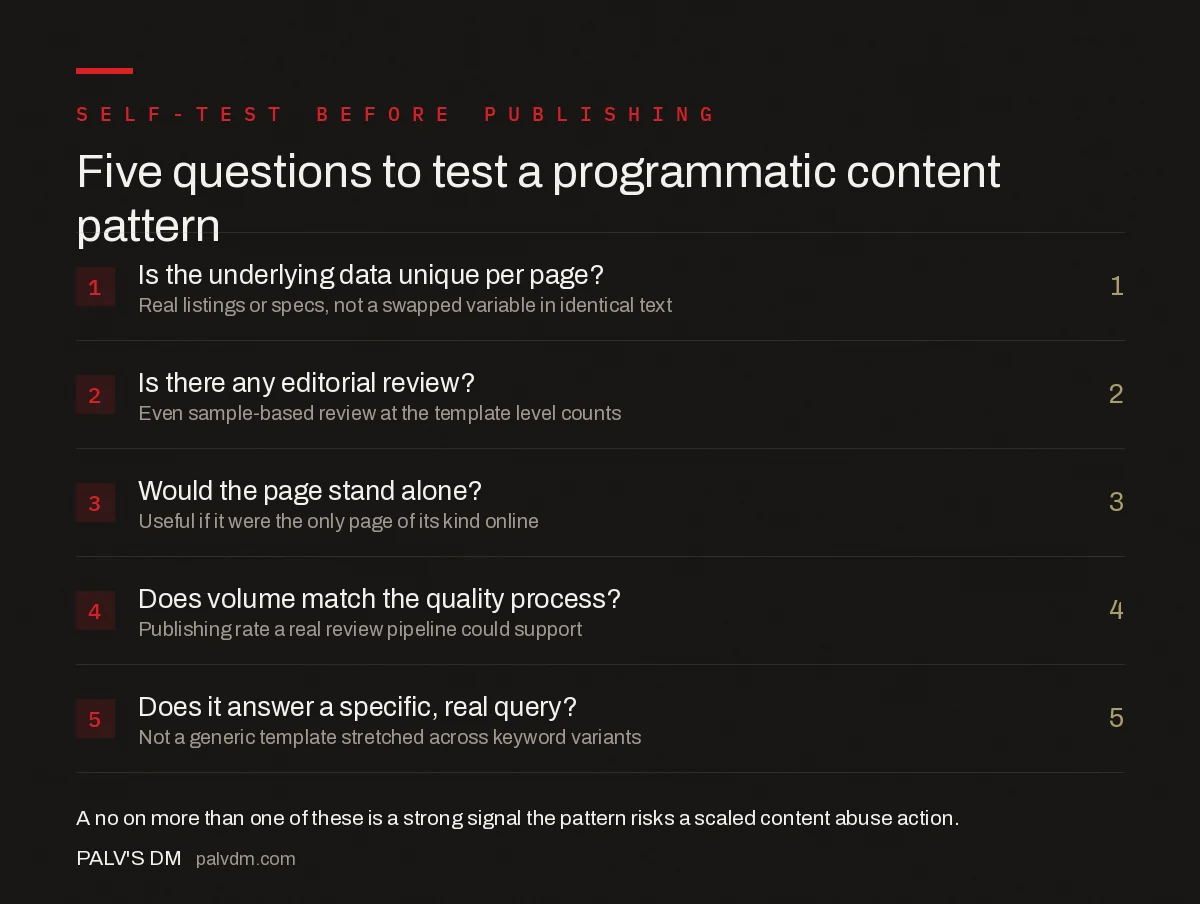
Five questions to test a programmatic content pattern
- Is the underlying data unique per page? — Real listings or specs, not a swapped variable in identical text.
- Is there any editorial review? — Even sample-based review at the template level counts.
- Would the page stand alone? — Useful if it were the only page of its kind online.
- Does volume match the quality process? — Publishing rate a real review pipeline could support.
- Does it answer a specific, real query? — Not a generic template stretched across many keyword variants.
How is scaled content abuse different from thin content or duplicate content penalties?
Thin content and duplicate content are older, narrower concepts usually assessed page by page — a single thin page might just rank poorly on its own. Scaled content abuse is explicitly a pattern-level policy: it looks at the practice across the site and can trigger a site-wide manual action or demotion even if individual pages, viewed in isolation, wouldn’t obviously fail a thin-content test. The scale itself, combined with the interchangeability, is part of what defines the violation.
What does recovery from a scaled content abuse action look like?
Because the action targets a pattern, fixing a handful of example pages Google cited in a manual action notice without addressing the broader pattern rarely works. Recovery typically means auditing the entire templated content set, removing or substantially rewriting pages that don’t clear the “unique, standalone value” bar, and only then filing a reconsideration request. Sites that treat this as a content strategy reset — cutting volume and raising the bar per page — tend to recover; sites that swap a few flagged examples and resubmit tend to see the action reinstated.
Frequently asked questions
Does using AI to write content count as scaled content abuse?
Not by itself. Google’s policy explicitly judges pages by whether they’re created primarily to manipulate rankings and lack genuine value, not by whether AI, automation, or a human wrote them. AI-assisted pages that are accurate, useful, and reviewed can rank normally; the same volume of unreviewed, thin AI output is what triggers action.
Is programmatic SEO against Google’s guidelines?
No. Programmatic SEO — generating many pages from a template and a dataset — is a legitimate technique when each page provides real, distinct value, such as unique local data or genuinely different product specifications. It becomes scaled content abuse when the template is filled with thin or duplicated variations that exist only to capture search traffic.
What happens if a site is hit by a scaled content abuse action?
It’s typically a site-wide manual action or a ranking demotion affecting the whole domain, not just the offending pages, because the policy treats scaled abuse as a pattern across the site. Recovery requires removing or substantially improving the offending pages and filing a reconsideration request once the pattern is genuinely fixed.
How can you tell if a page will be seen as scaled content abuse before publishing?
Ask whether the page would still be worth publishing if it were the only page of its kind on the internet — if the answer is no, and it only exists as one of thousands of near-identical variants, it’s a strong candidate for the policy regardless of how it was produced.
Sources
- Google Search Essentials: Spam Policies — Google Search Central
- Programmatic SEO: What Actually Scales Without Penalties
- Technical SEO: The Complete Working Guide
- How to Run a Technical SEO Audit With Screaming Frog
- Mobile-First Indexing: What Still Trips Sites Up
Want this done on your site?
Every PalV’s DM engagement starts with a free audit of your actual website — a 12-point
crawl covering what is blocking indexation, on-page gaps against your primary keywords, speed
findings, and the three to five fixes worth making first. Delivered in two working days. No
payment details, and the findings are yours whether you hire us or not.