Expired Domain Abuse: Why Buying Aged Domains Stopped Working
Google named expired domain abuse a spam policy in March 2024. Why domain age was never a ranking factor, and what the inherited links actually do.
Expired domain abuse is Google’s spam policy against buying a lapsed domain and repurposing it primarily to boost the rankings of low-value content by exploiting the domain’s past reputation. Google published it as an explicit policy on 5 March 2024, alongside the March 2024 core update. Buying an expired domain is not itself a violation — businesses do it for brand protection and for genuine relaunches. What the policy names is the repurposing: taking a domain that earned its standing as a defunct charity or a closed local newspaper and turning it into an affiliate site because the signals are still attached.
The practice was already unreliable before it was named. The policy simply removed the ambiguity, and turned a tactic with poor odds into one with a documented enforcement route attached.
What does the policy actually prohibit?
Google’s spam policies describe expired domain abuse as purchasing an expired domain and repurposing it with the primary purpose of manipulating search rankings by hosting content that provides little to no value to users. Both halves of that sentence matter. The intent has to be ranking manipulation, and the content has to be offering little.
Google published expired domain abuse in the same announcement as site reputation abuse and scaled content abuse. Site reputation abuse was given two months’ notice before taking effect; no such delay was announced for expired domain abuse. All three describe the same behaviour from different angles — borrowing accumulated reputation rather than building it.
| What you are doing | Where it sits |
|---|---|
| Buying a lapsed domain for a genuine new business on that name | Not the target of the policy |
| Registering variants of your own brand defensively | Not the target of the policy |
| Acquiring a competitor and consolidating their site into yours | An ordinary site move, if handled as one |
| Buying a defunct charity domain to host casino affiliate pages | The core case the policy describes |
| Buying an aged domain purely because its backlink profile looks strong | The core case the policy describes |
Myth: domain age is a ranking factor
This is the belief the whole aged-domain market rests on, and there is no documentation supporting it. Google’s published guide to Search ranking systems lists no system that rewards a domain for being old. Registration date is not a quality signal, and a 1998 registration on a domain with nothing behind it carries nothing.
What people are actually observing when an old domain outperforms a new one is usually links, brand recognition and accumulated topical coverage — all of which take time to acquire, and none of which transfer when the domain changes hands and subject. Age correlates with those things. It does not cause them. Domain authority explained deals with the related confusion, since third-party authority scores are also not Google metrics.
Myth: the backlinks come with the domain
They come with the domain in the sense that they still point at it. What they do not do is keep counting for content they were never about.
Links are earned in a context. A link from a local council page to a community sports club is a citation of that club. When the domain becomes a payday loan site, the citation has not moved — the thing it cited stopped existing. Treating the link as portable value assumes Google evaluates links without reference to what they point at, which is the opposite of how relevance works.
The redirect route fails for a related reason. Google’s documentation on redirects notes that redirecting URLs to an irrelevant destination may be treated as soft 404s rather than passing signals, so pointing a bought domain’s URLs at unrelated pages on your site does not transfer anything. A genuine consolidation is a different exercise entirely — see changing domains without losing rankings for what an actual site move requires.
Myth: it is fine if the content is good
The policy is written around purpose, not quality. If the domain was bought primarily because of its ranking signals and the content exists to monetise them, quality of execution does not move it into a different category.
The honest test is a single question: would this site exist on a domain registered yesterday? If the plan collapses without the acquired history, the history is the plan, and that is what the policy names. If the answer is yes, then buy the domain you want and get on with it.
How is expired domain abuse enforced?
Google’s spam policies are enforced both algorithmically and, in some cases, through manual review. Algorithmic enforcement gives no notification at all; manual actions appear as a notice in Search Console under Security & Manual Actions, naming the violation and its scope. If you have inherited a domain and want to know where you stand, that report is the first place to look — and it takes thirty seconds.
The two paths have very different recovery profiles, which is why the distinction is worth understanding before you start reacting. Manual action versus algorithmic suppression sets them out, and how to tell if you actually have a Google penalty covers the diagnostic order. Spam enforcement is also not the same mechanism as a core update, which is a reassessment rather than a penalty — the three mechanisms compared separates them.
What should you do if you already bought one?
- Check the Manual Actions report first. A notice tells you exactly what Google objects to and gives you a reconsideration process. An empty report means you are diagnosing without help.
- Establish what the domain was. Archived versions of the old site tell you what its links were actually citing. A domain whose history has nothing to do with your subject is carrying no relevant signal regardless of its metrics.
- Review the inherited link profile honestly. A backlink profile audit on an acquired domain frequently turns up the reason it was cheap. Where links were manipulated by a previous owner, disavowing them is one of the few situations where the tool genuinely applies.
- Stop treating the domain as an asset and start treating it as an address. Build coverage that serves an audience on the subject you actually work in. That is slower and it is the only thing that compounds.
- Do not mass-redirect it into your main site. Redirects to irrelevant destinations may be treated as soft 404s, and you risk importing a problem into a domain that did not have one.
- Clear out inherited filler. Whatever the previous owner left behind is usually thin content pointing at a subject you have no involvement in.
The wider pattern is worth noticing. Almost every shortcut Google has closed over the past two decades was a way of acquiring signals rather than earning them, and the history of Google’s algorithm updates reads as a sequence of those closures. Aged domains were one of the last places where the arbitrage still occasionally worked. It stopped being a clever tactic and became a named policy violation, and the sites still running it are trading against a documented enforcement route for a benefit that was never reliably there.
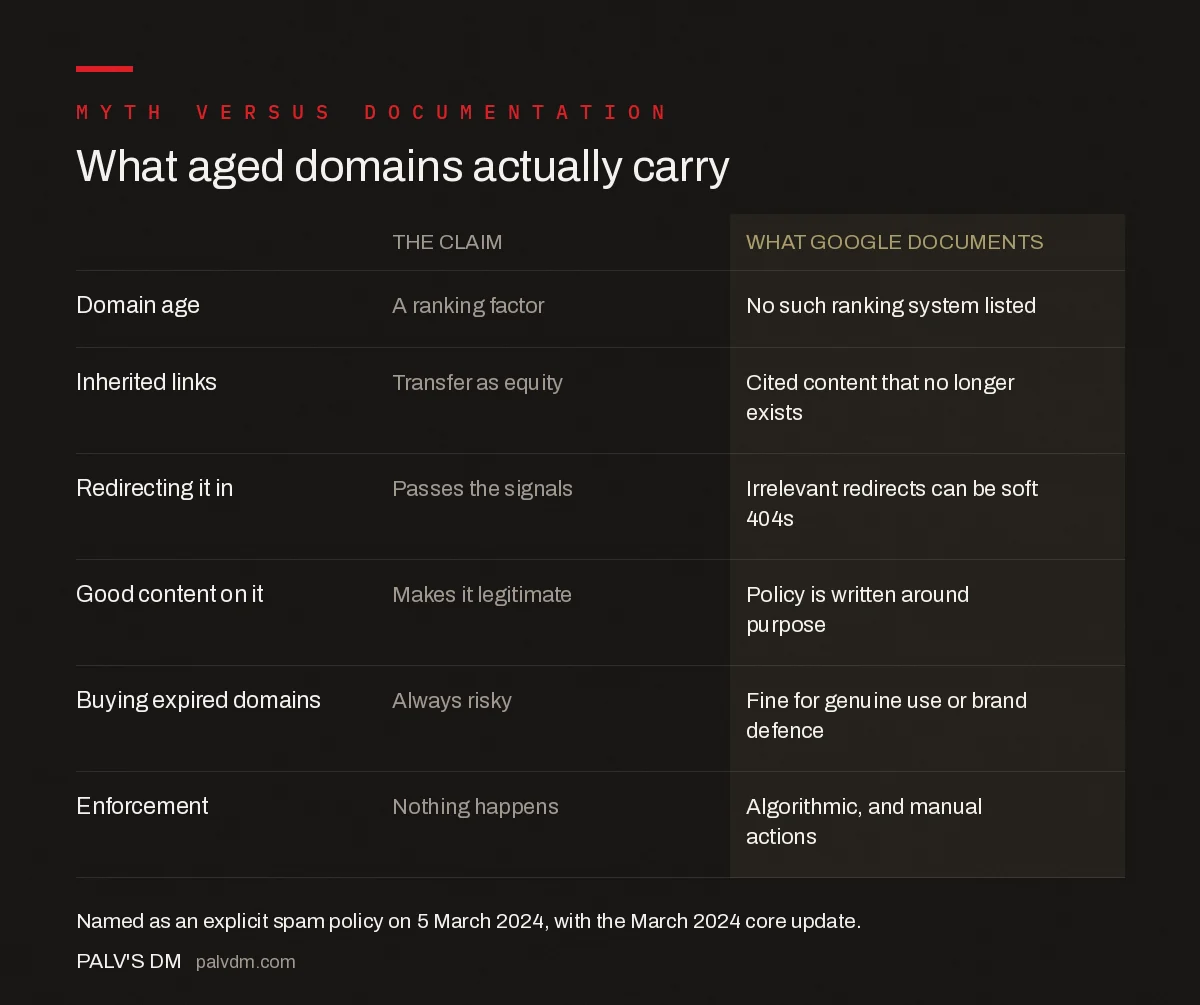
What aged domains actually carry
| The claim | What Google documents | |
|---|---|---|
| Domain age | A ranking factor | No such ranking system listed |
| Inherited links | Transfer as equity | Cited content that no longer exists |
| Redirecting it in | Passes the signals | Irrelevant redirects can be soft 404s |
| Good content on it | Makes it legitimate | Policy is written around purpose |
| Buying expired domains | Always risky | Fine for genuine use or brand defence |
| Enforcement | Nothing happens | Algorithmic, and manual actions |
Frequently asked questions
What is expired domain abuse?
Expired domain abuse is Google’s spam policy covering the purchase of a lapsed domain and its repurposing primarily to manipulate search rankings, by hosting content that provides little or no value to users while exploiting the domain’s past reputation. Google published it as an explicit policy on 5 March 2024 alongside the March 2024 core update.
Is buying an expired domain against Google's guidelines?
Not in itself. Businesses buy lapsed domains for genuine relaunches, for acquisitions and for brand protection, and none of that is a violation. The policy targets the repurposing of a domain primarily because of its ranking signals, to host content with little value to users. The test is the purpose of the purchase, not the purchase itself.
Is domain age a Google ranking factor?
There is no documentation supporting it. Google’s published guide to Search ranking systems lists no system that rewards a domain for being old. Older domains often perform better because they have accumulated links, brand recognition and topical coverage over time, but age correlates with those things rather than causing them, and none of them transfer when the domain changes subject.
Do backlinks still count after a domain changes hands?
Not for content they were never about. Links are earned in a context, so a citation of a defunct sports club does not become a citation of the payday loan site that later occupies the domain. Redirecting the acquired URLs to unrelated pages does not solve it either: Google’s documentation notes that redirects to irrelevant destinations may be treated as soft 404s.
How would I know if a domain I bought has a problem?
Check Search Console under Security and Manual Actions first. A manual action names the violation and its scope and comes with a reconsideration process. If the report is empty, review what the domain was previously used for through archived versions of the old site, and audit the inherited backlink profile for links a previous owner manipulated.
Can you recover a domain that was used for spam before you bought it?
Sometimes, but it is slow and rarely cheaper than starting clean. Remove the inherited low-value content, disavow links that a previous owner clearly manipulated, and build genuine coverage on the subject you actually work in. Algorithmic spam demotions lift only after Google’s systems recrawl and reassess the site, which takes months rather than days.
Sources
- Spam policies for Google web search
- What web creators should know about our March 2024 core update and new spam policies
- Redirects and Google Search — Search Central
- Manual Actions report — Search Console Help
Want this done on your site?
Every PalV’s DM engagement starts with a free audit of your actual website — a 12-point
crawl covering what is blocking indexation, on-page gaps against your primary keywords, speed
findings, and the three to five fixes worth making first. Delivered in two working days. No
payment details, and the findings are yours whether you hire us or not.