Thin Content: What Counts and How to Fix It
Thin content isn't about word count — it's a page that fails to add value beyond what's already available. Here's how Google identifies it and the four fixes that actually work.

Thin content is a page that fails to provide genuine value to someone searching for that topic — not necessarily a short page, but one offering little original information, no real depth, or content that simply repeats what’s already available elsewhere. Google’s Helpful Content system evaluates this at the domain level as well as the page level, meaning a large share of thin pages can suppress a site’s genuinely strong content too. Fixing it means auditing by traffic and engagement data, then improving, merging, or removing each page based on whether the topic deserves depth or was never worth a page at all.
The word “thin” misleads a lot of site owners into padding pages with filler paragraphs to hit some perceived minimum length. That doesn’t fix anything — Google states directly that there’s no preferred word count, and a padded 1,800-word page with no original insight is exactly as thin as the 400-word version it replaced.
What actually counts as thin content?
Google’s own guidance on creating helpful, reliable, people-first content lists the traits that define thin content, independent of length:
- Content copied or lightly rewritten from other sources without adding substantial original value, analysis, or perspective.
- Auto-generated pages built from a template with minimal unique content per page — location pages with only a swapped city name, for instance.
- Thin affiliate pages that exist mainly to link out, with little independent content about the product or service itself.
- Pages built primarily to rank for a keyword rather than to serve an existing or intended audience.
- Doorway pages — multiple near-duplicate pages targeting slight keyword variations of the same query, meant to funnel traffic to one destination.
None of these are about length. A single well-researched paragraph that fully answers a narrow, specific question is not thin. A 2,500-word article that says the same three things five different ways is.
How does thin content connect to the Helpful Content system?
Google’s Helpful Content system, folded into the core ranking algorithm since March 2024, doesn’t just assess individual pages in isolation — it evaluates the overall proportion of helpful versus unhelpful content across a domain. That’s the mechanism behind a pattern many site owners have seen: a handful of clearly thin pages seem to drag down rankings for pages that are genuinely strong, because the suppression operates at the domain level rather than being confined to the specific weak URLs.
This is why “just noindex the bad ones” is often not enough on its own if the volume is large — removing the pages from the index matters, but so does not having built them at scale in the first place.
How do you audit a site for thin content?
Two data sources triangulate thin content faster than a manual page-by-page read-through of a large site.
Search Console performance data
Filter for pages with impressions near zero over the past several months — Google has essentially stopped surfacing them for any query, which is often a sign the page adds nothing distinct in its space. Separately, pages with meaningful impressions but a very low click-through rate can indicate a title or snippet promising something the thin content underneath doesn’t deliver.
A manual quality pass against Google’s self-assessment questions
Google’s own creating-helpful-content guidance publishes a list of self-assessment questions worth running against a sample of suspect pages directly: does it provide original information or analysis, would you bookmark or recommend it, would it be referenced in a printed publication, and does it demonstrate real first-hand expertise on the topic.
What are the four fixes for thin content?
Once a page is confirmed thin, the fix depends on whether the underlying topic deserves a page at all.
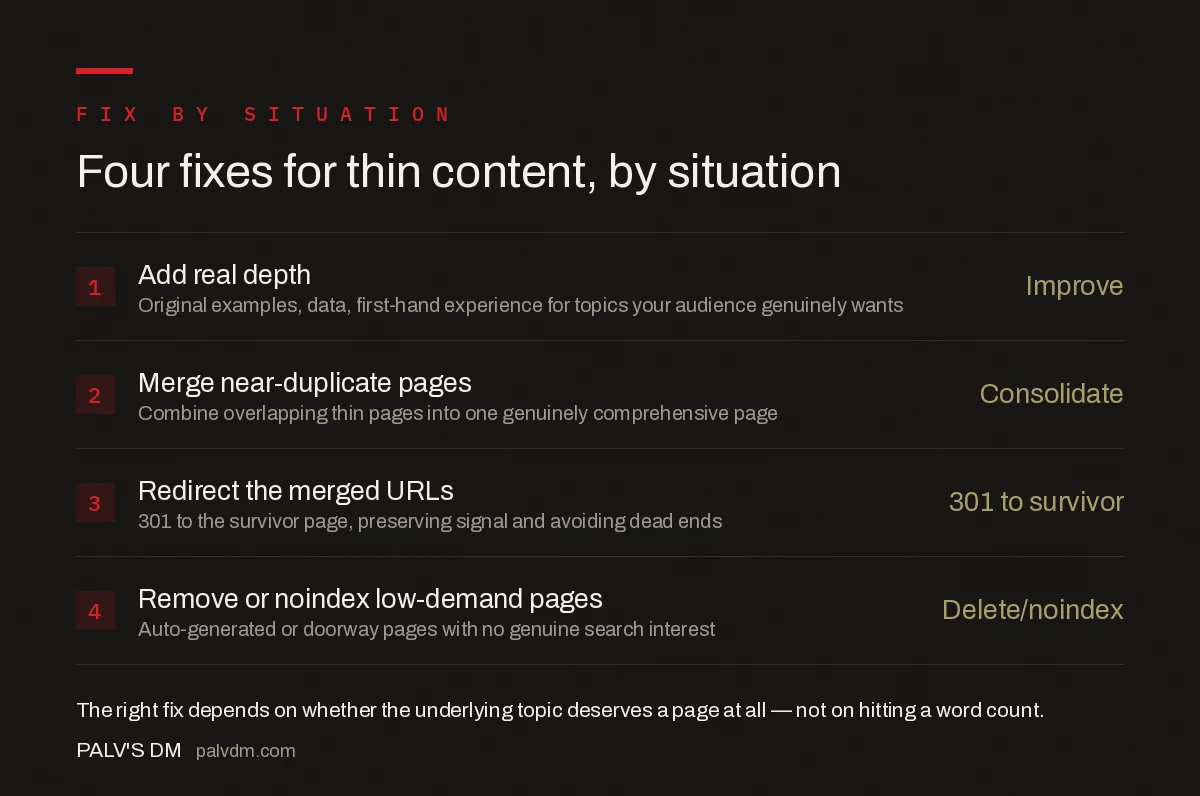
Four fixes for thin content, by situation
- Add real depth — Improve. Original examples, specific data, first-hand experience, and expert commentary for topics your audience genuinely wants covered.
- Merge near-duplicate pages — Consolidate. Combine several thin pages covering overlapping ground into one genuinely comprehensive page.
- Redirect the merged URLs — 301 to the survivor. Preserves any accumulated signal and avoids leaving dead ends for users who bookmarked the old URL.
- Remove or noindex pages with no real demand — Delete/noindex. Auto-generated or doorway pages with no genuine search interest behind them.
Which fix applies to which type of thin page?
| Type of thin page | Recommended fix | Reasoning |
|---|---|---|
| Real topic, shallow coverage | Add depth and originality | Genuine search demand exists; the content just hasn’t earned it yet |
| Several pages, one overlapping topic | Merge into one comprehensive page | Splitting a topic across near-duplicates dilutes both relevance and authority |
| Auto-generated template page, near-zero demand | Remove or noindex | No realistic audience benefit from keeping it indexed |
| Thin affiliate or doorway page | Remove, or rebuild with genuine independent content | Directly matches Google’s spam policy definitions if left as-is |
How do you prevent thin content from building up again?
The recurring cause is usually structural, not a one-time lapse — a CMS or content process that makes it easy to publish pages faster than they can be made genuinely useful. Google’s people-first content framework suggests three questions worth asking before a new page template goes live: does an existing or intended audience actually want this content if they came directly to the site, does it demonstrate real first-hand expertise, and would someone reading it leave feeling they’d learned enough to achieve their goal. A page that fails all three at the planning stage is thin before it’s even published.
Frequently asked questions
Does thin content mean short content?
No. Thin content is defined by lack of value, not word count. A 300-word page that fully answers a narrow question can be complete; a 2,000-word page padded with filler and no original insight is still thin. Google explicitly states it has no preferred word count.
Does thin content on a few pages hurt the whole site?
It can. Google’s Helpful Content system, integrated into the core ranking algorithm since March 2024, evaluates the overall proportion of unhelpful content across a domain. A site with a large share of thin pages can see suppression that affects even its genuinely strong content.
How do I find thin content on my own site?
Cross-reference Search Console’s performance data for pages with near-zero impressions or high impressions but very low click-through against a manual content review. Pages that rank for almost nothing, get no engagement, or duplicate what a stronger page already covers are the primary suspects.
Should I delete thin content or improve it?
Improve pages covering topics your audience genuinely searches for, by adding real depth, data, and first-hand detail. Delete or merge pages that exist only because a template auto-generated them or that duplicate a stronger page’s coverage with nothing unique to offer.
Is AI-generated content automatically considered thin?
No. Google’s guidance focuses on whether content is helpful and people-first, not on how it was produced. Content generated primarily to manipulate rankings, whether AI-assisted or entirely manual, is what gets penalized — not the production method itself.
Sources
- Creating Helpful, Reliable, People-First Content — Google Search Central
- On-Page SEO Checklist: The Complete Guide
- Content Pruning: Deciding What to Delete, Merge or Keep
- Redirecting a Merged Post Without Losing Rankings
- Content Freshness: When Updating Helps and When It Doesn’t
Want this done on your site?
Every PalV’s DM engagement starts with a free audit of your actual website — a 12-point
crawl covering what is blocking indexation, on-page gaps against your primary keywords, speed
findings, and the three to five fixes worth making first. Delivered in two working days. No
payment details, and the findings are yours whether you hire us or not.