What the 2026 Updates Have in Common: Evidence Over Volume
Five confirmed updates in 2026, one consistent direction. What the pattern across Discover, spam and core rollouts tells you to actually do.
Across five confirmed Google updates in 2026, one direction is consistent: evidence beats volume. The February Discover update explicitly rewarded in-depth, original content from sites with demonstrated expertise. Both core updates, in March and May, moved hardest against sites publishing large quantities of undifferentiated material. Both spam updates enforced existing policies faster than ever, with the March rollout completing in under 24 hours. Google published no new guidance with any of them — which is itself the pattern’s clearest signal, because Google’s position is that the existing helpful content guidance already says what it wants.
Two caveats before the argument. Only the February update came with stated goals; the rest is inference from observed movement. And a consistent direction is not a mechanism — knowing which way things are moving is not the same as knowing how the systems work.
The five confirmed updates
| Update | Dates | Duration | What it indicates |
|---|---|---|---|
| February Discover core update | 5–27 Feb | 22 days | Explicitly rewarded expertise, locality, depth. Penalised clickbait |
| March spam update | 24–25 Mar | <24 hours | Enforcement speed increasing sharply |
| March core update | 27 Mar – 8 Apr | 12 days | Undifferentiated content lost ground |
| May core update | 21 May – 2 Jun | 12 days | Same direction, heavier movement |
| June spam update | 24–26 Jun | ~2 days | Fast enforcement is now normal |
Full dates and dashboard references sit in the 2026 update timeline.
Pattern one: enforcement got dramatically faster
The August 2025 spam update ran nearly four weeks. The March 2026 spam update finished in under a day — the fastest on record. June 2026 took about two.
Google announced no new spam policies with either 2026 update, so this is not a change in what counts as spam. It is a change in how quickly existing policies get enforced.
The practical consequence is about risk timing. A tactic that violates policy used to offer a window — weeks of benefit before enforcement caught up. That window is now days. Anything working because it has not been caught yet is a much worse bet in 2026 than it was in 2025.
Pattern two: core rollouts got shorter, and steadier
The 2025 core updates lengthened steadily: 14 days in March, roughly 17 in June, 18 in December. Both 2026 core updates completed in about 12.
Google has never explained what determines rollout duration, and I would not speculate. What the shortening does change is your operating rhythm: the assessment window between “an update started” and “you can trust your data” is now closer to two weeks than three. That makes the discipline of waiting more affordable, and panic-reacting less excusable.
The May rollout is the caution here. Twelve days, but three separate waves of movement — day three, day nine, and the final 24 hours. Shorter does not mean smoother.
Pattern three: Google stopped issuing new guidance
Neither 2026 core update came with a companion blog post or new advice. Neither spam update announced new policies. The February Discover update was the only one with published goals, and even that pointed back to existing documentation.
This is easy to read as Google going quiet. The more accurate reading is that Google considers the guidance complete. Its position, stated repeatedly, is that there is nothing new or special creators need to do for any individual update as long as they have been making satisfying content meant for people.
Which means the absence of new guidance is the guidance. If you are waiting for Google to publish the thing that explains 2026, it already did, in 2022, and the self-assessment questions have not changed: who produced this content, how was it produced, and why does it exist.
Pattern four: the same content characteristics kept winning
This is the through-line, and it is the only one with a stated-goal anchor rather than pure inference.
Google said the February Discover update would surface “more in-depth, original, and timely content from websites with expertise in a given area, based on our systems’ understanding of a site’s content.” That single sentence contains four things: depth, originality, timeliness, and site-level expertise recognition.
The March and May core updates were widely observed to move in the same direction — though Google confirmed nothing about their mechanism. Sites with large volumes of thin content fared worst. Pages carrying original data, documented first-hand testing or named expertise fared better.
Note the phrase “based on our systems’ understanding of a site’s content.” That is a site-level assessment of what you are known for, not a page-level judgement, and it is the same logic behind topical authority. A site publishing across eight unrelated topics gives those systems little to work with.
What the pattern says to actually do
Five things follow, in order of leverage.
- Stop publishing to a quota. Volume was already a weak strategy and is now a site-level liability. One page with something genuinely new beats five competent restatements, and the five carry ongoing cost.
- Decide the information gain before commissioning. If the brief cannot answer “what will this say that the current top ten cannot,” the page should not be written. Information gain in practice covers the six workable forms.
- Put a real name and real credentials on everything. Google’s “who” question is unanswerable for anonymous content, and it appears in its published self-assessment list. An author page that signals genuine expertise is the mechanism; why anonymous content is losing ground is the argument.
- Audit against spam policies now, not after enforcement. With sub-24-hour rollouts, there is no longer a grace period to rely on.
- Prune honestly. Since assessment operates partly at site level, removing or genuinely improving weak pages is legitimate work, not an admission of failure.
What the pattern does not say
Three cautions, because a tidy narrative is exactly how people end up confidently wrong.
It does not name a mechanism. “Information gain became the dominant signal” is an industry label, not a Google statement. The direction is supportable; the mechanism is not.
It does not mean every drop was a core update. The August 2026 volatility is the clearest example: trackers spiked, the industry named an update, and Google’s dashboard recorded no incident at all, while a GA4 bug, Ad Manager disruptions and a mid-July Discover decline all landed in the same week.
It does not predict the next update. Four rollouts pointing one way is a trend, not a forecast. Plan for what is durable — usefulness, evidence, attribution — rather than for a continuation you cannot verify.
As of 17 August 2026, no update has been confirmed since 26 June. That interval is the working window for anyone who lost ground in May, and the 30-day recovery plan is how to spend it.
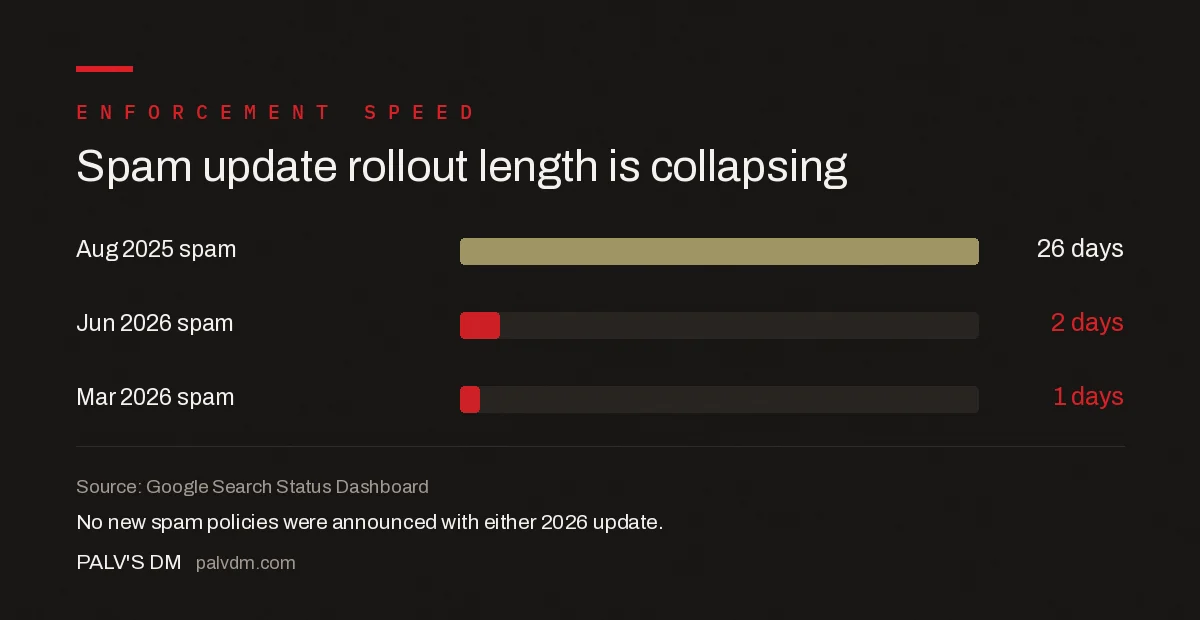
Spam update rollout length is collapsing
| Metric | Value |
|---|---|
| Aug 2025 spam | 26 days |
| Jun 2026 spam | 2 days |
| Mar 2026 spam | 1 days |
Source: Google Search Status Dashboard
Frequently asked questions
What do the 2026 Google updates have in common?
One consistent direction: evidence over volume. The February Discover update explicitly rewarded in-depth, original content from sites with demonstrated expertise, while both core updates moved hardest against sites publishing large quantities of undifferentiated material. Google published no new guidance with any of them, which indicates it considers its existing helpful content documentation sufficient.
How many Google updates were confirmed in 2026?
Five as of 17 August 2026: the February Discover core update (5–27 February), the March spam update (24–25 March), the March core update (27 March to 8 April), the May core update (21 May to 2 June), and the June spam update (24–26 June). No update has been confirmed since 26 June 2026.
Why are Google spam updates rolling out faster?
Google has not explained why, but the trend is clear: the August 2025 spam update ran nearly four weeks, the March 2026 spam update finished in under 24 hours, and the June 2026 update took about two days. Since no new spam policies were announced with either 2026 update, this reflects faster enforcement of existing policies rather than a change in what counts as spam.
Did Google publish new guidance with the 2026 updates?
No. Neither 2026 core update came with a companion blog post or new advice, and neither spam update announced new policies. Only the February Discover update published specific goals. Google’s consistent position is that there is nothing new or special creators need to do for any individual update provided they have been making satisfying content meant for people.
What should I change based on the 2026 update pattern?
Stop publishing to a quota, since quality is assessed partly at site level and weak pages weigh on strong ones. Decide what genuinely new information a page will add before commissioning it. Put real names and credentials on content so it can answer Google’s “who produced this” question. Audit against spam policies proactively, because sub-24-hour enforcement leaves no grace period.
Sources
- Google Search Status Dashboard
- Creating helpful, reliable, people-first content — Google Search Central
- February 2026 Google Discover Core Update Done Rolling Out — Search Engine Roundtable
Want this done on your site?
Every PalV’s DM engagement starts with a free audit of your actual website — a 12-point
crawl covering what is blocking indexation, on-page gaps against your primary keywords, speed
findings, and the three to five fixes worth making first. Delivered in two working days. No
payment details, and the findings are yours whether you hire us or not.