What Is Topical Authority and How Do You Actually Build It
Topical authority is an observed effect, not a Google ranking system. The four mechanisms behind it, how to map a topic, and how to tell if it is working.
Topical authority is the observed pattern that a site covering one subject thoroughly tends to rank more easily for new pages on that subject than a site covering it thinly. It is a description of an effect, not a named Google ranking system, and Google has never confirmed a site-level topical authority score. What Google has documented is adjacent and more useful: its helpful content guidance asks whether a site has a clear primary purpose, whether content provides substantial value compared with other pages in search results, and whether a person would trust the information. A site that covers a subject completely answers those questions well. That is the whole mechanism.
The distinction matters commercially, because “build topical authority” is sold as if it were a lever with a dial. It is not. It is an outcome of publishing genuinely complete, genuinely differentiated coverage of a defined subject, and the work is ordinary content and internal linking work done in a deliberate order.
Is topical authority a confirmed Google ranking factor?
No. There is no documented ranking system called topical authority, no score, and no report in Search Console that measures it. Anyone selling a topical authority score has invented a metric.
What is documented supports the underlying idea without naming it. Google has stated that its helpful content assessment operates partly at site level, which means a large volume of weak pages can affect how a whole domain is assessed rather than only the weak pages themselves. Google’s published self-assessment questions ask whether a site has a primary purpose or focus, and whether content demonstrates first-hand expertise and depth of knowledge. Those are site-level and subject-level questions, and a site with scattered, shallow coverage answers them badly.
Treat topical authority the way information gain should also be treated: a useful description of what recent core updates appear to reward, not a confirmed named system. That honesty is worth more to a client than a confident story, and it changes nothing about the work.
What actually produces the effect?
Four mechanisms, all of them mundane, none of them mysterious.
- Query space coverage. A subject generates hundreds of distinct queries. A site with forty pages across that space earns impressions on queries it never explicitly targeted, because there is a relevant page for far more of the space.
- Internal link density. Every page in a cluster is a place to link from. A new page on a well-covered subject arrives with fifteen contextual internal links pointing at it; the same page on a thin site arrives with one, which is why internal linking does more work here than anywhere else in SEO.
- Entity coverage. Comprehensive coverage naturally mentions the people, products, standards and concepts that belong to a subject. That vocabulary is how a page’s subject becomes unambiguous to a machine, which is the practical part of semantic SEO and entities.
- Citation accumulation. Depth attracts links. A definitive resource on a narrow subject earns references that a general overview never will, and those references compound across the cluster rather than sitting on one page.
Notice that none of these require Google to hold a variable called authority. They are ordinary ranking mechanics that happen to be produced by thorough coverage.
This also explains why the effect is subject-specific rather than site-wide. A site with deep coverage of one subject and one thin page about an unrelated one does not rank the unrelated page well, because none of the four mechanisms apply to it. There is no reservoir of credit to spend elsewhere. Every new subject starts near zero and has to be covered on its own terms, which is the single most common misunderstanding among businesses that expand their blog into adjacent categories and expect the previous cluster’s performance to carry over.
How do you map a topic properly?
Mapping is where most attempts fail, because a keyword list is not a topic map. A keyword list is sorted by volume; a topic map is sorted by how the subject is actually structured.
- Define the subject narrowly enough to finish. “Marketing” cannot be covered. “Local SEO for single-location clinics in India” can. A subject you can complete in six months beats one you can approach forever.
- Build the subtopic tree before touching volume data. What are the parts of this subject, in the order a person encounters them? Sources: your own sales calls, support tickets, competitor tables of contents, and the questions in search results.
- Attach queries to each node. Now bring in keyword data, using clustering to group query variants that share intent rather than treating each phrasing as a separate page.
- Split by intent, not by keyword. One page per intent. Two queries answered by the same page belong on the same page, and forcing them apart creates cannibalisation that suppresses both.
- Identify the pillar and the spokes. One page defines the subject and links to everything; the rest go deep on single nodes and link back. The mechanics are covered in pillar page strategy and the structural argument in topic clusters versus keyword-led content.
- Sequence by commercial value, publish by dependency. Publish the pages that convert first, then the supporting pages that link to them. Publishing thirty informational pages before the commercial page exists wastes six months of internal linking.
How many pages does a cluster need?
Enough to cover the subject, which is a real number you can count rather than a target you pick. Build the subtopic tree, count the nodes, and that is the cluster size. For most service businesses a defensible cluster lands between fifteen and forty pages, including the pillar.
Two failure modes bracket that range. Below roughly ten pages the coverage is usually partial, and the site reads as one of many general commentators on the subject. Above forty, teams typically start splitting nodes that should have been single pages, which produces near-duplicates that compete with each other. The signal that a cluster has gone too far is pages ranking for the same query in rotation — a symptom, not a coincidence.
Quality per page is not negotiable at any cluster size. Forty pages that each add nothing beyond the existing results do not accumulate into authority; they accumulate into the exact pattern Google’s helpful content guidance describes as unhelpful, and pruning them later is expensive.
How do you tell whether it is working?
Cluster-level metrics, not page-level ones. Four indicators move in a recognisable order.
| Indicator | Where to find it | Typically moves |
|---|---|---|
| Number of distinct queries earning impressions across the cluster | Search Console, filtered by URL path | Weeks 4-10 |
| Impressions on queries you never targeted | Search Console query list | Months 2-4 |
| Average position across all cluster URLs, not the best one | Search Console, path filter | Months 3-6 |
| Time for a new page in the cluster to reach page one | Compare publication dates against first top-ten date | Falls over months 6-12 |
That last row is the real test. If page thirty ranks faster than page five did, the cluster is doing what clusters are supposed to do. If it does not, the coverage is broad rather than deep, and adding a thirty-first page will not fix it.
Where do topical authority strategies go wrong?
Volume mistaken for coverage. Publishing a hundred pages that each restate the top three results produces a large thin site. Depth means adding something — original evidence, first-hand experience, data nobody else has — which is exactly what the E-E-A-T framework describes and what Google’s own question about substantial value asks.
Starting too broad. A subject that cannot be completed produces permanent partial coverage in several areas and authority in none.
Publishing without internal linking. An unlinked cluster is a folder of unrelated pages. The links are not decoration; they are the mechanism.
Abandoning at month four. Cluster effects appear once coverage passes a threshold, and a cluster abandoned at 60% complete captures very little of the benefit. This is a compounding programme and reviewing it monthly encourages exactly the wrong decision.
Ignoring the long tail. Head terms are won last, not first. Coverage of specific, low-competition queries is what builds the cluster that eventually supports the head term — the argument set out in head, body and long-tail keywords.
One closing note on AI search, because it changes the incentive rather than the method. Generative engines retrieve passages and prefer sources they can attribute, and peer-reviewed work presented at KDD 2024 found that adding statistics, quotations from named sources and citations to authoritative sources raised a source’s visibility in generative answers by up to around 40%. A site with complete, well-sourced coverage of one subject is disproportionately likely to be the source retrieved — which means the same work that produces topical authority in classic search also produces citations on the AI answer surface. The method has not changed. The payoff has widened.
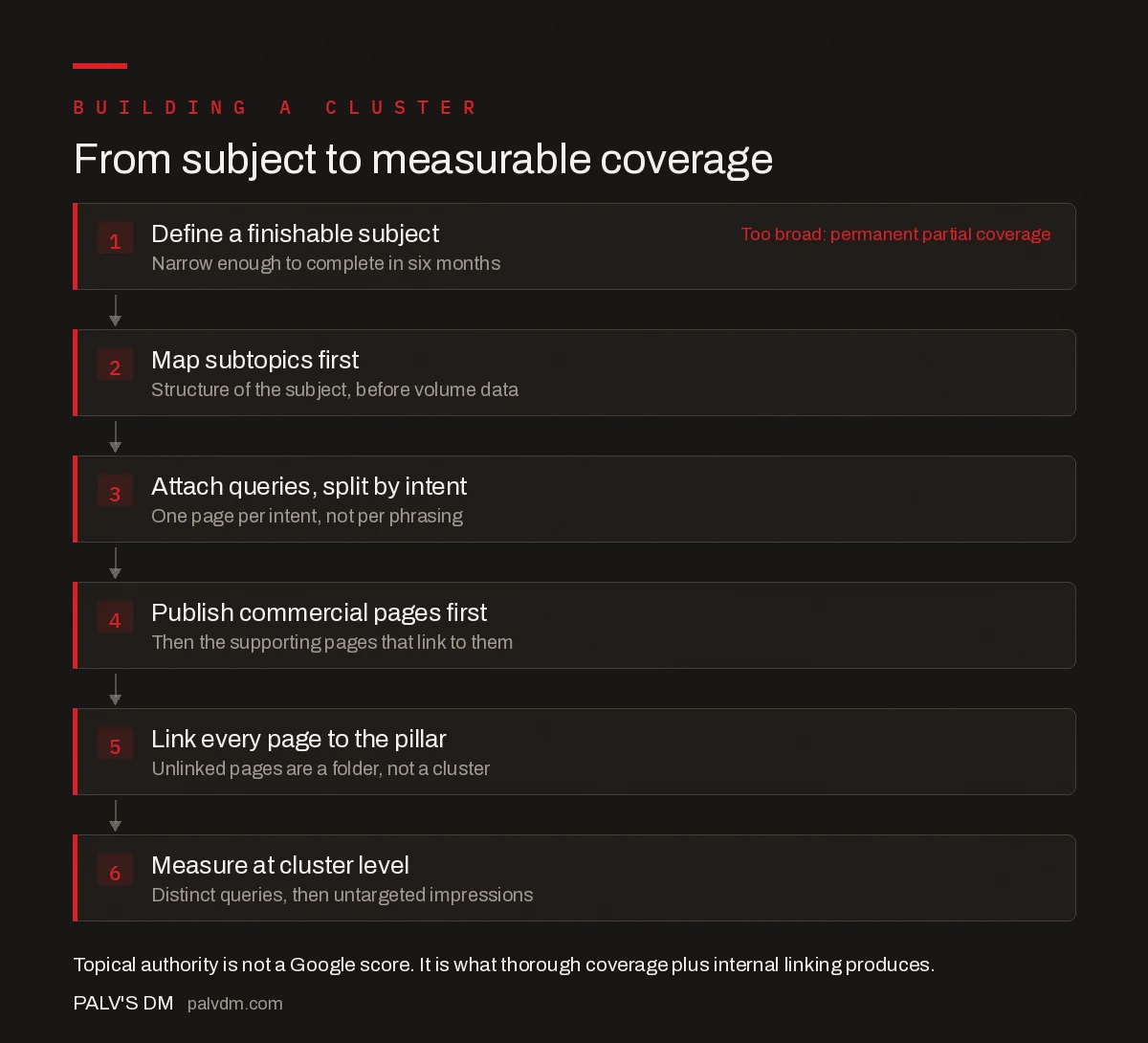
From subject to measurable coverage
- Define a finishable subject. Narrow enough to complete in six months. Too broad: permanent partial coverage
- Map subtopics first. Structure of the subject, before volume data.
- Attach queries, split by intent. One page per intent, not per phrasing.
- Publish commercial pages first. Then the supporting pages that link to them.
- Link every page to the pillar. Unlinked pages are a folder, not a cluster.
- Measure at cluster level. Distinct queries, then untargeted impressions.
Frequently asked questions
Is topical authority a Google ranking factor?
No. There is no documented Google ranking system called topical authority, no score, and no Search Console report measuring it. It is a description of an observed effect: sites covering a subject thoroughly tend to rank more easily for new pages on that subject. Google’s documented helpful content guidance asks related questions about a site’s primary purpose and depth of expertise.
How many pages do you need to build topical authority?
As many as the subject genuinely contains. Build the subtopic tree, count the nodes, and that is the cluster size — for most service businesses, between fifteen and forty pages including the pillar. Below about ten pages coverage is usually partial. Above forty, teams tend to split nodes that should have been single pages, creating near-duplicates that compete.
How long does it take to build topical authority?
Expect the first signals within four to ten weeks as the cluster starts earning impressions on more distinct queries, and the clearest evidence between months six and twelve, when new pages in the cluster reach page one faster than early pages did. A cluster abandoned at around 60% complete captures very little of the benefit.
What is the difference between topical authority and domain authority?
Domain authority is a third-party tool metric estimating overall link strength; Google does not use it. Topical authority describes subject-level coverage rather than site-wide link power. A small site covering one subject completely can outrank a large general site on that subject, which is why niche publishers often beat broad ones on specific queries.
How do you measure topical authority?
At cluster level, not page level. Filter Search Console by URL path and track four things: the number of distinct queries earning impressions across the cluster, impressions on queries you never targeted, average position across all cluster URLs rather than the best one, and how long a newly published page takes to reach the top ten compared with earlier pages.
Does publishing more content automatically build topical authority?
No. Pages that restate what already ranks add nothing and can make a site’s overall assessment worse, since Google has stated its helpful content assessment operates partly at site level. Depth means adding original evidence, first-hand experience or data others do not have, and connecting the pages with contextual internal links so the cluster functions as a structure.
Sources
- Creating helpful, reliable, people-first content — Google Search Central
- Google core updates and your website
- GEO: Generative Engine Optimization (Aggarwal et al., KDD 2024)
Want this done on your site?
Every PalV’s DM engagement starts with a free audit of your actual website — a 12-point
crawl covering what is blocking indexation, on-page gaps against your primary keywords, speed
findings, and the three to five fixes worth making first. Delivered in two working days. No
payment details, and the findings are yours whether you hire us or not.