
Entities and Semantic SEO: Writing for Meaning, Not Strings
Semantic SEO means structuring content around entities, not keyword strings. What an entity is, how Google's Knowledge Graph uses it, and how to write and structure content around it.
Semantic SEO means structuring content around entities — specific, unambiguous things like a person, product, or concept — instead of around keyword strings, because Google’s ranking systems now resolve meaning first and word-matching second. The practical shift is small to describe and large to execute: write content that clearly identifies what it’s about to a machine, not just to a human skimming for a phrase.
This page works as a reference for the whole entity and semantic SEO cluster on this site. It covers what an entity is, why it’s different from a keyword, how Google’s Knowledge Graph uses entities, and the concrete steps for writing and structuring content so it resolves correctly. Related posts on LSI keywords, author bios, and merging competing content go deeper on specific pieces of this; this page is the map.
What is an entity, and how is it different from a keyword?
A keyword is a string of characters — a word or phrase a person might type into a search box. An entity is a specific, real-world thing that string can refer to. The word “bank” is a keyword that could mean a financial institution, a river’s edge, a shot in pool, or the verb meaning to rely on something; “JPMorgan Chase & Co.” is an entity — one specific, disambiguated organisation with defined attributes (headquarters, founding date, subsidiaries) that don’t change no matter what language or phrasing describes it.
This distinction matters because search engines historically matched strings — count occurrences, match the phrase, rank accordingly. Modern systems instead try to resolve which entity a query and a page are actually about, then match on that resolved meaning. A page about “Apple” the company and a page about “apple” the fruit can both rank for very similar-looking queries once the system correctly disambiguates which entity each query intends.
How does Google’s Knowledge Graph use entities?
The Knowledge Graph is Google’s internal database connecting entities to facts about them and to other related entities — a person to their employer, a product to its manufacturer, a place to the region it’s in. When Google’s systems process a page, part of the evaluation is whether the page’s content maps cleanly onto entities already represented in that graph, and how strongly the page’s other entity mentions relate to the primary one.
A page about a specific software product benefits from also correctly naming the company that makes it, the category it belongs to, and its direct competitors or alternatives — not for keyword coverage, but because those mentions are the relationship signals that help Google confirm which specific entity the page is actually about, especially when the product name alone is ambiguous or shared with something else.
How do you write content that resolves clearly to the right entities?
Start by naming the primary entity precisely and early — in the title, the opening paragraph, and the first heading, use the full, specific name rather than a pronoun or a vague reference. “This tool,” used three paragraphs after the product name was last mentioned, is exactly the kind of ambiguity that string-matching systems handled fine and entity-resolution systems have to work harder to parse.
Cover related entities naturally: the category the primary entity belongs to, close alternatives or competitors, the organisation or person behind it, and any standard or specification it relates to. This is not about density or a target count — it’s about giving the page enough real relationship context that its subject is unambiguous even if read as an isolated excerpt, which is increasingly how AI systems and answer engines consume content.
Use consistent naming throughout a page and across a site. Referring to the same entity as “Google Search Console,” then “GSC,” then “the console,” then “Search Console” across one article isn’t wrong, but anchoring the full, correct name at least once per major section keeps the entity resolution unambiguous for a system reading passages independently of full-page context, which is exactly what large language model retrieval and snippet extraction do.
What role does structured data play?
Schema.org markup makes entity relationships explicit rather than inferred. An Article’s author property pointing to a Person entity, that Person’s worksFor pointing to an Organization, and that Organization carrying an address and URL — this is the same graph structure Google’s Knowledge Graph itself uses, expressed directly in the page’s code instead of left for the crawler to infer from prose. It doesn’t replace clear writing; it confirms what the writing already establishes, in a format a machine can parse without ambiguity.
| Signal type | What it communicates | Where it lives on the page |
|---|---|---|
| Precise, early entity naming | What the page is primarily about | Title, first paragraph, first H2 |
| Related entity coverage | The category, competitors, and relationships around the primary entity | Body sections covering context and comparison |
| Consistent naming | Removes ambiguity between mentions across sections | Repeated at section starts, not just once at the top |
| Structured data (Schema.org) | Explicit, machine-readable entity relationships | JSON-LD in the page head, not visible to readers |
| Author and organisation markup | Who is asserting the information, and their credibility signals | Person and Organization schema tied to the byline |
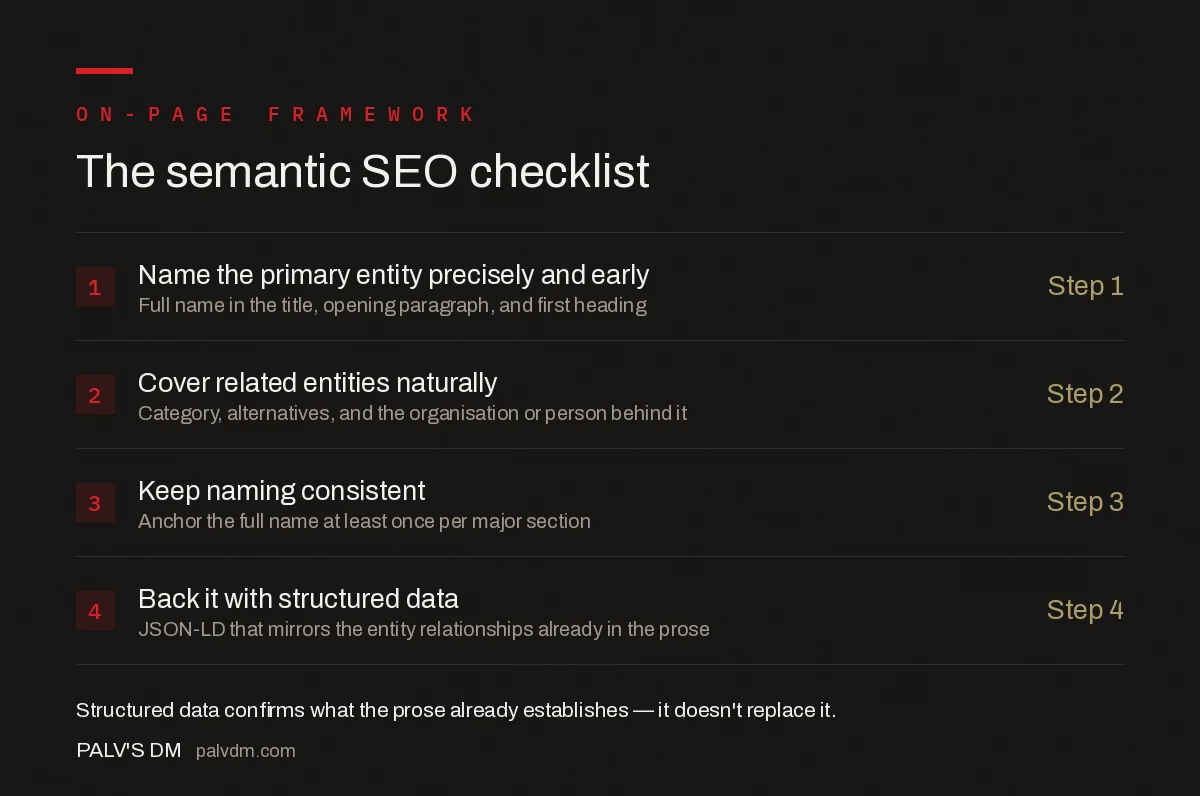
The semantic SEO checklist
- Name the primary entity precisely and early — full name in the title, opening paragraph, and first heading.
- Cover related entities naturally — category, alternatives, and the organisation or person behind it.
- Keep naming consistent — anchor the full name at least once per major section, not just at the top.
- Back it with structured data — JSON-LD that mirrors the entity relationships already established in the prose.
How does semantic SEO connect to AI visibility and answer engines?
Large language models and AI answer engines retrieve and cite passages, not whole pages, which makes entity clarity more important than it was for traditional search, not less. A passage pulled out of context still needs to unambiguously identify what it’s discussing, because the system extracting it often has no access to the rest of the page for disambiguation. This is why author bios with clear Person and Organization schema, consistent entity naming per section, and explicit relationship markup have become part of the standard on-page checklist rather than an advanced, optional tactic — they are what makes a passage independently citable.
Where does this fit in the broader on-page SEO picture?
Entity and semantic SEO is one layer of a larger on-page system that also includes title tag construction, keyword placement, internal linking, and structured FAQ and snippet formatting. None of these operate in isolation — a page with perfect entity coverage but a title tag Google keeps rewriting, or strong structured data undermined by two competing articles cannibalising the same query, still underperforms. The cluster of posts linked below covers each of those adjacent pieces in depth.
Frequently asked questions
What is an entity in SEO?
An entity is a specific, unambiguous thing — a person, place, organisation, product, or concept — that can be identified independently of the words used to describe it. Unlike a keyword, an entity has a defined identity regardless of language or phrasing.
Is semantic SEO different from keyword-based SEO?
Yes. Keyword-based SEO optimises for matching specific word strings a searcher might type. Semantic SEO optimises for the underlying meaning and entities behind those words, so a page can rank for a query even without the exact phrase, if it clearly covers the same concept.
Do I need Schema.org markup for semantic SEO?
It helps but isn’t strictly required. Structured data makes entity relationships explicit and machine-readable, which speeds up how quickly Google’s systems can confirm what your content is about, but clear, well-structured prose alone also communicates entities effectively.
How does Google’s Knowledge Graph relate to my website?
The Knowledge Graph is Google’s internal database of entities and the relationships between them. Your content doesn’t need to be “in” the Knowledge Graph to benefit from entity-based writing — the goal is writing clearly enough about known entities that Google’s systems can connect your page to them.
Does semantic SEO replace the need for keyword research?
No. Keyword research still identifies what people search for and how they phrase it. Semantic SEO changes what you do after that: instead of repeating the exact phrase, you build content around the entities and related concepts the query implies.
Sources
- SEO Starter Guide: The Basics — Google Search Central
- On-Page SEO Checklist: The Complete Guide
- LSI Keywords Do Not Exist. Here’s What People Mean Instead
- Author Bios and Bylines: Making Expertise Machine-Readable
- How to Merge Two Competing Posts Into One
Want this done on your site?
Every PalV’s DM engagement starts with a free audit of your actual website — a 12-point
crawl covering what is blocking indexation, on-page gaps against your primary keywords, speed
findings, and the three to five fixes worth making first. Delivered in two working days. No
payment details, and the findings are yours whether you hire us or not.


