How to Merge Two Competing Posts Into One
When two posts split rankings for the same intent, merging into one URL with a 301 redirect consolidates the signal. The six-step process, and how to pick which post survives.

Merging two competing posts means picking the stronger of the two, folding in whatever unique value the weaker one has, and 301 redirecting the weaker URL to the survivor — the redirect is what actually consolidates the split ranking signal, not the content edit alone. Skip the redirect and you’ve just edited one post while leaving a second, still-live URL competing with it for the same query.
This situation is common on sites that have published for years without a content audit: two posts written months or years apart, both answering close to the same question, both ranking somewhere on page two because neither one has the full authority signal to itself.
How do you know two posts should be merged, not just edited separately?
The test is intent, not just keyword overlap. Two posts can use different keywords and still compete if a searcher would be equally satisfied by either one. Pull both URLs’ performance in Search Console and check which queries they rank for — heavy overlap in the query list, especially with both pages ranking below position 10 for terms either one could own outright, is the signal that they’re splitting a single opportunity rather than serving two distinct needs.
If the overlap is only superficial — same broad topic, genuinely different angle, like a comparison post versus a step-by-step guide — merging can actually hurt by cramming two different search intents into one page that satisfies neither well. In that case, reoptimising each post around its own distinct keyword and restructuring internal links to stop them competing is the better fix.
Step 1: Confirm both posts target the same intent
Before touching either post, list the queries each one ranks for in Search Console and check the SERP for the primary shared query. If the same page types — both guides, both comparisons, both listicles — occupy the top results, that confirms the intent match. If the top results mix content types, the query itself may support two different angles, which argues against a straight merge.
Step 2: Pick the stronger post as the survivor
Compare the two posts on three signals: current organic traffic, referring domains or backlinks, and current average ranking position. The post that wins on those three, not the one that happens to be longer or more recently published, should be the URL that survives. Publish date is a weak signal on its own — an older post with years of accumulated backlinks is often the stronger foundation even if its content needs a substantial refresh.
| Signal | Why it matters for picking the survivor |
|---|---|
| Organic traffic (last 3-6 months) | Shows which URL Google currently trusts more for the query |
| Referring domains / backlinks | Link equity is expensive to rebuild; keep the URL that already has it |
| Average ranking position | A page already near page one needs less lift than one buried on page three |
| URL structure and length | Prefer the cleaner, more keyword-relevant URL when signals are close |
Step 3: Fold the weaker post’s unique value into the survivor
This is a content edit, not a copy-paste job. Read the weaker post specifically for what it covers that the survivor doesn’t — a section, an example, a data point, a subtopic entirely missing from the stronger page. Add those gaps into the survivor’s existing structure rather than appending the weaker post’s sections wholesale, which usually produces a page that repeats itself and reads like two articles stapled together.
What is the full six-step merge process?
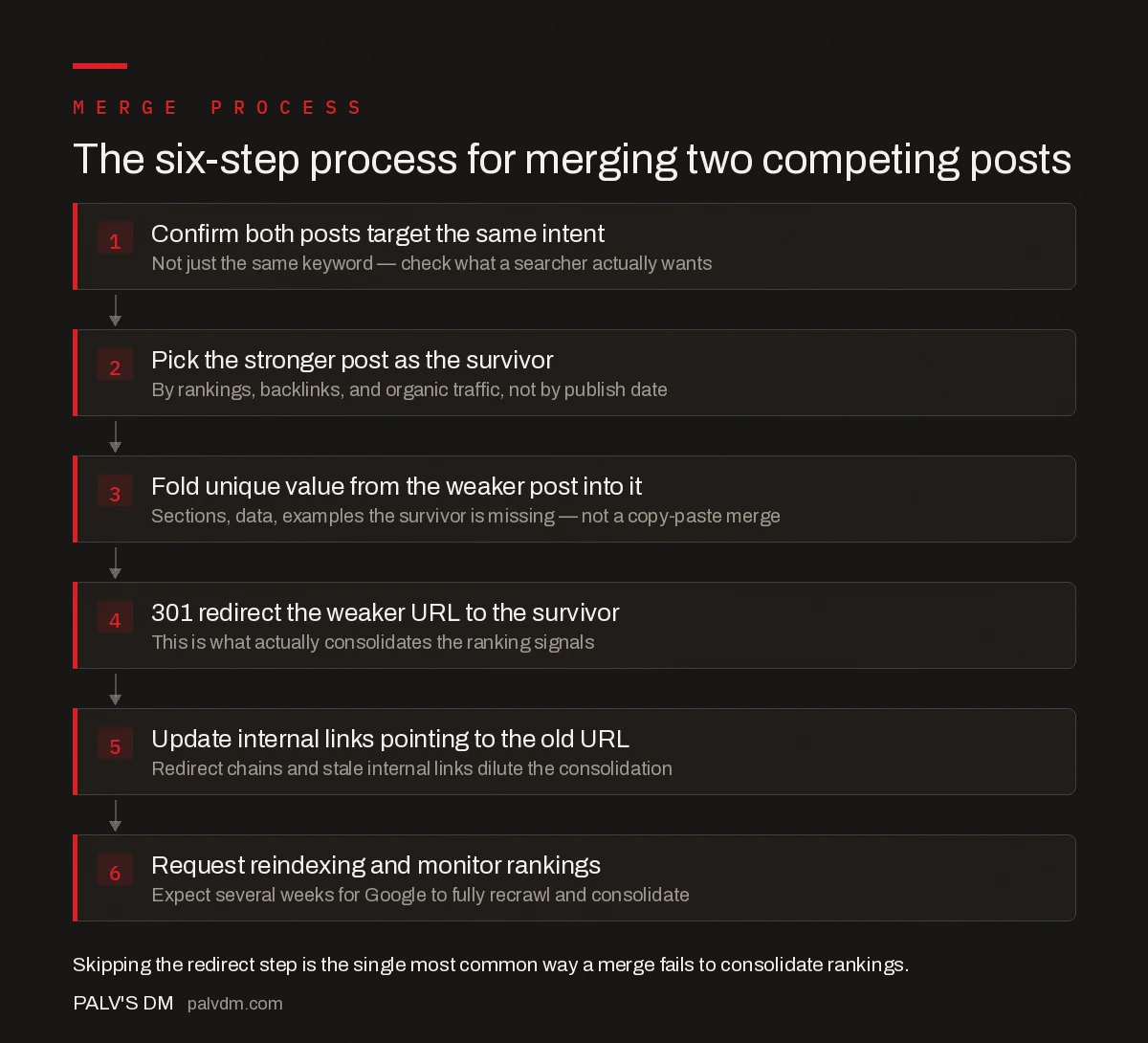
The six-step process for merging two competing posts
- Confirm both posts target the same intent — not just the same keyword, check what a searcher actually wants.
- Pick the stronger post as the survivor — by rankings, backlinks, and organic traffic, not by publish date.
- Fold unique value from the weaker post into it — sections, data, examples the survivor is missing, not a copy-paste merge.
- 301 redirect the weaker URL to the survivor — this is what actually consolidates the ranking signals.
- Update internal links pointing to the old URL — redirect chains and stale internal links dilute the consolidation.
- Request reindexing and monitor rankings — expect several weeks for Google to fully recrawl and consolidate.
Step 4: 301 redirect the weaker URL to the survivor
This is the step that actually merges the ranking signal, not the content edit. A 301 redirect tells Google the old URL’s content has permanently moved, and it consolidates the bulk of that URL’s link equity and ranking history onto the destination. Point the redirect at the specific survivor URL directly — never at the homepage or a category page, which wastes the consolidation and reads as a soft failure to Google’s crawlers.
Step 5: Update internal links that still point to the old URL
Every internal link still pointing to the retired URL now passes through a redirect instead of going straight to the live page. That’s not broken, but it’s inefficient, and on a site with many such links it can create redirect chains if the old URL gets merged again later. Update navigation menus, related-post modules, and any in-content links across the site to point directly at the survivor URL.
Step 6: Request reindexing and monitor the result
Submit the survivor URL through Search Console’s URL Inspection tool to prompt a faster recrawl, though this doesn’t guarantee an immediate reindex. Track the survivor’s rankings and traffic over the following weeks rather than days — Google needs to recrawl the redirect, process the consolidated signals, and re-rank the merged page, which realistically takes several weeks rather than being instant.
What mistakes undo the benefit of a merge?
- Merging content but skipping the redirect. Two live URLs still exist, still competing, and the merge accomplished nothing for rankings even though the content itself improved.
- Redirecting to the homepage instead of the specific survivor page. This wastes the link equity and ranking signal instead of consolidating it onto a relevant, specific URL.
- Leaving the weaker post’s URL live and unredirected “just in case.” A live duplicate defeats the entire purpose and keeps the cannibalisation problem in place.
- Not checking for other pages linking to the retired URL externally. External backlinks to the old URL still pass value through the redirect, so removing the redirect later after a “cleanup” throws that value away.
Frequently asked questions
How do I know if two posts should be merged instead of just updated separately?
Check whether they target the same search intent, not just similar keywords. If a searcher would be satisfied by either page and both currently rank for overlapping queries, merging usually helps. If they serve genuinely different intents — a comparison versus a how-to — reoptimising each around its own distinct angle is often the better fix.
Which post should I keep when merging two competing pages?
The one with stronger current rankings, more backlinks, and more organic traffic — not necessarily the newer or longer one. Check Search Console performance data and a backlink tool before deciding, since publish date and word count are weak proxies for actual ranking strength.
Do I need a 301 redirect after merging the content?
Yes, this is the step that actually consolidates ranking signals. Merging the text without redirecting the old URL leaves two live pages competing for the same query, which is the exact problem the merge was meant to fix. The 301 tells Google and users the old URL’s content now lives at the new one.
How long does it take to see ranking results after a merge?
Typically several weeks, depending on how quickly Google recrawls both URLs and processes the redirect. Some sites see movement within two to three weeks; others take longer if the merged page also needs significant new crawling due to the added content.
Sources
- How to Specify a Canonical with rel=”canonical” — Google Search Central
- On-Page SEO Checklist: Every Element That Matters
- Keyword Cannibalisation: Diagnosis and Repair
- Duplicate Title Tags and Metas Across a Large Site
- Content Pruning: Deciding What to Delete, Merge or Keep
Want this done on your site?
Every PalV’s DM engagement starts with a free audit of your actual website — a 12-point
crawl covering what is blocking indexation, on-page gaps against your primary keywords, speed
findings, and the three to five fixes worth making first. Delivered in two working days. No
payment details, and the findings are yours whether you hire us or not.