LSI Keywords Do Not Exist. Here’s What People Mean Instead
Latent Semantic Indexing was never used by Google, and John Mueller has said so directly. Here's what LSI keyword tools actually approximate, and what to do instead.

LSI keywords do not exist as an SEO concept, and Google has confirmed this directly — John Mueller has said flatly that “there’s no such thing as LSI keywords” and that anyone telling you otherwise is mistaken. Latent Semantic Indexing is a real but decades-old information-retrieval technique that was never part of Google’s ranking systems at any point. What SEO tools sell as “LSI keyword” lists are really just co-occurring terms pulled from top-ranking pages — a rough, dated proxy for something Google now handles with genuinely modern language understanding.
The term keeps circulating because it sounds technical and because the underlying advice — “cover related concepts, don’t just repeat one keyword” — happens to be correct. The label is wrong even when the instinct behind it isn’t, and that mismatch is worth untangling because it changes what you should actually do about it.
What is Latent Semantic Indexing, really?
Latent Semantic Indexing (LSI) is a mathematical technique from 1988, developed for information retrieval, that analyses relationships between terms and documents in a fixed collection using a method called singular value decomposition. It was built for small, static document sets in research contexts — nothing like the scale, size, or constant flux of the modern web. Google has never listed LSI among its ranking systems, in the “How Search Works” documentation or anywhere else, and no credible technical source claims Google uses it today.
Myth: Google ranks content higher for including “LSI keywords”
Claim: SEO tools generate lists of “LSI keywords” for a target term and recommend inserting them into content to signal topical relevance to Google.
Reality: John Mueller addressed this directly in 2019 — “There’s no such thing as LSI keywords — anyone who’s telling you otherwise is mistaken, sorry” — and again in 2023, reiterating that using such lists “has no effect.” There is no LSI scoring system in Google’s ranking pipeline for these tools to be optimising toward.
Why the confusion exists: SEO writers in the mid-2000s found the academic term “LSI” and misapplied it to describe the general practice of using semantically related words instead of repeating one exact-match keyword. The term stuck because it filled a real gap in vocabulary, even though the technical claim behind it was never accurate.
What does Google actually use to understand content meaning?
Google’s modern relevance systems rely on machine-learned language models, not a fixed-collection algebra technique from the 1980s. BERT, introduced for search in 2019, reads words in the full context of a sentence rather than as isolated tokens, letting Google understand nuances like prepositions changing a query’s meaning. The Knowledge Graph connects entities — people, places, concepts — and their relationships, letting Google recognise when a page is genuinely about a topic versus superficially mentioning it. Neither system works anything like LSI, and neither can be gamed by inserting a list of “related” words generated from term co-occurrence.
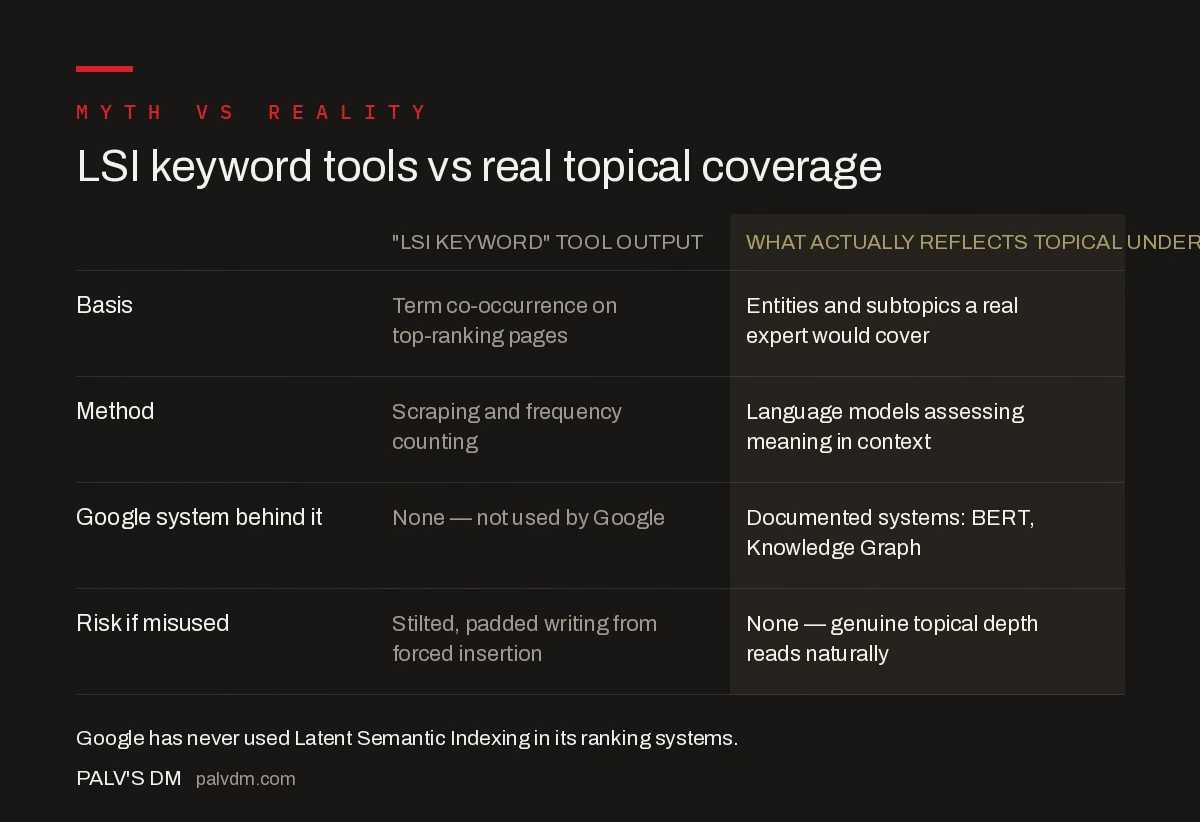
LSI keyword tools vs what actually reflects topical coverage
| “LSI keyword” tool output | What actually reflects topical understanding | |
|---|---|---|
| Basis | Term co-occurrence on top-ranking pages | Entities, subtopics, and context a real expert would cover |
| Method | Scraping and frequency counting | Language models assessing meaning in context (e.g. BERT) |
| Google system behind it | None — not used by Google | Documented systems: BERT, Knowledge Graph, passage ranking |
| Risk if misused | Stilted, padded writing from forced term insertion | None — genuine topical depth reads naturally |
The real comparison, restated
- Basis — LSI tools: term co-occurrence on ranking pages. Real signal: entities and subtopics an expert would cover.
- Method — LSI tools: scraping and frequency counting. Real signal: language models assessing meaning in context.
- Google system behind it — LSI tools: none, not used by Google. Real signal: documented systems including BERT and the Knowledge Graph.
- Risk if misused — LSI tools: stilted, padded writing from forced insertion. Real signal: none, genuine depth reads naturally.
What should you actually do instead of chasing LSI keywords?
- Read the top five ranking pages for your target query and note which subtopics, entities, and questions they cover that your draft doesn’t — this reflects real competitive coverage, not a scraped word list.
- Check “People also ask” and “Related searches” on the live SERP for the actual follow-up questions searchers have, and answer the ones that fit your page’s scope.
- Write for a knowledgeable reader first, then check afterward whether the natural vocabulary you used already covers the related terms a tool would have suggested — it usually does, because genuine expertise produces that vocabulary without effort.
- Use entity-aware structured data (schema.org markup, clear headings, consistent internal linking to related topics) to reinforce for search engines what your content is actually about.
Frequently asked questions
Did Google ever confirm using LSI keywords?
No. Google’s John Mueller has said directly, on multiple occasions including 2019 and 2023, that there is no such thing as LSI keywords and that anyone recommending them is mistaken. Latent Semantic Indexing is a 1980s information-retrieval technique, not a component of Google’s ranking systems.
So does related-term coverage in content matter at all?
Yes, but not because of LSI. Google’s modern language models, including BERT and successors, assess whether content demonstrates real topical understanding, which naturally involves covering related terms, entities, and subtopics a genuine expert would mention. The effect is real; the LSI explanation for it is not.
What should I use instead of an LSI keyword tool?
Look at what currently ranks for your target query, note the subtopics and entities those pages cover that yours doesn’t, and check Google’s “People also ask” and “Related searches” for the actual questions searchers ask around that topic. That reflects real search demand rather than a term-co-occurrence guess.
Will stuffing LSI-tool keywords into my content hurt me?
It won’t trigger a specific “LSI penalty,” because there’s no such mechanism, but forcing in a list of loosely related terms produces stilted, padded writing that reads worse to both users and Google’s language-quality assessments. The harm comes from bad writing, not a missed algorithmic checkbox.
Sources
- Google Says LSI Keywords Have No Effect — Search Engine Roundtable
- Semantic SEO and Entities: The Complete Guide
- On-Page SEO Checklist: The Complete Working List
- Author Bios and Bylines: Making Expertise Machine-Readable
- How to Write Title Tags That Google Won’t Rewrite
Want this done on your site?
Every PalV’s DM engagement starts with a free audit of your actual website — a 12-point
crawl covering what is blocking indexation, on-page gaps against your primary keywords, speed
findings, and the three to five fixes worth making first. Delivered in two working days. No
payment details, and the findings are yours whether you hire us or not.