Topic Clusters vs Keyword-Led Content: Which Structure Wins
Clusters win for informational depth, keyword-led wins for commercial and location pages. The real differences, when each applies, and how to retrofit.
Topic clusters win for informational and educational content, keyword-led pages win for transactional and location pages, and most sites need both. Neither structure is a Google ranking system — Google has never documented anything called a topic cluster — so the choice is about how a site is organised for people and for internal linking, not about triggering a hidden signal. A topic cluster organises pages by the structure of a subject, with one pillar page and a set of supporting pages linked to it. Keyword-led content organises pages by keyword list, one page per target term, with no required relationship between them.
The reason clusters usually outperform on informational subjects is unglamorous: they force internal links to exist, they prevent two pages from being written for the same intent, and they make coverage of a subject countable. Keyword-led planning does none of those things automatically, which is why it degrades into a large blog of unconnected pages after about eighteen months.
What is the actual difference between the two structures?
| Keyword-led content | Topic clusters | |
|---|---|---|
| Unit of planning | One keyword | One subject, broken into subtopics |
| Selection criterion | Search volume and difficulty | Structure of the subject, then volume |
| Relationship between pages | None required | Pillar and spokes, linked both ways |
| Internal linking | Ad hoc, often forgotten | Built into the model |
| Duplicate intent risk | High | Low, if intents are split properly |
| Coverage measurable? | No | Yes, count the mapped subtopics |
| Best suited to | Transactional, product, location pages | Informational and educational depth |
Read the “relationship between pages” row twice, because it is where the practical difference lives. In a cluster, publishing a new page automatically creates links from the pillar and from related spokes. In a keyword-led plan, the same page ships with whatever links the writer remembered to add, which on most sites is none.
Why does keyword-led content decay over time?
It rarely fails immediately. It fails at scale, and four specific problems arrive in a predictable order.
Cannibalisation. A keyword list contains phrasings of the same intent — “seo pricing”, “seo cost”, “how much does seo cost” — and treating each as a page produces near-duplicates that Google rotates between. Neither page holds a stable position, and cannibalisation is the single most common structural defect in keyword-led blogs.
Orphan pages. Pages reachable only from a paginated archive receive almost no internal links. They are crawled infrequently, understood weakly, and effectively invisible in the site’s structure.
Uneven coverage. Volume-sorted planning produces four pages on a popular subtopic and none on the unglamorous subtopic that customers actually ask about. Coverage looks busy and is full of holes.
Nothing to prune against. Without a map, there is no way to tell whether a page belongs. A content audit on a keyword-led blog becomes a subjective argument, whereas on a mapped cluster the question is simply whether the page corresponds to a node.
When is keyword-led content actually the right choice?
More often than cluster advocates admit. Keyword-led planning is correct whenever the query space is genuinely flat — that is, when queries are parallel rather than hierarchical.
- Location pages. Twenty city pages for a service business are not a hierarchy. They are twenty parallel pages, each needing genuinely distinct local content rather than a template with the place name swapped.
- Product and category pages. Ecommerce catalogues are already structured by the catalogue. Imposing an editorial cluster on top of them adds nothing.
- Comparison and alternative pages. “X vs Y” queries are discrete and commercially valuable, and each one stands alone.
- Bottom-of-funnel service pages. Pages targeting high-intent commercial queries earn their place through conversion, not through their position in an information architecture.
The honest formulation is that clusters are right when a subject has depth to be covered and wrong when a query space is simply wide. Applying clusters everywhere produces artificial pillar pages nobody needed.
How do you build a topic cluster properly?
The model is simple enough to describe in five steps, and the sequence is where most implementations go wrong.
- Map the subject before touching volume data. List the parts of the subject in the order a person encounters them, drawn from sales calls, support tickets and competitor tables of contents. Volume comes later and only reorders the queue.
- Split by intent, one page per intent. Group query variants with keyword clustering so that phrasings of one need share a page. This is the step that prevents cannibalisation before it happens rather than fixing it afterwards.
- Write the pillar to define, not to rank immediately. The pillar covers the subject broadly, links to every spoke, and typically ranks last. Judging it in month two produces the wrong conclusion, as pillar page strategy sets out.
- Publish commercial pages first, then supporting pages. Supporting pages exist partly to link at the pages that convert. Publishing thirty informational pages before the commercial page exists wastes months of internal linking.
- Link in both directions, contextually. Pillar to spoke, spoke to pillar, and spoke to spoke where genuinely relevant. Links inside sentences, not a related-posts widget — the distinction that makes internal linking work at all.
How do you convert an existing keyword-led blog into clusters?
Retrofitting is normal work and does not require deleting the archive. Four stages, in order.
Inventory and group. Export every URL with its impressions, clicks and primary query from Search Console. Assign each page to a subject and a subtopic. Pages that fit nowhere are the first question of the project, not the last.
Find the duplicate intents. Within each subject, look for pages competing on the same queries. Consolidate them into the strongest URL and redirect the others, which recovers the signals split across near-duplicates.
Identify the gaps. Subtopics with no page are the publishing queue, and they are usually a shorter list than expected because most keyword-led blogs are over-supplied at the top of the subject and empty underneath.
Prune or improve the remainder. Pages with no impressions, no links and no place in the map are candidates for merging or removal, though pruning should be a decision per page rather than a blanket rule applied to a date range.
Expect the internal linking pass to produce the earliest visible movement. It is the cheapest part of the project and the part most often skipped.
How do you tell which model your site is currently running?
Most sites believe they have clusters and actually have a keyword-led blog with a category page. Three checks settle it in about twenty minutes, and none of them require a tool.
Count contextual internal links into your five newest posts. Not navigation, not related-posts widgets, not the archive — links inside sentences on other pages. If the answer is zero or one, the site is keyword-led whatever the plan document says, and closing that gap is what internal linking at scale addresses.
Ask what the subject’s subtopics are, and whether you can list the missing ones. A cluster has a map, so gaps are nameable. A keyword-led blog has a backlog sorted by volume, so the only answer to “what is missing” is “whatever has volume and is not written yet”. That difference is the whole model.
Search your own site for your three main commercial queries. If two or more of your own pages appear for the same query, you have duplicate intents competing. On a keyword-led blog this is normal and usually widespread, particularly around long-tail phrasings of one need that were each treated as a separate target.
Failing all three checks is not a reason to rebuild the site. It is a reason to run the retrofit above, which is mostly consolidation and linking rather than new writing.
Which structure performs better in AI search?
Clusters, for a mechanical reason rather than a philosophical one. Generative engines retrieve passages rather than whole documents, and a cluster produces pages whose sections are already scoped to single questions. A keyword-led page written to cover a broad term tends to produce sections that only make sense in the context of the whole page, which is exactly the material that retrieves badly.
Depth also affects whether a source is chosen at all. Research presented at KDD 2024 found that adding statistics, quotations from named sources and citations to authoritative sources raised a source’s visibility in generative answers by up to around 40%, and complete coverage of a subject makes that kind of sourcing far easier to sustain across many pages. The connection to topical authority is direct: the same coverage that lets a site rank for new pages quickly also makes it the source an engine reaches for.
The workable answer for most businesses is a hybrid with a clear rule. Cluster the informational content, where depth compounds and internal linking does real work. Keep commercial, location and comparison pages keyword-led, where each page stands alone and conversion is the metric. Then make sure the informational cluster links into the commercial pages, because a cluster that never points at anything that earns money is a publishing habit rather than a strategy — and mapping queries to URLs before writing is what keeps both halves honest.
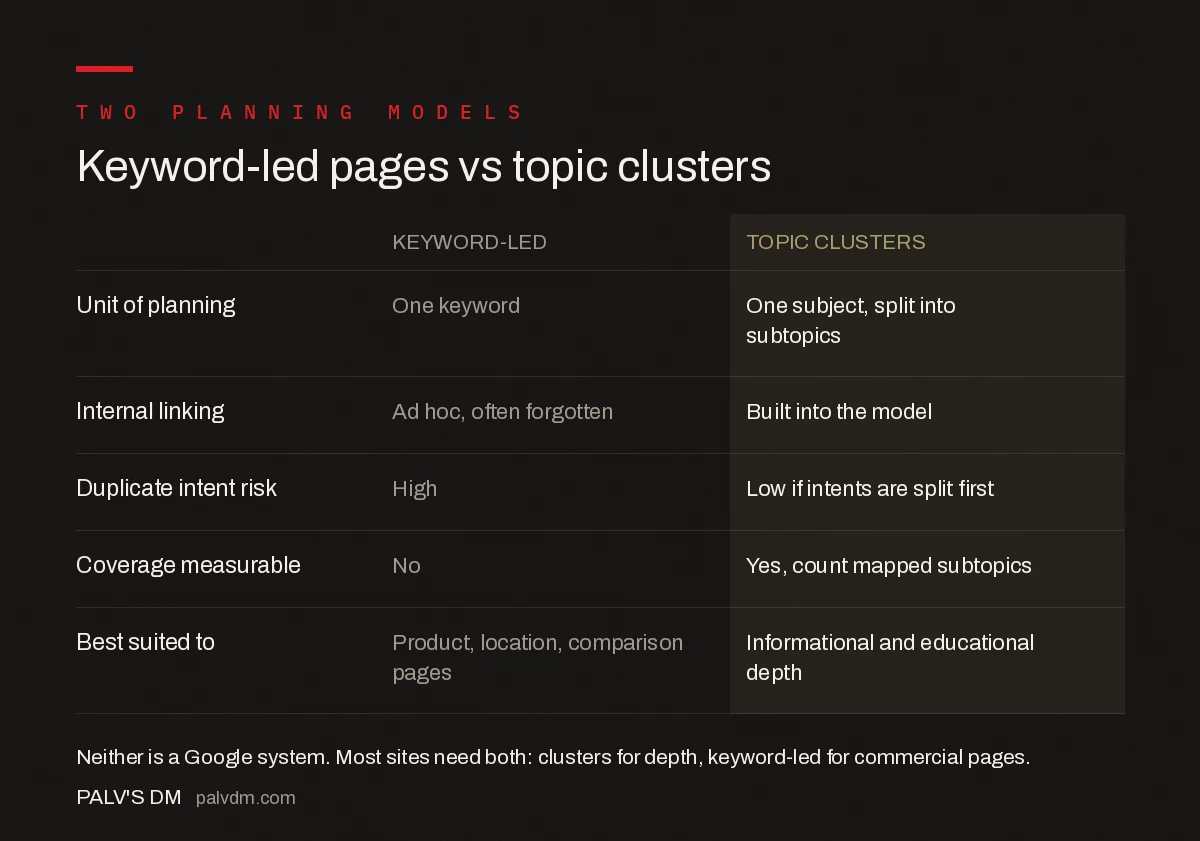
Keyword-led pages vs topic clusters
| Keyword-led | Topic clusters | |
|---|---|---|
| Unit of planning | One keyword | One subject, split into subtopics |
| Internal linking | Ad hoc, often forgotten | Built into the model |
| Duplicate intent risk | High | Low if intents are split first |
| Coverage measurable | No | Yes, count mapped subtopics |
| Best suited to | Product, location, comparison pages | Informational and educational depth |
Frequently asked questions
What is a topic cluster in SEO?
A group of pages covering one subject, made up of a pillar page that defines the subject broadly and supporting pages that go deep on individual subtopics, with contextual internal links running in both directions. It is a content planning model rather than a Google ranking system — Google has never documented anything called a topic cluster.
Are topic clusters better than keyword-led content?
For informational and educational subjects, yes, because clusters force internal links to exist, prevent two pages being written for the same intent, and make coverage countable. For transactional, product, location and comparison pages the query space is flat rather than hierarchical, and keyword-led planning is the correct approach.
Does Google reward topic clusters directly?
No. There is no documented ranking system for clusters and no signal that detects one. The benefit is indirect and mechanical: clusters produce dense contextual internal linking, prevent duplicate-intent pages competing with each other, and give complete coverage of a subject, all of which improve ranking through ordinary means rather than a hidden signal.
How many pages should a topic cluster have?
As many as the subject genuinely contains. Map the subtopics first and count the nodes — for most service businesses that lands between fifteen and forty pages including the pillar. Choosing a page count in advance and then finding subjects to fill it produces near-duplicate pages that compete with each other.
How do you convert an existing blog into topic clusters?
Export every URL with impressions, clicks and primary query from Search Console, then assign each page to a subject and subtopic. Consolidate pages competing on the same queries into the strongest URL and redirect the rest. List subtopics with no page as the publishing queue, prune what fits nowhere, and add contextual internal links throughout.
Should the pillar page be written first or last?
Write it early to define the structure, but expect it to rank last. A pillar covers a subject broadly and depends on supporting pages linking into it, so judging it after two months produces the wrong conclusion. Publish the commercial pages first, then the supporting pages that link at them, then let the pillar accumulate.
Sources
- Creating helpful, reliable, people-first content — Google Search Central
- Search Console Performance report — Search Console Help
- GEO: Generative Engine Optimization (Aggarwal et al., KDD 2024)
Want this done on your site?
Every PalV’s DM engagement starts with a free audit of your actual website — a 12-point
crawl covering what is blocking indexation, on-page gaps against your primary keywords, speed
findings, and the three to five fixes worth making first. Delivered in two working days. No
payment details, and the findings are yours whether you hire us or not.