Head, Body and Long-Tail Keywords: Where to Start and Why
Head, body and long-tail keywords compared, why new sites must start at the long-tail end, and how specific pages compound into head-term rankings later.
Head keywords are short, high-volume and broad; body keywords are two or three words with clearer intent; long-tail keywords are four words or more, specific, and individually low-volume. Almost every site should start at the long-tail end and work upwards, because long-tail queries are the only ones a site without established authority can realistically win in its first year. The reason is not that long-tail terms are easier in some abstract sense. It is that they are answerable — a query with four words states exactly what the searcher wants, so a page can satisfy it completely, and a specific page satisfying a specific query beats a general page every time.
The strategic point most articles miss: the long tail is not a consolation prize you graduate out of. It is the mechanism by which a site earns the coverage, links and internal structure that eventually make head terms winnable at all.
What are head, body and long-tail keywords?
| Head | Body | Long tail | |
|---|---|---|---|
| Typical length | 1-2 words | 2-3 words | 4+ words |
| Example | shoes | running shoes | best running shoes for flat feet under 5000 |
| Volume per term | Very high | Moderate | Low, sometimes single figures |
| Intent clarity | Unknowable | Partial | Explicit |
| Competition | Established brands | Mixed | Often weak or absent |
| Conversion rate | Low | Moderate | Highest |
| Realistic for a new site | No | Sometimes | Yes |
The single most useful column is intent clarity. Nobody knows what a person searching “shoes” wants — a shop, a definition, an image, a repair. Someone searching “best running shoes for flat feet under 5000” has told you the category, the use case, the constraint and the budget. You can write a page that answers that completely. You cannot write a page that answers “shoes” completely, which is why head terms are won by brands rather than by pages.
Why should a new site start with long-tail keywords?
Three reasons, and only the first is about difficulty.
They are winnable now. Head terms are contested by sites with years of accumulated citations. A specific four-word query is frequently contested by nobody, or by a forum post from 2019. That is a gap a well-made page closes in weeks rather than years.
They convert better. Specificity correlates with readiness. A searcher who has narrowed to a use case and a budget is further down the decision than one typing a category name, which is the practical distinction behind commercial versus informational queries.
They compound into the head term. Twenty long-tail pages on one subject produce internal links, coverage of the query space and citations that a single page chasing the head term never generates on its own. This is the mechanical basis of topical authority, and it is why the sequence matters more than the individual keyword choices.
How do you find long-tail keywords worth writing about?
Keyword tools are the worst place to start, because they report averaged volume and systematically miss queries too rare to be sampled reliably. Six better sources, in order of usefulness.
- Your own Search Console query report. Filter to queries with impressions and few or no clicks. These are phrases Google already associates with your site, where you are visible and not chosen — the fastest available wins, and closely related to striking distance keywords.
- Your sales calls and support tickets. The exact wording customers use before they buy. This is the highest-value source and almost nobody mines it.
- Google’s own suggestions. Autocomplete, People Also Ask and related searches are Google telling you what it associates with a subject, which is what makes autocomplete research worth doing systematically rather than casually.
- Community threads. Reddit, Quora and category-specific forums contain questions phrased the way people actually phrase them, and mining those threads surfaces problems no keyword tool has a row for.
- Your site search logs. What visitors typed into your own search box is unfiltered demand from people already on your site.
- Competitor gaps. Queries competitors rank for that you do not, which a gap analysis produces in an afternoon.
Should every long-tail keyword get its own page?
No, and this is where most long-tail strategies collapse into a hundred near-identical pages competing with each other.
Group by intent, not by phrasing. “Best running shoes for flat feet”, “running shoes for flat feet India” and “which running shoes suit flat feet” are three phrasings of one intent and belong on one page. Splitting them creates cannibalisation, where Google rotates between your near-duplicates and none of them establishes a stable position.
The test is simple: would a searcher using phrasing A be satisfied by a page written for phrasing B? If yes, one page. If the answer genuinely differs — “running shoes for flat feet” versus “running shoes for wide feet” — two pages. Grouping properly is what keyword clustering exists to do, and doing it before writing rather than after publishing saves a consolidation project later.
What about zero-volume keywords?
Volume figures in keyword tools are estimates derived from sampling, and terms below a threshold are commonly reported as zero regardless of whether anyone searches them. A query showing zero volume can still produce impressions in Search Console, which is directly checkable on your own site.
Zero-volume terms are worth writing when three conditions hold: the query describes a real customer problem you have heard stated aloud, the intent is commercial or close to it, and the page also serves related phrasings. In B2B and specialist categories that describes a large share of the genuinely valuable queries — the total addressable audience for a term may be forty people a year, of whom three become customers worth lakhs. Judging that page on traffic is judging it on the wrong axis, which is the argument set out in writing for zero-volume keywords.
How do long-tail pages turn into head-term rankings?
Not by magic, and not by any single page climbing. The progression is structural.
A cluster of specific pages accumulates internal links, and those links can be pointed at whichever page is meant to compete for the broader term. Coverage of the surrounding query space means the site is relevant to more of the subject rather than to one phrase. Specific pages earn citations more readily than general ones, because they are the definitive answer to something rather than the fourteenth overview of everything. And the broader page, when it is finally written, arrives supported instead of alone.
Expect the sequence rather than a date: long-tail pages moving in weeks six to ten, mid-competition body terms across months four to six, and head terms in the second half of the first year at the earliest. Writing the head-term page first inverts the order and produces a page with nothing supporting it, which is the most common reason a well-written pillar sits on page four for a year.
Do long-tail keywords still matter in AI search?
They matter more, because the input has got longer. People type keywords into a search box and sentences into an assistant. A prompt like “which running shoes suit flat feet if I run 30km a week on concrete and want to spend under 5000” is a long-tail query with the constraints made explicit rather than left implied.
That shift favours pages built for specific questions over pages built for broad categories. Generative engines retrieve passages, so a section that fully answers one narrow question is directly usable, while a general overview offers nothing quotable about any particular case. Peer-reviewed work presented at KDD 2024 found that adding statistics, quotations from named sources and citations to authoritative sources raised a source’s visibility in generative answers by up to around 40%, and specific pages are far easier to write that way than broad ones.
The practical adjustment is small: keep writing for grouped intents, but make each section self-contained enough to stand alone when lifted out of the page. That is a formatting change rather than a strategy change, and it is the overlap between long-tail keyword work and optimising for AI search.
What goes wrong with long-tail strategies?
Chasing volume instead of intent. A high-volume long-tail query with informational intent will not produce enquiries, whatever the traffic chart says.
One page per phrasing. The cannibalisation problem above, and by far the most common.
Thin pages because the term is small. A low-volume query does not license a 300-word answer. The page still has to be the best available answer, or it adds nothing beyond what already ranks — the exact question Google’s self-assessment guidance asks about substantial value.
Never revisiting the plan. Search Console will show you queries you never targeted within weeks of publishing. Those queries are the next set of pages, and a keyword plan that is not re-derived from real query data every quarter is a plan built from estimates when measurements were available.
Start where you can win, group by intent, write pages that fully answer the question, and let coverage carry you upwards. The order is the strategy — the individual keywords are just the inputs, and the wider keyword research process is what keeps that order honest.
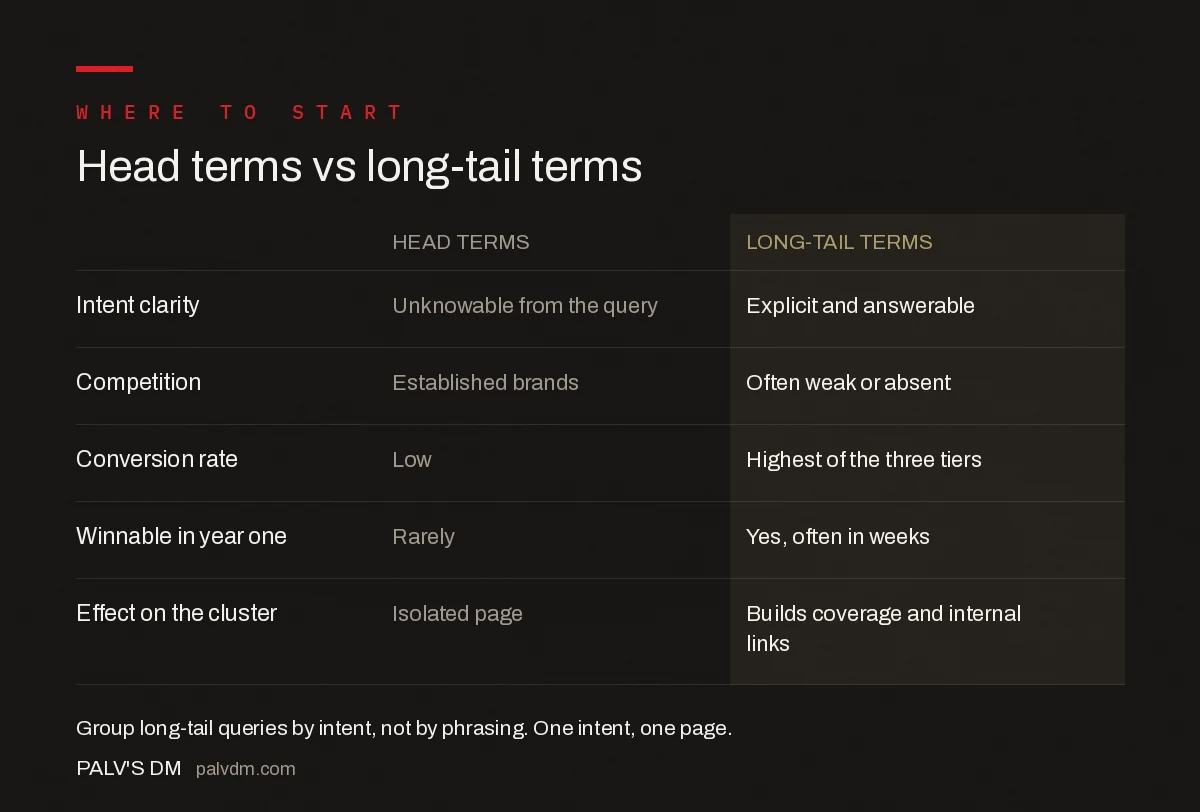
Head terms vs long-tail terms
| Head terms | Long-tail terms | |
|---|---|---|
| Intent clarity | Unknowable from the query | Explicit and answerable |
| Competition | Established brands | Often weak or absent |
| Conversion rate | Low | Highest of the three tiers |
| Winnable in year one | Rarely | Yes, often in weeks |
| Effect on the cluster | Isolated page | Builds coverage and internal links |
Frequently asked questions
What is a long-tail keyword?
A search query of roughly four words or more that states a specific need, such as “best running shoes for flat feet under 5000”. Individually these queries carry low search volume, but they have explicit intent, face far less competition than short head terms, and convert better because the searcher has already narrowed their requirement before typing it.
Are long-tail keywords easier to rank for?
Usually, though not because they are inherently easier. A four-word query states exactly what the searcher wants, so a page can answer it completely, and complete specific answers outrank general ones. Head terms are contested by sites with years of accumulated citations, while many long-tail queries are contested by nobody, or by an old forum thread.
Should each long-tail keyword have its own page?
No. Group queries by intent rather than by phrasing. Three different wordings of the same need belong on one page; splitting them creates cannibalisation, where Google rotates between near-duplicate pages and none holds a stable position. Two queries deserve two pages only when a searcher using one would not be satisfied by the other’s page.
Are zero-volume keywords worth targeting?
Often, in B2B and specialist categories. Keyword tools estimate volume from samples and report terms below a threshold as zero regardless of real demand, and such queries frequently still produce impressions in Search Console. Write them when the query describes a real customer problem, the intent is commercial, and the page also serves related phrasings.
How do long-tail keywords help you rank for competitive head terms?
A cluster of specific pages accumulates internal links that can be pointed at the page competing for the broader term, covers more of the surrounding query space, and earns citations more readily because each page is definitive about something. The head-term page then arrives supported rather than alone. Writing it first inverts the sequence.
Where do you find long-tail keywords?
Start with your own Search Console query report, filtering for impressions with few clicks. Then sales calls and support tickets for the exact wording customers use, Google autocomplete and People Also Ask, community threads on Reddit and Quora, your own site search logs, and a competitor gap analysis. Keyword tools are the weakest source for rare queries.
Sources
- Search Console Performance report — Search Console Help
- Creating helpful, reliable, people-first content — Google Search Central
- How Google Search works
- GEO: Generative Engine Optimization (Aggarwal et al., KDD 2024)
Want this done on your site?
Every PalV’s DM engagement starts with a free audit of your actual website — a 12-point
crawl covering what is blocking indexation, on-page gaps against your primary keywords, speed
findings, and the three to five fixes worth making first. Delivered in two working days. No
payment details, and the findings are yours whether you hire us or not.