March 2026 Core Update: The Information Gain Recalibration
The March 2026 core update ran 12 days and 4 hours. Google issued no new guidance. Here is what is confirmed, and what the industry invented.

The March 2026 core update began on 27 March 2026 and completed on 8 April 2026 at 06:12 PDT — 12 days and 4 hours, inside Google’s two-week estimate. It was the first broad core update of 2026 and the third confirmed Google update in roughly five weeks. Google described it in its standard terms as “a regular update designed to better surface relevant, satisfying content for searchers from all types of sites,” published no companion blog post, and issued no new guidance with either the launch or the completion notice.
That last fact is the most important one on this page, because a large amount of commentary has attached a specific mechanism to this update — that it made “information gain” the dominant ranking signal — and Google said nothing of the kind. The subtitle of this article is the industry’s name for what happened, not Google’s. It is worth being precise about which is which.
What Google actually confirmed
| Detail | Confirmed |
|---|---|
| Start | 27 March 2026 |
| Completion | 8 April 2026, 06:12 PDT |
| Total rollout | 12 days, 4 hours |
| Scope | Global, all languages and regions |
| Stated purpose | “A regular update designed to better surface relevant, satisfying content for searchers from all types of sites” |
| New guidance issued | None |
| Companion blog post | None |
That is the complete set of confirmed facts. Everything else written about this update — including everything below in the interpretation section, and including this article’s own framing — is inference from observed movement.
Where it sat in a very busy five weeks
The March core update did not land in isolation, which matters enormously for attribution. Three confirmed updates ran in close succession:
- 5–27 February 2026: the February 2026 Discover core update, 22 days, aimed exclusively at Google Discover
- 24–25 March 2026: the March 2026 spam update, under 24 hours, the fastest spam rollout on record
- 27 March – 8 April 2026: the core update
The core update began two days after the spam update finished. If your traffic moved in late March, you cannot attribute it to the core update without first separating spam enforcement, and if you are a publisher you cannot separate either without first isolating Discover from Search. Sites that read a single blended number in Search Console during that window reached confident conclusions that the data does not support.
What the industry claimed, and what stands up
Within weeks of completion, a consensus narrative formed: the March 2026 core update elevated “information gain” from one signal among many to the dominant content-quality evaluator. Specific figures circulated — pages with proprietary data or first-hand case studies gaining 15–25% visibility, templated or rewritten content dropping 30–50%, AI content farms losing 60–80%.
Here is the honest position on that.
Information gain is a real concept. Google holds a patent titled Contextual Estimation of Link Information Gain, filed in 2018. The idea is to score a document by how much genuinely new information it adds beyond what the user has already seen on the same topic. It is a sensible thing for a search engine to want.
A patent is not evidence of deployment. Google files thousands of patents it never ships. The existence of a patent tells you Google considered an idea, not that the idea is running in production, and certainly not that it was switched on in a particular month.
The percentage figures have no published methodology. They come from vendor analyses without disclosed sample sizes, keyword sets or controls. They may be directionally right. They are not measurements you should repeat as fact, and quoting them in a client report is a risk you do not need to take.
Google explicitly issued no new guidance. When Google does change what it wants from creators, it generally says so. It said nothing here.
So what can you defensibly say? That the update appeared to reward content offering something the existing results did not, and to penalise competent restatements of the current top ten. That maps cleanly onto Google’s long-standing helpful content guidance, which has asked since 2022: “Does your content provide substantial value when compared to other pages in search results?” That is a real question from Google’s own published self-assessment list, and it describes information gain without using the term.
The useful conclusion does not depend on the contested part. Whether or not a named “information gain” system shipped in March 2026, content that only paraphrases the SERP has been losing ground for years and continued to. What information gain means in practice covers how to actually build it.
What to do if the March 2026 update moved your rankings
The rollout is long finished, so any assessment you make now is on stable data. That is an advantage — most people assessed during the rollout and drew conclusions from a position that later changed.
- Use clean comparison windows. Compare a period fully before 27 March against a period fully after 8 April, of equal length. A window straddling the rollout blends two states into one meaningless average. Choosing the right comparison window covers the mechanics.
- Separate the March spam update out. If your drop began on 24 or 25 March, that is the spam update, not the core update, and the response is entirely different.
- Isolate Discover. Publishers who lost Discover traffic in this period may be looking at the February Discover update still settling, not the March core update at all.
- Segment by query cluster and template. Core updates rarely hit everything evenly. Find which page types lost and which held.
- Compare against the winners honestly. Pull the pages that gained on your lost queries and ask what they offer that yours does not. If the answer is “original data, first-hand testing, or a named expert”, you have your brief.
Note that the May 2026 core update followed six weeks later and was widely judged heavier than March. If you have not separated the two, your March analysis is probably contaminated. The 30-day recovery plan sets out a safer sequence than reacting to each rollout in turn.
The rollout length, in context
At 12 days and 4 hours, March 2026 was the shortest core rollout since December 2024. The recent series: March 2025 at 14 days, June 2025 at roughly 17, December 2025 at 18, then both 2026 updates at about 12.
The 2025 trend of lengthening rollouts reversed. Google has never explained what determines rollout duration, and anyone telling you what a shorter rollout signifies is guessing. The only practical implication is the one that always applies: do not draw conclusions until Google marks the update complete, because rankings genuinely swing mid-rollout.
Every confirmed 2026 date sits in the 2026 update timeline, and what the 2026 updates have in common looks at the through-line across all five.
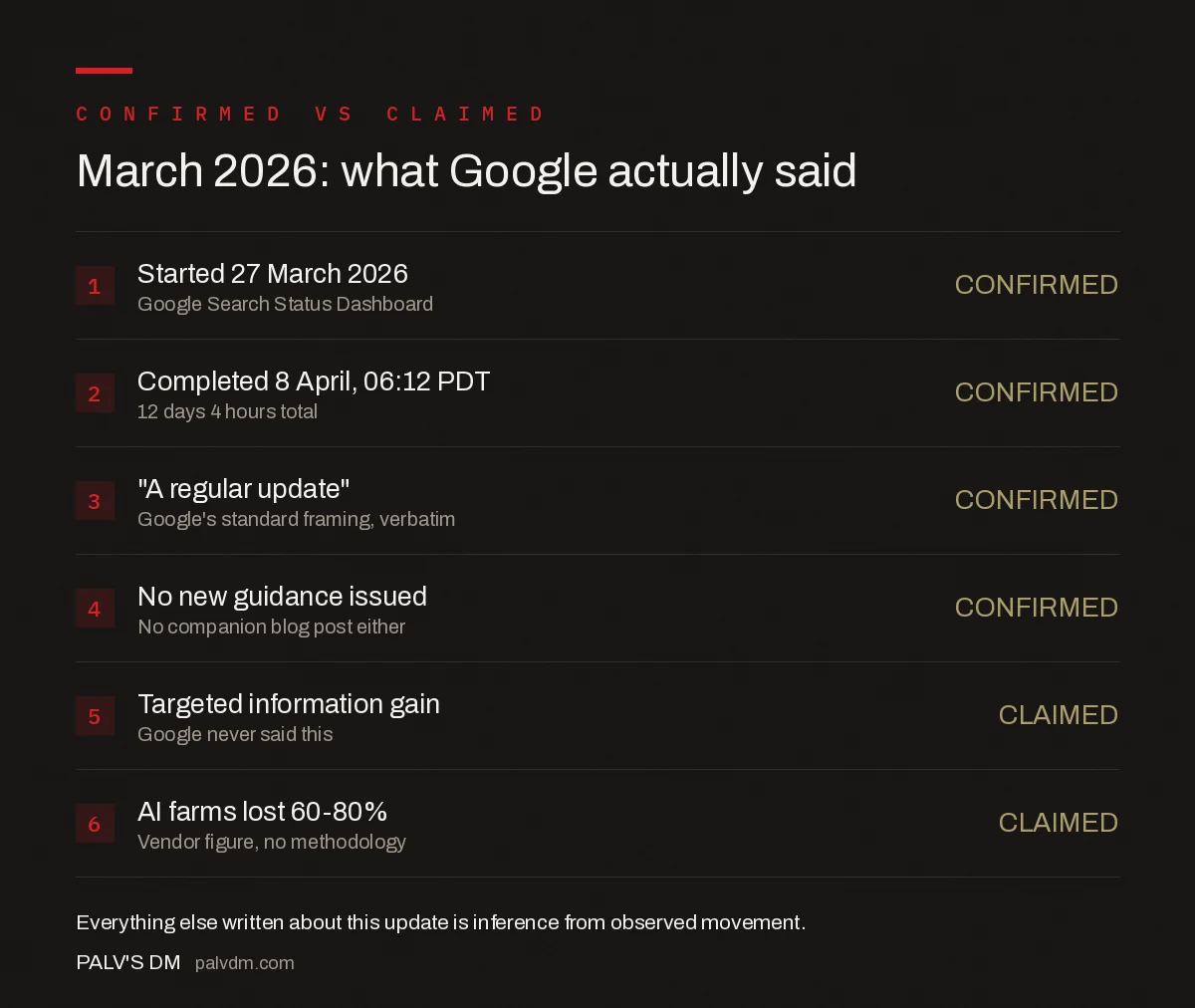
March 2026: what Google actually said
- Started 27 March 2026 — CONFIRMED. Google Search Status Dashboard.
- Completed 8 April, 06:12 PDT — CONFIRMED. 12 days 4 hours total.
- “A regular update” — CONFIRMED. Google’s standard framing, verbatim.
- No new guidance issued — CONFIRMED. No companion blog post either.
- Targeted information gain — CLAIMED. Google never said this.
- AI farms lost 60-80% — CLAIMED. Vendor figure, no methodology.
Frequently asked questions
When did the March 2026 core update start and finish?
It began on 27 March 2026 and Google confirmed completion at 06:12 PDT on 8 April 2026, a total rollout of 12 days and 4 hours. That was inside Google’s original two-week estimate and faster than the December 2025 core update, which ran 18 days.
Did the March 2026 core update target information gain?
Google never said so. It described the update in its standard terms as a regular update to better surface relevant, satisfying content, published no companion blog post, and issued no new guidance. Google does hold a patent referencing information gain, filed in 2018, but a patent is not evidence of deployment. Claims that this update made information gain the dominant ranking signal are industry interpretation, not confirmed fact.
Are the percentage figures about the March 2026 update reliable?
Treat them with caution. Figures circulating in SEO write-ups — such as proprietary data gaining 15–25% visibility or AI content farms losing 60–80% — come from vendor analyses with no published methodology, sample size or controls. They may be directionally right, but they are not measurements worth repeating as fact in a client report.
How do I separate the March 2026 core update from the March spam update?
By date. The March 2026 spam update ran 24 to 25 March, completing in under 24 hours. The core update began on 27 March, two days later. If your traffic changed on 24 or 25 March, that points to spam enforcement, which requires removing a violating practice rather than improving content quality generally.
Can I still recover from the March 2026 core update?
Yes, though recovery from a core update typically arrives with a subsequent core update rather than between them. The May 2026 core update has already run, so the next opportunity is whichever core update Google announces next. Use the interval to make substantive improvements rather than cosmetic ones, since Google states there are no specific actions that guarantee recovery.
Sources
- Google March 2026 core update rollout is now complete — Search Engine Land
- Google Search Status Dashboard
- Creating helpful, reliable, people-first content — Google Search Central
- Google core updates and your website
Want this done on your site?
Every PalV’s DM engagement starts with a free audit of your actual website — a 12-point
crawl covering what is blocking indexation, on-page gaps against your primary keywords, speed
findings, and the three to five fixes worth making first. Delivered in two working days. No
payment details, and the findings are yours whether you hire us or not.