The 2025 Google Update Timeline in Review
Google confirmed four updates in 2025: three core updates and one spam update. Every date, every duration, and the changes Google never announced.
Google confirmed four algorithm updates in 2025: core updates in March, June and December, plus a single spam update in August. That is down from seven confirmed updates in 2024 and nine in 2023, and it is the lowest count in years. Fewer confirmations did not mean a calmer year. Google has stated that it does not announce every core update and only confirms the larger, broader ones, and the biggest single shift in most sites’ reported data in 2025 was not an algorithm update at all — it was the withdrawal of the &num=100 URL parameter in September.
That gap between what Google confirmed and what actually moved is the story of 2025. If you are reconstructing why a site’s numbers changed last year, the confirmed timeline below is necessary but nowhere near sufficient on its own.
What did Google confirm in 2025?
| Update | Started | Completed | Duration |
|---|---|---|---|
| March 2025 core update | 13 Mar 2025 | 27 Mar 2025 | 14 days |
| June 2025 core update | 30 Jun 2025 | 17 Jul 2025 | ~17 days |
| August 2025 spam update | 26 Aug 2025 | 22 Sep 2025 | 27 days |
| December 2025 core update | 11 Dec 2025 | 29 Dec 2025 | 18 days |
Two patterns are worth noting before the detail. Core update rollouts lengthened across the year, from 14 days in March to 18 in December. And the one spam update of the year was the slowest spam rollout in recent memory at 27 days, which makes the contrast with 2026 — where the March spam update finished in under 24 hours — genuinely striking.
What happened in the March 2025 core update?
The March 2025 core update started on 13 March and completed on 27 March, taking 14 days. Google described it in its standard language: “a regular update designed to better surface relevant, satisfying content for searchers from all types of sites.”
Google added one sentence that it has not repeated since: that it would “continue our work to surface more content from creators through a series of improvements throughout this year”, with some already shipped and more to come. That was the closest thing to a stated direction Google gave with any 2025 update. Data providers reported volatility broadly similar to previous core updates rather than anything exceptional. The full account sits in the March 2025 core update in hindsight.
What happened in the June 2025 core update?
The June 2025 core update launched on 30 June and completed on 17 July, roughly 17 days. Google used the same “regular update” phrasing and offered no additional guidance.
Two things distinguished it. Practitioners reported partial recoveries for some sites that had been hit by the September 2023 helpful content update and by earlier core updates — the first widely reported recoveries of that kind in a long while. And volatility spiked hard between 11 and 14 July, late in the rollout, which caught out anyone who had already concluded the update was finished with them. What moved in the June 2025 core update goes through the detail.
What happened in the August 2025 spam update?
The August 2025 spam update began on 26 August and was marked complete on 22 September, running 27 days — just under four weeks. Google called it “a normal spam update” rolling out “for all languages and locations”, and announced no new spam policies alongside it.
The impact profile was unusual for its length. Sites that were hit saw effects within roughly 24 hours of launch rather than gradually across the four weeks, and then the update visibly reintensified around 9 September, with fresh ranking fluctuation and indexing reports. Some sites penalised by earlier spam updates recovered significantly. The August 2025 spam update and its long rollout covers what that shape means for diagnosis.
What happened in the December 2025 core update?
The December 2025 core update ran from 11 December to 29 December, taking 18 days and closing the year. Google again used the “regular update” wording with no new guidance.
The volatility pattern was distinctive: relatively calm on weekdays with two large spikes, both landing on Saturdays — 13 December and 20 December. It was also the longest core update rollout of 2025 and, at 18 days, longer than either 2026 core update that followed it. The December 2025 core update sets out the dates and the shape.
What moved in 2025 that was not an algorithm update?
This is where most 2025 diagnoses go wrong. Several changes with large measurable effects were never confirmed updates:
- The
&num=100withdrawal, around 12 September. Google stopped serving 100 results per request. Rank trackers broke, and scraper-generated impressions vanished from Search Console — 87.7% of properties in one 319-site analysis saw impressions fall. How the num=100 removal broke rank tracking explains the mechanism, and why impression counts fell off a cliff covers the reporting fallout. - AI Mode rolling out and expanding. Google launched AI Mode to all US users during 2025 and extended it to more countries through the year, changing what a results page looks like for a growing share of queries.
- A ranking change for explicit video content in June. Google documented that pages whose embedded video files cannot be fetched may be demoted or filtered where its systems judge the page may contain explicit content.
- Two Google bugs. A short-lived serving issue in June where new content was not appearing, and a crawling bug in August that took Google several days to resolve.
Any of those could produce a chart that looks exactly like a core update hit. Only one of them is even mentioned in Google’s official update record.
How does 2025 compare with 2024 and 2026?
The count of confirmed Google updates has fallen steadily for four years. Search Engine Land’s year-end tallies put it at ten confirmed updates in each of 2021 and 2022, nine in 2023, seven in 2024, and four in 2025.
| Year | Confirmed updates | Longest rollout |
|---|---|---|
| 2023 | 9 | — |
| 2024 | 7 | March 2024 core update, ~45 days |
| 2025 | 4 | August 2025 spam update, 27 days |
| 2026 to date | 5 | February 2026 Discover core update, 22 days |
The rollout lengths tell a different story from the counts. The March 2024 core update took around 45 days from 5 March to 19 April 2024 — more than double any 2025 rollout. By contrast, both 2026 core updates completed in 12 days, and the March 2026 spam update finished in under 24 hours, the fastest spam rollout on record against 27 days for the August 2025 equivalent.
Google has never explained why rollout duration varies, so any account of what a long or short rollout signifies is speculation. What the series does support is a practical rule: a rollout that is still running is not a result. Rankings genuinely swing mid-rollout, and 2025 provided two clear demonstrations — the June core update spiking between 11 and 14 July, days before completion, and the August spam update reintensifying around 9 September, a fortnight after launch.
Why did Google confirm so few updates in 2025?
Four confirmed updates, against seven in 2024 and nine in 2023, is a steep drop — and it came after Google had signalled that site owners should expect core updates more often, not less.
The reconciliation Google itself offered is that it releases smaller core updates it does not announce, and only confirms the larger, broader ones. That is a meaningful admission, because it means the absence of a dashboard entry is not evidence that nothing shipped. It also means volatility trackers and dashboard confirmations are answering different questions, which is the core of confirmed versus unconfirmed updates.
The practical consequence: stop treating “was there an update?” as a yes-or-no question with an authoritative answer. Google’s Search Status Dashboard tells you when Google chose to announce something. It does not tell you when Google changed something.
How should you use the 2025 timeline?
- Match your drop to a date range, not a month. “We fell in June” is not a diagnosis when the June 2025 core update did not start until 30 June. Half of June predates it entirely.
- Check whether September 2025 sits inside your comparison window. If it does, impressions and average position are not comparable across it, and clicks are.
- Rule out your own changes first. Deployments, migrations and plugin updates cause more traffic drops than algorithm updates do. Work through whether it was an update or you before anything else.
- Compare 2025 with what followed. The 2026 rollouts have been notably shorter — 12 days each for the March and May core updates. The 2026 update timeline shows the contrast, and rollout duration across every core update puts both years in a longer series.
- Treat recovery as a next-update event. Google’s standing guidance is that the largest changes tend to arrive with a subsequent core update, not between them. What a core update actually is explains why that follows from the mechanism rather than being a brush-off.
The most useful thing 2025 offers a site owner in 2026 is a caution: the year’s four confirmed updates are a partial record of a year in which a great deal moved. Diagnose from your own data first, use the confirmed timeline to check the dates, and treat everything a volatility tracker tells you as a prompt to investigate rather than a conclusion.
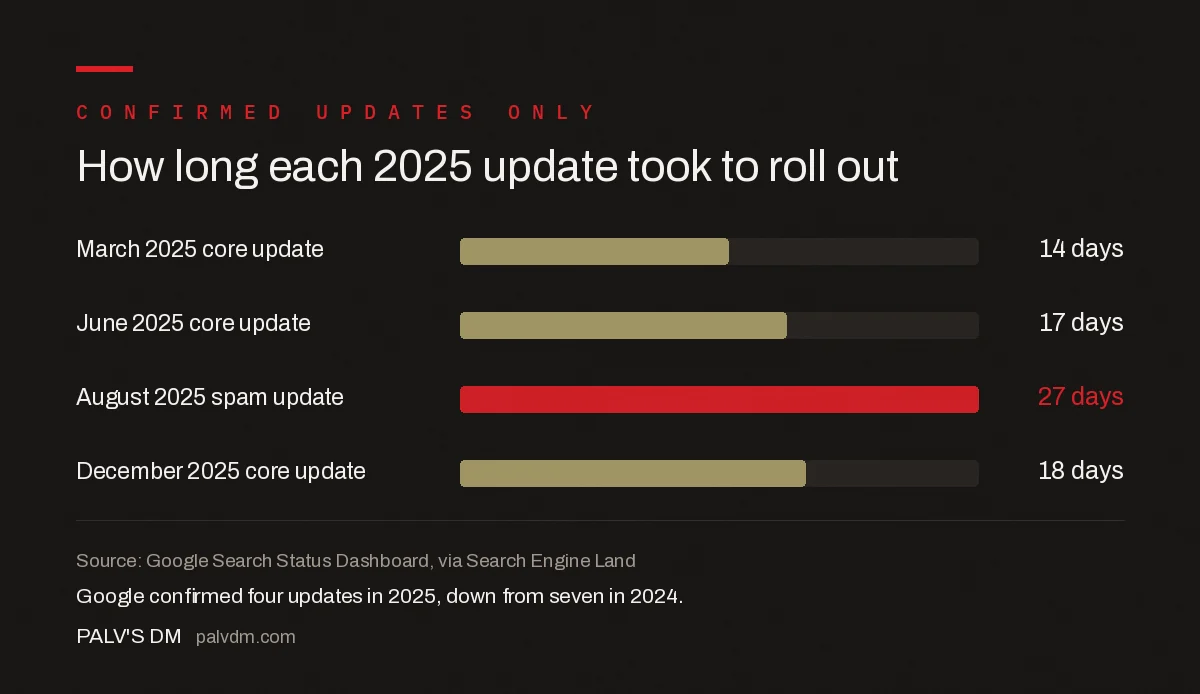
How long each 2025 update took to roll out
| Metric | Value |
|---|---|
| March 2025 core update | 14 days |
| June 2025 core update | 17 days |
| August 2025 spam update | 27 days |
| December 2025 core update | 18 days |
Source: Google Search Status Dashboard, via Search Engine Land
Frequently asked questions
How many Google algorithm updates were there in 2025?
Google confirmed four algorithm updates in 2025: core updates in March, June and December, and one spam update in August. That is fewer than the seven confirmed in 2024 and the nine in 2023. Google has said it releases smaller core updates that it does not announce, so the confirmed count is not the total number of changes that shipped.
What were the dates of the 2025 Google core updates?
The March 2025 core update ran from 13 March to 27 March, taking 14 days. The June 2025 core update ran from 30 June to 17 July, roughly 17 days. The December 2025 core update ran from 11 December to 29 December, taking 18 days. All three were confirmed on Google’s Search Status Dashboard.
How long did the August 2025 spam update take?
The August 2025 spam update started on 26 August 2025 and was marked complete on 22 September 2025, running 27 days. It was the only spam update Google confirmed in 2025. Sites affected typically saw the impact within about 24 hours of launch, and the update visibly reintensified around 9 September before completing.
Did Google announce any new guidance with the 2025 updates?
Very little. All three core updates used Google’s standard description of a regular update designed to better surface relevant, satisfying content from all types of sites. The March 2025 announcement added that Google would continue work to surface more content from creators through improvements across the year. The August spam update was described simply as a normal spam update.
Why did my traffic change in 2025 when no update was running?
Several non-update changes moved data in 2025. The biggest was Google withdrawing the num=100 URL parameter around 12 September, which removed scraper-generated impressions from Search Console and broke rank-tracking tools. Google also had a serving issue in June and a crawling bug in August, and AI Mode expanded to more users and countries through the year.
Were there fewer Google updates in 2025 than in 2024?
There were fewer confirmed updates: four in 2025 against seven in 2024. Google has stated that it does not announce every core update and only confirms the larger, broader ones, so a lower confirmation count is not evidence of fewer changes. Third-party trackers recorded substantial ranking volatility throughout 2025 outside the confirmed windows.
Sources
- Google algorithm updates 2025 in review: 3 core updates and 1 spam update — Search Engine Land
- Google Search Status Dashboard
- Google core updates and your website — Search Central
- 77% of sites lost keyword visibility after Google removed num=100: Data — Search Engine Land
Want this done on your site?
Every PalV’s DM engagement starts with a free audit of your actual website — a 12-point
crawl covering what is blocking indexation, on-page gaps against your primary keywords, speed
findings, and the three to five fixes worth making first. Delivered in two working days. No
payment details, and the findings are yours whether you hire us or not.