June 2025 Core Update: What Moved
The June 2025 core update ran 30 June to 17 July, roughly 17 days. The dates, the late volatility spike, and the recoveries practitioners reported.

The June 2025 core update started rolling out on 30 June 2025 and Google marked it complete on 17 July 2025, a rollout of roughly 17 days. Google described it in its usual terms — “a regular update designed to better surface relevant, satisfying content for searchers from all types of sites” — and issued no new guidance with it. Its two distinguishing features were both about timing rather than targeting: the heaviest volatility arrived between 11 and 14 July, late in the rollout, and practitioners reported the first widely discussed partial recoveries from the September 2023 helpful content update.
The late spike is the detail worth carrying forward. Anyone who assessed their position on 5 July, concluded the update had passed them by, and moved on was reading a state that changed substantially in the following week. Mid-rollout readings of a core update are not results.
What did Google say about the June 2025 core update?
Google announced the update on its Search Status Dashboard on 30 June 2025 with the standard description: “This is a regular update designed to better surface relevant, satisfying content for searchers from all types of sites.”
That is the same sentence Google used for the March 2025 core update, the December 2025 core update, and both 2026 core updates. No new documentation was published, no ranking system was named, and no advice was offered beyond Google’s standing guidance on core updates. Anyone who told you the June 2025 core update “targeted” a particular content type or signal was extrapolating from third-party volatility data, not quoting Google.
This matters because the absence of guidance is itself a consistent pattern across recent core updates, and it shapes what a sensible response looks like. If Google names nothing, there is nothing specific to undo — which is exactly why core updates are not penalties in any operational sense.
How long did the June 2025 core update take?
Seventeen days, from 30 June to 17 July 2025. Google’s usual estimate for a core update is up to two weeks, so this one ran past its own guidance — as several have.
| Core update | Started | Completed | Days |
|---|---|---|---|
| March 2025 | 13 Mar 2025 | 27 Mar 2025 | 14 |
| June 2025 | 30 Jun 2025 | 17 Jul 2025 | ~17 |
| December 2025 | 11 Dec 2025 | 29 Dec 2025 | 18 |
| March 2026 | 27 Mar 2026 | 8 Apr 2026 | 12 |
| May 2026 | 21 May 2026 | 2 Jun 2026 | ~12 |
Read across the series and 2025 shows a lengthening trend — 14, then roughly 17, then 18 days — which reversed in 2026 at 12 days for both core updates. Google has never explained why rollout durations vary, so the pattern is worth knowing and not worth interpreting. Rollout duration across the full core update series sets out the longer record, including the March 2024 core update that ran around 45 days.
Why did volatility spike between 11 and 14 July?
Because core updates do not deploy evenly. Google rolls changes out across data centres, locales and query types over the announced window, and the resulting movement arrives in bursts rather than a smooth curve.
In the June 2025 rollout, the heaviest reported volatility landed on 11 to 14 July — days 12 to 15 of a 17-day rollout, over a weekend. Data providers characterised the update overall as a substantial one. Sites that had looked stable through the first ten days moved sharply in the final week.
Two practical rules follow, and both apply to every core update rather than just this one:
- Do not assess until Google marks the rollout complete. Comparing a period that straddles the rollout to one that does not produces a meaningless blend. Use equal-length windows that both sit fully outside the rollout dates.
- Do not make sweeping changes during a rollout. You will be optimising against a moving target, and afterwards you will not be able to attribute any change to anything you did. The safer sequence is set out in the 30-day recovery plan.
If Google published no new guidance, what were sites meant to do?
Google’s answer to that question has not changed across any recent core update, including June 2025: there are no specific actions that guarantee recovery, a drop does not necessarily mean anything is wrong with your pages, and site owners should work through the self-assessment questions in Google’s helpful content documentation.
Those questions are organised around three axes, and they are more searching than they first appear. Who produced the content — is there a named author with relevant expertise, and can a reader verify it? How was it produced — was it researched first-hand, or assembled from what already ranked? Why does it exist — was it written to help someone, or to occupy a keyword?
Content published under no byline cannot answer the first. Content assembled at volume to fill a content-map gap struggles to answer the third honestly. Google also asks, in the same list, whether your content “provides substantial value when compared to other pages in search results” — which is the closest thing in official documentation to the idea that a page has to add something the existing results do not. That idea is often described in the industry as information gain, a useful description of what recent core updates appear to reward rather than a confirmed named ranking system.
The uncomfortable implication is that the work is editorial, not technical. There is no setting to change. What a core update actually is explains why that follows from the mechanism.
What were the reported recoveries?
During and after the June 2025 rollout, practitioners reported partial recoveries for some sites that had been hit by the September 2023 helpful content update and by subsequent core updates. These were the first such recoveries to be widely discussed after nearly two years in which sites hit by the helpful content system saw very little movement.
Two cautions belong with that. First, these are practitioner reports of individual sites, not a measured study, and no published methodology sits behind them. Second, partial is the operative word: the reports described recovery of some visibility, not restoration to previous levels.
What they do support is Google’s own standing statement about recovery timing — that sites may see some movement between core updates but the largest changes tend to arrive with a subsequent core update. A site hit in 2023 that improved substantially through 2024 and 2025 would, on that model, expect its recovery to surface at a core update rather than gradually. When recovery actually arrives after a core update covers what that means for planning.
How does June 2025 fit the wider picture?
It sat between the March 2025 core update, which ran 13 to 27 March, and the August 2025 spam update, which ran 26 August to 22 September. The December 2025 core update closed the year from 11 to 29 December.
Four confirmed updates across the whole year — three core, one spam — is the fewest Google has confirmed in years, down from seven in 2024. The full record is in the 2025 update timeline, and it includes a warning worth repeating: Google has said it releases smaller core updates it does not announce. The absence of a dashboard entry is not evidence that nothing shipped.
One further complication for anyone reconstructing 2025 from data. In September 2025 Google withdrew the &num=100 URL parameter, which removed a large volume of rank-tracker impressions from Search Console across nearly every site. If your analysis of the June 2025 core update compares a pre-June window with a post-September window, impressions and average position are not comparable across that boundary. Clicks are.
What should you do if the June 2025 core update hit you and you never recovered?
- Confirm the dates fit. A decline beginning before 30 June 2025 is not this update. A decline beginning on 12 July very plausibly is.
- Check Search Console for a manual action. Security and Manual Actions. Thirty seconds, and it eliminates the possibility people fear most.
- Identify what lost, not just that you lost. Segment by URL, query cluster, device and country. A core update loss almost always has a pattern — a content type, a template, a topic — and the pattern is the diagnosis.
- Compare the losing pages against the pages that gained. Ask what those pages offer that yours does not. Usually the answer is specificity: first-hand experience, real numbers, or a named author with relevant credentials rather than a competent restatement of the existing top ten.
- Rule out yourself. Deployments, migrations, plugin changes and robots.txt edits cause more traffic losses than core updates do. Was it an update or was it you walks the sequence.
- Set the horizon at the next core update. Google’s guidance is explicit that there are no specific actions guaranteeing recovery and that the largest changes tend to follow a subsequent core update. Since June 2025 there have been three: December 2025, March 2026 and May 2026, all listed in the 2026 update timeline.
The most useful thing about the June 2025 core update, eighteen months on, is the shape of it. A 17-day rollout whose biggest movement came in the final week is a standing argument against reacting quickly to a core update. What you measure on day five is not the outcome.
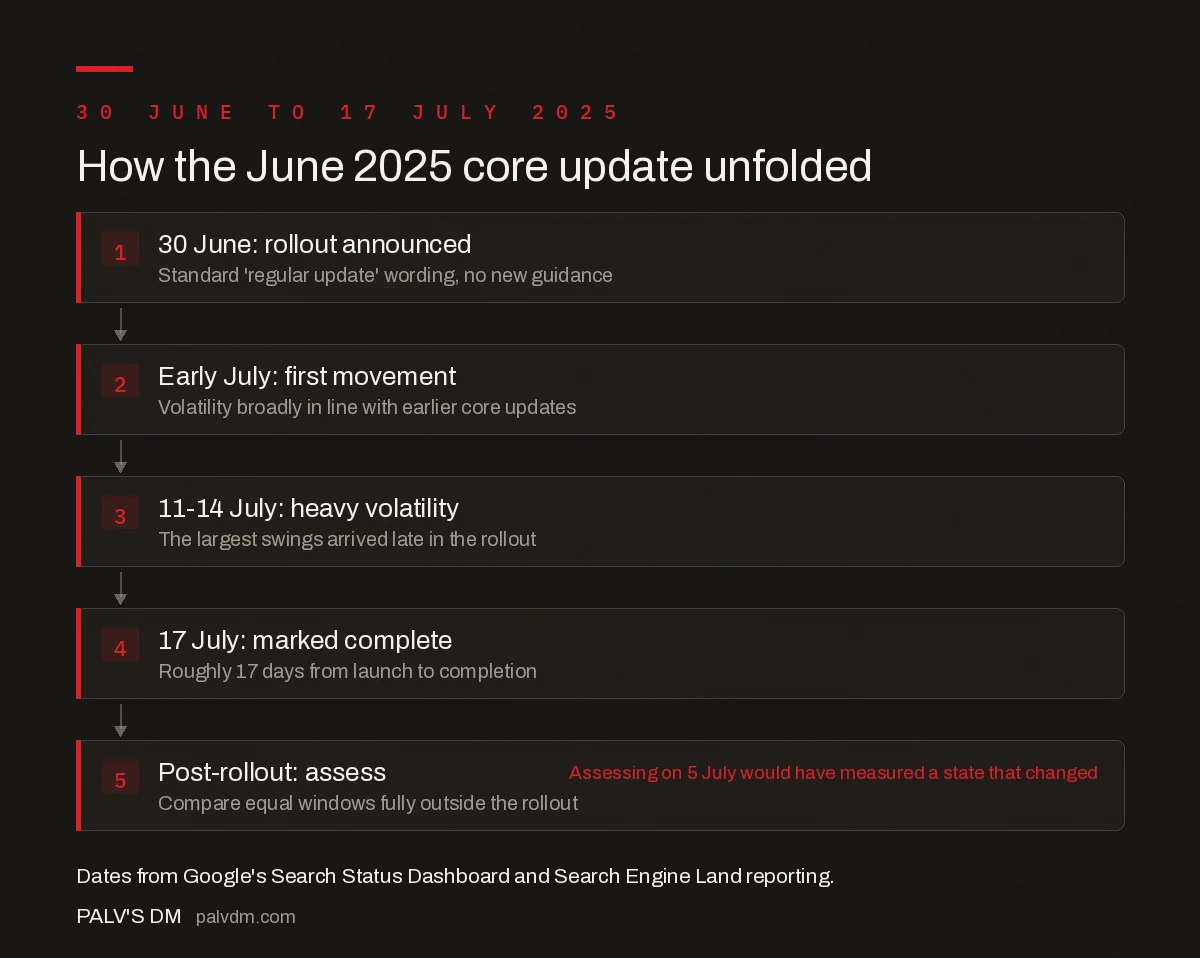
How the June 2025 core update unfolded
- 30 June: rollout announced. Standard ‘regular update’ wording, no new guidance.
- Early July: first movement. Volatility broadly in line with earlier core updates.
- 11-14 July: heavy volatility. The largest swings arrived late in the rollout.
- 17 July: marked complete. Roughly 17 days from launch to completion.
- Post-rollout: assess. Compare equal windows fully outside the rollout. Assessing on 5 July would have measured a state that changed
Frequently asked questions
When was the June 2025 Google core update?
The June 2025 core update started rolling out on 30 June 2025 and Google marked it complete on 17 July 2025, a rollout of roughly 17 days. It was announced on Google’s Search Status Dashboard, which is the only authoritative confirmation that a core update is running, and it was the second of three core updates Google confirmed in 2025.
What did the June 2025 core update target?
Google named no target. It described the update in its standard language as a regular update designed to better surface relevant, satisfying content for searchers from all types of sites, and published no new guidance alongside it. Any claim that the update focused on a specific content type or ranking signal is third-party interpretation rather than a Google statement.
Why did rankings move so much in mid-July 2025?
The heaviest volatility of the June 2025 core update was reported between 11 and 14 July, days 12 to 15 of a 17-day rollout. Core updates deploy unevenly across data centres, locales and query types, so movement arrives in bursts. Sites that appeared stable through the first ten days of that rollout moved sharply in the final week.
Did any sites recover during the June 2025 core update?
Practitioners reported partial recoveries for some sites hit by the September 2023 helpful content update and by earlier core updates. These were individual reports rather than a measured study, and the recoveries described were partial rather than full. They are consistent with Google’s guidance that the largest changes tend to arrive with a subsequent core update.
How long do Google core updates usually take?
Google typically estimates up to two weeks, and the record varies more than that suggests. The March 2025 core update took 14 days, June 2025 roughly 17, and December 2025 took 18. Both 2026 core updates completed in 12 days. Google has never explained why rollout durations vary, so the pattern is worth knowing and not worth interpreting.
What should I do if I lost rankings in the June 2025 core update?
Confirm the decline began on or after 30 June 2025, check Search Console for a manual action, then segment the loss by URL, query cluster, device and country to find the pattern. Compare your losing pages honestly against pages that gained. Rule out your own deployments and migrations, which cause more traffic drops than core updates do.
Sources
- Google June 2025 core update rolling out now — Search Engine Land
- Google June 2025 core update rollout is now complete — Search Engine Land
- Google core updates and your website — Search Central
- Google Search Status Dashboard
Want this done on your site?
Every PalV’s DM engagement starts with a free audit of your actual website — a 12-point
crawl covering what is blocking indexation, on-page gaps against your primary keywords, speed
findings, and the three to five fixes worth making first. Delivered in two working days. No
payment details, and the findings are yours whether you hire us or not.