August 2025 Spam Update: The Long Rollout
The August 2025 spam update ran 26 August to 22 September, 27 days. What Google said, why it hit within a day, and how to tell it from a core update.
The August 2025 spam update began on 26 August 2025 and was marked complete on 22 September 2025, running 27 days — just under four weeks, and the longest spam rollout in recent memory. It was the only spam update Google confirmed in the whole of 2025. Google described it as “a normal spam update” that would “roll out for all languages and locations”, and announced no new spam policies alongside it. That combination — a very long rollout enforcing existing rules — is what made it hard to read at the time.
The length is also misleading in a specific way. Sites that were hit generally saw the impact within about 24 hours of launch, not spread across the four weeks. A long rollout window does not mean a gradual effect, and treating those two things as the same thing led a lot of site owners to wait for a decline that had already fully landed.
What did Google say about the August 2025 spam update?
Very little, and deliberately so. Google posted the update to its Search Status Dashboard on 26 August 2025 with the standard description: a normal spam update rolling out for all languages and locations. There was no accompanying blog post explaining a change of policy, no new spam policy documentation, and no named target such as expired-domain abuse or site reputation abuse.
That absence is informative rather than empty. A spam update with no new policy is an enforcement update: Google pushing an improved version of the systems that detect practices already listed in its published spam policies. If you were affected, the relevant question is not “what new rule did Google make” but “which existing rule do my pages match”.
Why did a 27-day rollout hit within 24 hours?
Because rollout duration and impact timing are different things. The dashboard window records how long Google takes to finish deploying a change across its systems and locales. It does not describe how gradually the effect reaches any individual site.
With the August 2025 spam update, the pattern reported across the industry was fast and hard: affected sites saw results within roughly a day of launch. Then the update visibly reintensified around 9 September, two weeks in, with a fresh round of ranking fluctuations and indexing reports. So the shape was two pulses inside a long window, not a steady slope.
Practically, that means two things. If you were untouched in the first week you were not necessarily safe, because of the September pulse. And if you dropped on day two, waiting three weeks “to see whether it settles” was not a diagnosis — it was three lost weeks. The general rule that you should not draw conclusions mid-rollout applies most strongly to core updates, where positions genuinely swing throughout. Spam enforcement tends to arrive and stay.
What does a spam update actually enforce?
Google publishes its spam policies for Google web search, and a spam update enforces those policies algorithmically. The named practices include cloaking, doorway pages, scraped content, hidden text, link spam and paid links, expired-domain abuse, scaled content abuse, and site reputation abuse.
The distinction that matters is this: a spam update is enforcement against something you did, while a core update is a reassessment of everyone. Being hit by a spam update means something on your site matched a published policy. That is a materially better position to be in than a core update loss, because there is a concrete thing to identify and remove — the full mechanics are in core update versus spam update versus manual action.
Two of the named policies deserve particular attention for anyone publishing at volume. Scaled content abuse covers generating many pages primarily to manipulate rankings rather than to help people, and Google’s policy is explicit that it applies regardless of whether the pages were produced by automation, by humans, or by a combination of the two. Site reputation abuse covers third-party content published on a site largely because of that site’s ranking signals rather than because it serves the site’s own audience — the rented-subfolder pattern. Neither policy was new in August 2025, and neither requires intent to be found. A publisher who added a coupons section run by an outside partner in 2023 is describable by the second policy whether or not that was ever the plan.
One thing spam updates are not: a manual action. A manual action is a human reviewer at Google penalising a specific site, and it always appears as a notice in Search Console under Security and Manual Actions. Algorithmic spam enforcement never does. If that section of your Search Console is empty, no reconsideration request applies to you.
How do you tell spam enforcement from a core update hit?
The signatures differ, and the correct response differs even more.
| August 2025 spam update | A core update | |
|---|---|---|
| Cause | Your site matched a published spam policy | Google reassessed how all content is ranked |
| Onset | Fast — within roughly 24 hours of launch | Gradual, with swings across the rollout |
| Shape of loss | Sharp, often site-wide or concentrated on offending pages | Patterned by content type, template or query cluster |
| What to do | Identify and remove the violating practice | Improve substantially, wait for the next core update |
| Recovery timing | After removal, once Google recrawls and reassesses — months, not days | Typically with a subsequent core update |
Dates are the fastest discriminator. The August 2025 spam update ran 26 August to 22 September 2025. The nearest core update in either direction was the June 2025 core update, which finished on 17 July, and the December 2025 core update, which did not start until 11 December. A loss that begins on 27 August is not core update movement.
What about the reported recoveries?
Alongside the losses, practitioners reported that some sites hit by earlier spam updates saw significant recovery during the August 2025 rollout. That is consistent with how algorithmic spam enforcement works: the suppression is applied by a system, and when that system is re-run against a site that no longer matches the policy, the suppression can lift.
It is also the honest answer to “can you recover from a spam update”. Yes, but only by removing the practice and then waiting for Google to recrawl, reassess and re-run — which in practice means months, and typically means the recovery surfaces during a subsequent spam update rather than between them. Anyone offering a faster route is selling something.
Why did September 2025 make diagnosis so much harder?
The rollout window overlapped almost exactly with an unrelated event that moved everyone’s numbers. Around 12 September 2025 Google stopped serving the &num=100 URL parameter, which rank trackers had used to pull 100 results in one request. Scraper-generated impressions vanished from Search Console across the industry.
So in the same fortnight, a site could see a genuine spam enforcement loss and a large measurement artefact. The two look completely different once separated: the num=100 removal cost impressions at deep positions, skewed heavily to desktop, and left clicks alone. Spam enforcement cost clicks and top-ten rankings on real queries. Plotting clicks and impressions on the same chart resolves it in minutes, which is the first step in diagnosing an impressions drop.
This is the practical reason to be sceptical of any 2025 post-mortem that names a single cause. The 2025 update timeline contains four confirmed updates and at least four significant unconfirmed changes, several of them clustered in the same weeks.
What should you do if the August 2025 spam update hit you?
- Check Search Console for a manual action first. Security and Manual Actions. Empty means algorithmic, and no reconsideration request applies.
- Confirm the dates line up. A loss starting on or just after 26 August 2025 fits. One starting in mid-September is more likely the measurement change or something on your own site.
- Audit honestly against Google’s published spam policies. Bought links, expired domains repurposed for their history, third-party content hosted on your subfolder, pages generated at volume to cover keyword gaps. If any of that describes your site, you have your answer regardless of what a volatility tracker says.
- Remove the practice rather than compensating for it. Publishing more good content does not offset a link scheme that is still live. Where links were bought, disavow genuinely is the right tool — one of the few situations where it is. The risk profile of buying backlinks covers why.
- Rule out yourself. Deployments, migrations, robots.txt edits and plugin changes cause more traffic losses than updates do. Was it an update or was it you walks the sequence, and how to confirm what actually hit your site covers the Search Console work.
- Set a realistic recovery horizon. Months. Google’s systems have to recrawl and reassess before anything changes.
One closing note on context. The August 2025 spam update’s 27 days looks even more distinctive next to what followed: the March 2026 spam update completed in under 24 hours, the fastest on record, and the June 2026 spam update took about two days. Google has never explained why rollout lengths vary, and nobody outside Google can tell you what a long or short spam rollout signifies. What you can take from it is that a dashboard window is a deployment schedule, not a forecast of how your site will be affected.
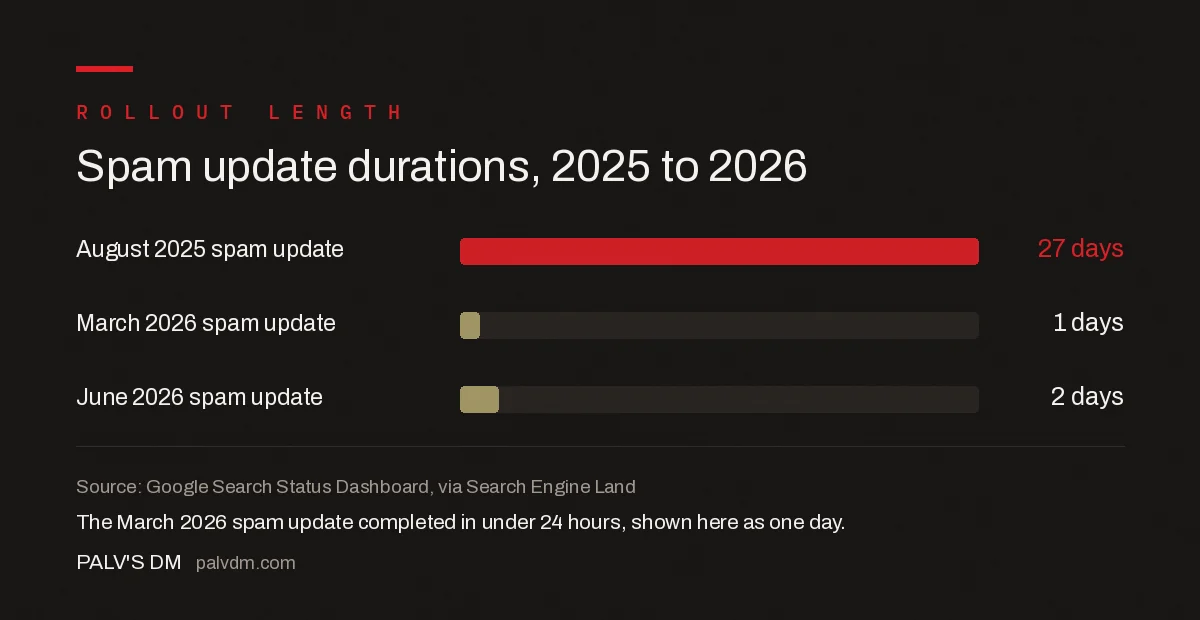
Spam update durations, 2025 to 2026
| Metric | Value |
|---|---|
| August 2025 spam update | 27 days |
| March 2026 spam update | 1 days |
| June 2026 spam update | 2 days |
Source: Google Search Status Dashboard, via Search Engine Land
Frequently asked questions
When did the August 2025 spam update start and finish?
The August 2025 spam update started rolling out on 26 August 2025 and Google marked it complete on 22 September 2025, a rollout of 27 days. It was announced on Google’s Search Status Dashboard and was the only spam update Google confirmed during 2025, compared with three spam updates in 2024.
What did the August 2025 spam update target?
Google announced no new spam policies with it and described it simply as a normal spam update rolling out for all languages and locations. That makes it an enforcement update against practices already listed in Google’s published spam policies, which include cloaking, doorway pages, scraped content, link spam, expired domain abuse, scaled content abuse and site reputation abuse.
Why did the August 2025 spam update take 27 days to roll out?
Google has never explained why rollout lengths vary, and any account of what a long rollout signifies is speculation. What is documented is that the impact did not arrive gradually: affected sites generally saw results within about 24 hours of launch, and the update visibly reintensified around 9 September before completing on 22 September.
How do I know if a spam update or a core update hit my site?
Check the dates first. The August 2025 spam update ran 26 August to 22 September 2025; the nearest core updates finished on 17 July 2025 and began on 11 December 2025. Spam enforcement usually shows a sharp loss on real queries in the top ten, while core update movement is patterned by content type or query cluster and swings during the rollout.
Can you recover from a Google spam update?
Yes, but only by removing the practice that matched a spam policy and then waiting for Google’s systems to recrawl and reassess. Recovery takes months rather than days and often surfaces during a later spam update. Some sites hit by earlier spam updates did recover during the August 2025 rollout, which is consistent with how algorithmic enforcement is re-run.
Was the September 2025 impressions drop caused by the spam update?
Almost certainly not. Around 12 September 2025 Google stopped serving the num=100 URL parameter, which removed rank-tracker impressions from Search Console for nearly every site. That change costs impressions at deep positions and leaves clicks unaffected, while spam enforcement costs clicks and top-ten rankings. Plotting clicks against impressions separates the two quickly.
Sources
- August 2025 spam update — Google Search Status Dashboard
- Google August 2025 spam update done rolling out — Search Engine Land
- Google Search spam policies — Search Central
- Google algorithm updates 2025 in review — Search Engine Land
Want this done on your site?
Every PalV’s DM engagement starts with a free audit of your actual website — a 12-point
crawl covering what is blocking indexation, on-page gaps against your primary keywords, speed
findings, and the three to five fixes worth making first. Delivered in two working days. No
payment details, and the findings are yours whether you hire us or not.